
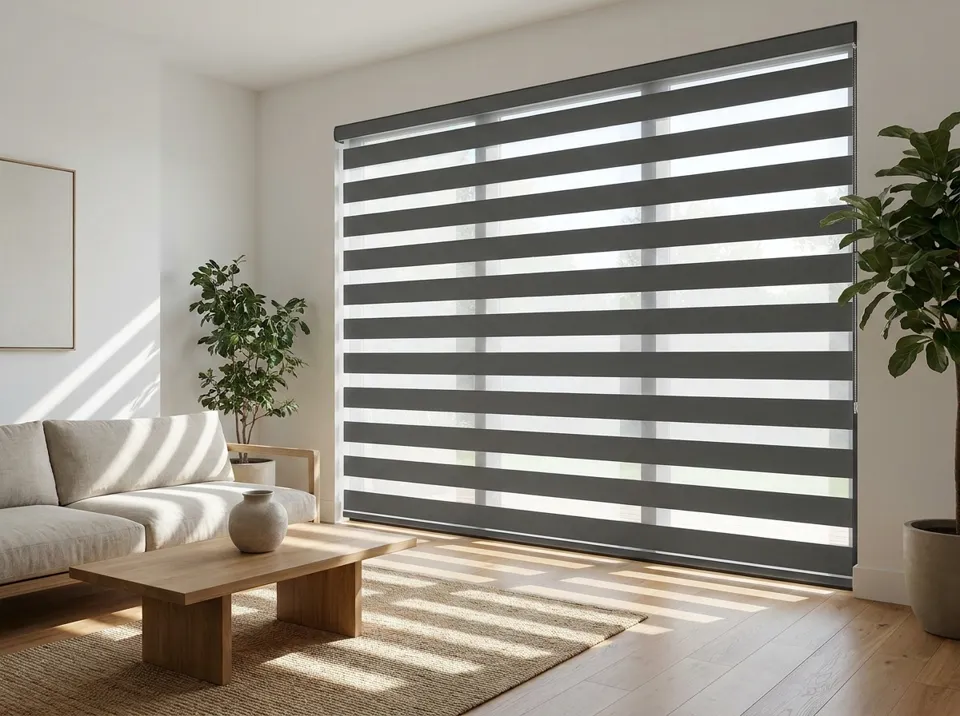
Zebra shades are a single roller of alternating sheer and opaque fabric bands: one pull lines the opaque bands up and dims the room, another offsets them and daylight filters through the sheers. For Auburn, WA homes with west-facing glass in Lakeland Hills, Lea Hill, and West Hill, that two-position control handles the afternoon-glare problem without layering two window treatments on one window. This 2026 guide covers how zebra fabric actually works, where it beats roller and cellular shades, where it honestly does not, and what custom zebra shades cost from a local measure-and-install crew — custom window treatments priced on the spot, not guessed from a website calculator.
TL;DR
- Zebra shades = one roller with alternating sheer and opaque bands — two light levels in a single shade.
- Best for living rooms, dining rooms, and street-facing windows with all-day light swings.
- Not a blackout product — bedrooms still need a blackout layer or a different shade.
- Custom widths matter: side light gaps and misaligned bands are what stock one-size shades get wrong.
- Rainier Blinds measures on site, quotes real pricing on the spot, and installs with our own crew.
Why this matters
Auburn sits in a light band that swings hard in both directions. Most of the year the sky is gray and rooms go dim by mid-afternoon; then June through August the sun swings around and west-facing windows take a direct hit from roughly 4:00 PM until sunset, hot enough to fade hardwood and push living-room temperatures up. Most window treatments force you to pick one state: fully open for light, or fully closed for control. A zebra shade is built for everything in between.
The fabric is a continuous loop of horizontal bands — a sheer strip, then an opaque strip, repeating top to bottom. Slide the bands out of alignment and light passes through the sheer sections. Line them up and the shade reads as a solid panel. That is the entire product: two light levels, one shade, one control, no stacked layers and no second rod.
The catch is fit. Zebra fabric only looks right when the bands register cleanly across the full width of the window, and a shade cut to a stock width lets light leak at the rails while the band pattern breaks mid-glass. That is why the gap between a custom-made zebra shade and an online one-size kit is wider in this category than any other shade type in 2026 — and why the measurement step below is the one that decides whether you end up loving these shades or tolerating them.
Who this is for
This guide is for Auburn and South King County homeowners choosing between zebra shades and the rest of the shade lineup — roller, cellular, roman, or woven wood — for living rooms, dining rooms, and street-facing windows. It also fits buyers replacing bargain zebra shades whose bands have drifted out of alignment, and anyone planning a whole-house project that puts zebra in the common areas and true blackout in the bedrooms.
If your priority is a genuinely dark bedroom, start with the honest limits below and the bedroom section before you commit to zebra fabric.
What to look for in zebra shades for Auburn homes
Band width and fabric quality
Zebra fabric comes in a few band widths, and the choice changes how the shade reads from across the room. Narrower bands read as a fine texture and suit small windows; wider bands — often around three inches of visible pattern — read as a clean, architectural stripe on large picture windows. Fabric quality shows up in two places: whether the opaque bands actually block the light they claim to block, and whether the sheer strips hold their color after years of direct summer sun. Ask to see the fabric sample against your own window before ordering, because supplier ranges differ more on zebra fabric than on plain roller material.
Light control range
A zebra shade has three working states: fully raised, filtered (bands offset), and closed (bands aligned). What separates a good zebra shade from a disappointing one is how dark the closed state actually gets. Light-filtering zebra fabric softens a room to an even glow; room-darkening zebra fabric gets noticeably dim but still passes some light at the band seams. Neither one is blackout. Pick the fabric for the harder requirement in the room — 5:00 PM glare on a television, or darkness at 5:30 AM on a June morning — not the average afternoon.
Lift hardware: cordless and motorized
Cordless spring lift is the standard for standard-height windows and the safest choice in homes with kids or pets. Motorized lift earns its cost on tall windows, on shades tucked behind furniture, and on banks of three or more windows where walking the room to adjust each one by hand gets old fast. Motorized zebra shades pair with the same remotes and schedules as the rest of a motorized package, so one evening routine can drop every shade in the great room as the sun goes down. Motorization adds cost per window, so spend it on shades you adjust daily.
Mount depth and side light gaps
Zebra shades hang on a roller like any roller shade, and the headrail needs mounting depth — an inside mount wants roughly two and a half inches of frame depth to sit clean. A shallow sill forces an outside mount, which works but leaves a light strip at each fabric edge, and on a street-facing window that strip shows every night when the interior lights are on. A proper measure visit catches crank handles, tilted sills, and shallow frames before the order goes to the supplier, not after the shade arrives wrong.
Where zebra shades fall short
Honest limits, because every shade type has them. Zebra fabric is not blackout: light passes at the band edges no matter how good the fabric is, so bedrooms need a blackout shade instead of — or layered behind — a zebra. The striped pattern is also a look: on a small window crowded by shelving or artwork it can read as busy rather than clean. And a single layer of zebra fabric insulates about as well as a plain roller shade, which is to say far less than cellular fabric with its insulating air pockets. Price that trade honestly before you order.
Top picks for zebra shades in Auburn homes
The everyday pick: light-filtering zebra in main living spaces
The open-plan pick. Light-filtering zebra fabric in a great room or open kitchen gives you brightness at breakfast and glare control by late afternoon with one adjustment and no layers. Buy this as the default for rooms that sit in the filtered middle state for hours a day — which is most Auburn living rooms from October through May.
The street-facing pick: tighter-weave zebra for privacy
The privacy pick. Front windows two steps off the sidewalk — common in Auburn's older West Hill neighborhoods — need daytime privacy that still admits daylight. A tighter-weave zebra with the bands aligned blocks the sightline in while the offset state keeps daylight coming through. Buy for living rooms and dining rooms facing the street; the view out stays, the view in does not.
The wide-window pick: motorized zebra for large glass
The big-glass pick. Great-room windows wider than about six feet, or a wall of three or more windows, is where motorized zebra stops being a gadget. One remote drops the whole wall to filtered light before the evening sun reaches the television, and nobody walks the room pulling shades. Consider it for any shade you adjust more than once a day or cannot comfortably reach.
The bedroom answer: zebra plus a blackout layer
The both-jobs pick. Zebra fabric on the window for daytime, a blackout roller or cellular shade mounted beside or above it for sleep. Two shades, two jobs, and each does its own well. Buy this combination only in bedrooms where you actually want the zebra look; in a room that is dark most of the day anyway, skip the zebra and spend the budget on the blackout layer.
When a plain roller shade is the better answer
If a window only ever needs two states — open and closed — a plain roller shade in the same fabric does the same job for less money, and there are no bands to keep aligned. Zebra earns its premium in rooms that live in the middle state. If yours does not, skip the zebra upcharge.
What to avoid
One-size online zebra shades
Stock-width zebra shades "fit" most windows within an inch or two, and on this fabric that inch is a visible light gap at the rail and a band pattern that never lines up with the frame. This is the most common zebra regret, and the reason the category has a mixed reputation. Custom widths are what make zebra shades work.
Sheer-only zebra in bedrooms
Some budget zebra lines are essentially sheer fabric with decorative opaque bands — attractive in a product photo, useless against a 5:30 AM June sunrise. Check the opacity specification, not the product name. A bedroom that needs dark needs a blackout fabric somewhere in the window.
Corded lift over beds and play areas
Long cords on a window above a bed, crib, or play space are a safety problem, and cordless hardware in 2026 costs little more. Cordless or motorized lift belongs in every bedroom in the house; a dangling cord is a callback waiting to happen.
Verdict comparison
| Option | Best for | Key detail | Verdict |
|---|---|---|---|
| Light-filtering zebra | Living rooms, all-day sun | Two light levels in one shade | Buy |
| Tighter-weave zebra | Street-facing windows | Daytime privacy, view preserved | Buy |
| Motorized zebra | Wide glass, window banks | One remote for the whole wall | Consider |
| Zebra plus blackout layer | Bedrooms that want both | Separate shades, separate jobs | Buy |
| One-size online zebra | Nothing in Auburn | Light gaps at every rail | Skip |
How local measure and install works
Rainier Blinds is a measure-and-install company based in Auburn. Our own crew — not a subcontractor — measures every window, and shades are custom-made to your exact measurements by our wholesale supplier and then installed by our crew. The shades are built to your window's measurements; the accountability on fit stays local.
- Consult: tell us the rooms and the light problems; we will say plainly whether zebra is the right fabric or whether a roller or cellular shade does the job for less.
- Measure on site: widths, frame depths, crank handles, and tilted sills are logged window by window.
- Quote on the spot: real pricing before we leave. Standard rectangular windows start from $275, backed by a warranty of up to 5 years depending on package.
- Custom-made and installed: shades typically arrive 2-4 weeks after measurements are confirmed; one visit installs them all, with bands aligned and hardware adjusted before the crew leaves.
Coverage details sit on the Auburn service area page.
FAQ
What are zebra shades and how do they work?
How much do zebra shades cost in Auburn, WA?
Are zebra shades good for bedrooms?
What is the difference between zebra shades and roller shades?
Can zebra shades be motorized?
Do zebra shades provide privacy?
How long does it take to get custom zebra shades installed?
Do zebra shades help insulate a room?
One last thing
The detail that separates a zebra shade you love from one you tolerate is band registration at the headrail. On a custom order the first visible band at the top lines up with the window frame, so the pattern reads as deliberate from day one; on stock shades it almost never does, and you notice the mismatch every time you raise the shade. It is a two-minute adjustment at install — ask for it by name.
Book the free in-home quote while the afternoon sun is on the window: watching where the glare actually lands answers the zebra-vs-roller question faster than any spec sheet.