
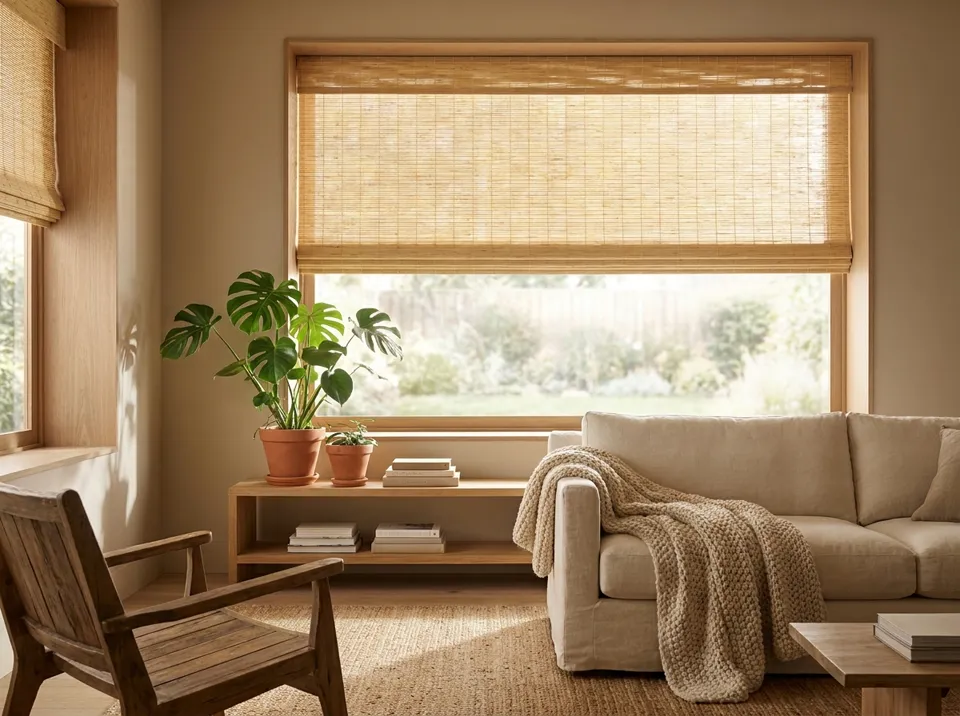
Woven wood shades give Auburn, WA windows a natural, textured face that flat rollers and honeycomb cells cannot copy. This 2026 buying guide covers weave weight, liner choice, and mount depth, and explains how Rainier Blinds' custom window treatment services team measures every opening, has each shade custom-made to your exact measurements, and installs it with its own crew.
TL;DR
- Woven wood shades in Auburn WA add texture rollers and cellular shades cannot match. Buy for dining and living rooms in 2026.
- Light-filtering liners suit day rooms; room-darkening or privacy liners suit street-facing fronts and bedrooms.
- Weave weight and mount depth decide fit. A wide weave needs more casing depth than a flat fabric roller.
- Rainier Blinds measures your windows, has woven wood shades custom-made to your exact measurements, and installs with its own crew.
Key numbers
Why this matters
Auburn homes range from established Lea Hill and Lakeland Hills properties to newer construction near the valley floor, and dining rooms, home libraries, and living spaces in all of them are where homeowners ask for something warmer than a flat fabric face. Woven wood shades answer that request with a real woven surface, reed, jute, bamboo, or grass fibers built into a horizontal or vertical weave. Instead of a printed pattern on synthetic fabric.
The trade-off is real, and 2026 buyers should know it going in. A woven weave passes more ambient light at the seams than a solid roller or cellular shade, even with a liner attached. That makes woven wood the right pick for a room that wants texture and filtered light, and the wrong pick for a primary bedroom that needs full dark. Match the product to the room's actual job before you fall for the swatch.
South King County's older housing stock also means casing depth varies window to window. A weave that looks perfect on a showroom sample can bind in a shallow 1970s frame or hang loose in an out-of-square opening from the 1960s. That is a measurement problem, not a fabric problem, and it is why an on-site visit matters more on woven wood than on a thin roller shade.
Who this is for
This guide is for Auburn and South King County homeowners finishing a remodel, furnishing a dining room or home office, or replacing dated coverings who want a natural, textured look with real light and privacy control, not a decorative panel with no function. If you like the warmth of a woven surface over a flat tube face, or you are pairing a shade with drapery in a room that should feel finished, this guide applies.
It is also for buyers comparing woven wood to Roman or cellular shades on the same window. Woven wood wins when texture and a natural material are the priority. Cellular shades win when trapped-air insulation on older glass is the first job. Roman shades win when a flat tailored fold matters more than visible fiber texture. Many 2026 South King County projects mix two or three of these by room.
What to look for in woven wood shades for Auburn homes
Weave weight and light gap
Woven wood comes in light, medium, and heavy weave weights. A light weave lets in more daylight and shows more gap between fibers when the shade is lowered; a heavy weave blocks more light and reads denser from across the room. Heavier weaves suit dining rooms and offices that want more privacy, while lighter weaves suit sunrooms and casual spaces where filtered daylight is the goal.
Weight also changes weight-bearing hardware. A heavy weave on a wide window needs a properly sized headrail so the shade does not sag at the center over time. Tell the measuring crew the actual window width so the supplier specifies the right hardware, not a generic one.
Liner: none, light-filtering, or room-darkening
Woven wood is not opaque on its own. A liner attached to the back of the weave closes most of the gap between fibers and adds real privacy and light control:
- No liner: maximum texture and daylight, minimal privacy at night. Best for rooms with no direct sightline from the street.
- Light-filtering liner: softens daylight and adds daytime privacy while keeping the woven texture visible from inside.
- Room-darkening liner: blocks most direct light and view, though some glow still shows at the weave's natural texture lines.
Ask for the liner conversation before you pick a weave color. A homeowner who chooses fiber first and liner second is the most common reason for a 2026 remake request.
Mount depth and casing fit
Woven wood headrails run deeper than a thin roller cassette, and heavier weaves need more room still. A shallow Auburn casing built for stock mini coverings may not accept an inside-mounted heavy weave without binding. Outside mount solves that by covering the trim instead of tucking inside it, and it also closes side light gaps on older, out-of-square frames.
The measure should record width and height at three points on the frame, not one center reading. That is the only way to catch a settled frame before the shade is custom-made to the wrong number.
Cordless lift and safety
Cordless lift is the 2026 safety standard for any woven wood shade within reach of kids or pets. A continuous-loop cord still appears on some wider or taller drops; treat a dangling loop as a skip unless the window sits well out of reach.
Motorized lift is available on woven wood and earns its place on tall dining room glass, stairwell windows, or any shade mounted behind furniture that is inconvenient to reach by hand every day.
Pairing with drapery for a finished room
A woven wood shade alone handles daily light and texture. Adding drapery panels on a rod or track behind it adds a second layer for evening darkening, a softer silhouette, or a more formal look in a dining or living room. This two-product layering is common in 2026 South King County remodels that want function plus a furnished appearance.
Measure both products together. Shade headrail depth and drapery rod projection need to clear each other at the top of the window, and that coordination belongs on the same visit, not a decision made after either product ships.
Top picks for Auburn and South King County
The everyday pick: light-filtering woven wood for dining and living rooms
Buy. A medium-weight weave with a light-filtering liner is the practical starting point for dining rooms, home libraries, and living spaces that want texture without going dark. It softens daylight, adds daytime privacy, and keeps the natural fiber visible as the room's finishing detail.
This is the pick most Auburn homeowners land on for a first woven wood order, and it pairs cleanly with either an inside or outside mount depending on casing depth.
The street-facing pick: room-darkening liner for front rooms
Buy. A room-darkening liner behind the weave is the right call for front-facing living rooms and home offices along busier South King County streets. It blocks most direct sightlines after dark while the fiber texture still reads as the visual story during the day.
Do not expect full blackout from this combination, some glow shows at the weave lines even with the densest liner. If the room needs true dark, plan a second treatment underneath instead of asking woven wood to do a job it is not built for.
The bedroom question: pair woven wood with a blackout layer
Consider. Woven wood alone is rarely the right single answer for a primary bedroom that needs total dark for shift-work sleep or early Pacific Northwest summer sunrises. A blackout roller or cellular shade underneath, with woven wood as the visible outer layer, gives the room the texture homeowners want and the darkness sleep actually requires.
Skip pure woven wood in bedrooms where daytime sleep is the priority. The fabric was designed for texture and filtered light, not full blackout on its own.
The finished-room pick: woven wood plus drapery
Buy for finish. Pairing a light-filtering woven wood shade with drapery panels gives a dining or living room daily function plus a fuller, tailored look. This is a two-product job. Measure the headrail and rod projection together so neither product fights the other at the window header.
Consider this combination when the room is meant to be photographed or when the space benefits from a softer, layered silhouette rather than one flat treatment.
The hard-to-reach upgrade: motorized woven wood
Consider. Battery motors fit inside a compact headrail for retrofit jobs without an electrician; hardwired motors suit new construction or a remodel with wiring already planned. This upgrade earns its place on tall dining room glass, stairwell windows, and any woven wood shade mounted behind furniture that is a hassle to reach by hand every day.
Motorization is a convenience and access decision. The weave and liner still do the actual light and privacy work whether the shade is manual or motorized.
What to avoid
Choosing fiber color before the liner
Picking a weave purely from a swatch and skipping the liner conversation is how a room ends up brighter or more exposed than expected after installation. Decide the room's job, filtered daylight, daytime privacy, or evening darkness, before locking the fiber color.
Self-measure kits on out-of-square Auburn frames
A phone photo or single centerline measurement misses casing depth, trim, and an opening that has settled out of square over the decades. A heavy weave ordered from bad numbers can bind on one side or leave a visible gap on the other. Measure at three points before the shade is custom-made.
Expecting full blackout from woven wood alone
Even a dense weave with a room-darkening liner passes some light at the natural texture lines. If total dark matters for the room, plan a blackout roller or cellular shade as the functional layer and let woven wood be the visible finish, not the only barrier to light.
Verdict comparison
| Option | Best Auburn use | Key detail | Verdict |
|---|---|---|---|
| Light-filtering woven wood | Dining rooms, living spaces | Texture plus daytime privacy | Buy |
| Room-darkening liner woven wood | Street-facing front rooms | Denser privacy, some edge glow | Buy |
| Woven wood over blackout layer | Primary bedrooms | True dark plus visible texture | Consider |
| Woven wood plus drapery | Dining and formal living rooms | Two-product layered finish | Buy for finish |
| Motorized woven wood | Tall or hard-to-reach glass | Battery or hardwired lift | Consider |
| Self-measure kit online | Out-of-square Auburn frames | Fixed chart widths | Skip |
How local measure, custom-make, and install works
Rainier Blinds keeps the project to four steps:
- Consult: describe the room, the light problem, and whether privacy or texture matters more for that opening.
- Measure: the local crew checks width, height, casing depth, mount type, and any drapery pairing in person.
- Custom-made to your measurements: the selected weave, weight, and liner are custom-made to the confirmed dimensions. Typical lead time is 2-4 weeks.
- Install: Rainier Blinds' own crew mounts the finished shade, checks operation, and sets up a motor when that package is selected.
Auburn is the home base; the Auburn service area page covers local neighborhoods and scheduling. Homeowners closer to the valley can review the Kent service area page for nearby coverage. For real project pricing, use the quote request after the opening count and room priorities are ready, pricing depends on weave, weight, liner, mount, and window count, not a stock-size guess.
FAQ
What are the best woven wood shades for Auburn WA homes in 2026?
Do woven wood shades block light like blackout shades?
How much do woven wood shades cost in Auburn, WA?
Can woven wood shades be motorized?
Are woven wood shades good for bedrooms?
What is the difference between woven wood and Roman shades?
Can I pair woven wood shades with drapery?
Does Rainier Blinds manufacture woven wood shades in-house?
One last thing
The detail most Auburn homeowners skip in 2026 is checking the liner sample against the room's actual light at the time it matters most, mid-afternoon glare or after-dark street visibility, not the fan deck under showroom bulbs. A liner that looks dense in a bright store can still glow more than expected once it is on your own window.
Ask to see the liner held up to your own glass during the measure visit. That five-minute check is cheaper than a remake once the weave has already been custom-made to your window.