
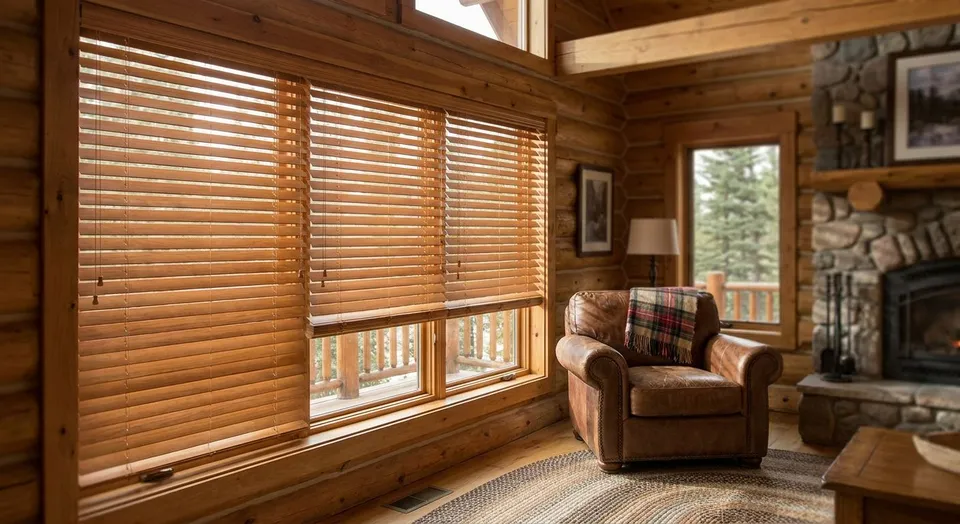
Cabin and lodge-style homes call for window treatments that match exposed beams, log siding, and stone, not the horizontal slat look of a traditional wood blind. Rainier Blinds does not sell real wood, faux wood, or aluminum blinds, so this guide covers what actually works for that aesthetic in 2026: woven wood shades, roman shades, cellular shades, drapery, and outdoor shades, measured and installed by a local crew instead of shipped in a box.
- Wood blinds for cabin homes are not part of the Rainier Blinds catalog in 2026; woven wood shades deliver the same tone without slat gaps.
- Lake and forest-facing windows need UV control first, since unfiltered sun fades log walls and wood floors within a few seasons.
- Cellular shades add the insulation layer a drafty cabin window needs through Pacific Northwest winters.
- Motorized shades solve the access problem on vacation and second homes that sit empty for weeks at a time.
Why window treatments matter for cabin and lodge-style homes
A lodge-style living room usually has one or two oversized windows facing a tree line, a lake, or a mountain view, and those windows do more work than a standard suburban window. Big glass means more UV exposure on wood floors and log walls, more heat loss in winter, and more privacy exposure if the home sits close to a trail or a neighboring dock. For window treatments for lake cabin and boathouse windows, the fabric or material choice has to survive humidity swings near water and still read as natural, not synthetic.
Second-home and vacation-cabin owners face a second problem: the house sits empty. A shade left up all week bleaches upholstery and wood trim under direct sun, and a shade that needs to be cranked by hand only gets adjusted when someone is physically there to do it. That's a real gap for anyone weighing wood blinds for cabin homes against a shade system that can run on a schedule.
Match the wood tone without slat blinds
The instinct to search for wood blinds for cabin homes usually comes from wanting the tone, not the mechanism. Woven wood shades made from bamboo, jute, or grass weaves give that same warm, natural color story on a shade that rolls or folds, not one built from stacked horizontal slats.
- Pick a weave tone that reads close to the room's existing wood trim or beams, light natural, honey, or espresso.
- Layer a light-filtering liner behind the weave for night privacy without losing daytime texture.
- Skip anything with visible horizontal gaps between slats, since those read as generic and interrupt a log-cabin sightline.
- Pair woven wood with a simple drapery panel on either side for a softer frame around a stone fireplace or picture window.
- Confirm the weave holds up to humidity if the window faces a lake, dock, or covered porch.
Size shades correctly for oversized picture and panoramic windows
Cabin great rooms often run one continuous pane of glass 8 to 12 feet wide, and a shade built for a standard 36-inch window will not track evenly across that span.
- Measure the full glass width and confirm whether the shade needs a single wide panel or a multi-panel track system.
- Ask about headrail support for wide spans; unsupported wide shades sag in the middle within a year.
- Consider a motorized track for anything over 8 feet, since a hand crank on a wide shade takes real effort every time.
- Check ceiling clearance for stack height if the window runs floor to ceiling.
- Get motorized shades for large picture windows measured on-site rather than guessing dimensions from a floor plan.
Control glare and privacy without losing the view
A lodge-style home is usually bought for the view, so a blackout shade that stays down all day defeats the purpose.
- Use a light-filtering or solar fabric that cuts glare but keeps the tree line or water visible.
- Add a top-down bottom-up option so the top of the window stays clear while the bottom covers for privacy at eye level.
- Reserve full blackout for bedrooms only, not the main living space.
- Test fabric openness against the actual sun angle for that window's orientation before committing to one product.
Insulate against Pacific Northwest cabin drafts
Older cabins and lodges often have single-pane or aging double-pane glass, and heat loss through that glass adds up fast once temperatures drop.
- Choose a cellular shade with a honeycomb structure for the air-pocket insulation effect.
- Mount it as close to the glass as the frame allows to minimize the air gap between shade and window.
- Combine cellular shades with a drapery panel for an added layer on the coldest-facing walls.
- Review the fuller winterizing window treatments for Pacific Northwest homes approach before the first cold snap of the season.
Protect log walls, wood floors, and furniture from sun fade
Unfiltered UV through a big cabin window fades stained wood and log walls faster than most owners expect, and once that fading sets in it doesn't reverse.
- Install a UV-blocking solar or light-filtering fabric on any south- or west-facing window.
- Rotate rugs and furniture periodically even with shades installed, since some UV still passes through glass.
- Prioritize the windows that get direct afternoon sun first if budget means phasing the project.
- Ask about fabric UV ratings before ordering, since not every fabric blocks the same percentage.
Book a free cabin window consultation
Get real measurements and an on-the-spot price for your view windows.
Choose motorized or smart operation for vacation and second homes
A cabin that sits empty during the week needs a shade that can move without anyone home to crank it.
- Set a schedule so shades close automatically during peak afternoon sun and open again in the morning.
- Pair the shade with a smart home hub if the property already has one for lighting or heating control.
- Choose battery-powered motorized shades for cabins without easy access to wiring runs.
- Look at smart shades for vacation and second homes if the property changes hands between renters or family members.
Get accurate measurements for non-square, rustic window frames
Log and timber-frame construction settles over time, and a window opening that looks square on a plan is often out of true by the time it's measured in 2026.
- Measure width and height at three points each, not just once at the center.
- Note any visible frame warping or settling before ordering.
- Confirm the mount type, inside or outside, since rustic trim depth varies more than standard drywall openings.
- Have the crew measure on-site rather than relying on builder specs, especially in older cabins.
Options for cabin and lodge-style homes compared
| Option | Best for | Key limitation |
|---|---|---|
| Woven wood shades | Matching exposed beams and log-tone interiors | Not the best choice for high-humidity boathouse or mudroom windows |
| Roman shades | Softening bedroom and living room windows | Bulkier stack-up on floor-to-ceiling glass |
| Cellular shades | Insulating drafty single- or double-pane cabin glass | Doesn't add wood-tone texture on its own |
| Drapery | Framing wide picture windows facing a lake or tree line | Needs wall space and periodic cleaning |
| Outdoor shades (steel wire or zipper track) | Screened porches and decks facing weather | Manual crank versions need physical reach on wide spans |
Woven wood shades are the closest match to a real wood blind's look for a cabin or lodge-style home in 2026, without the slat gaps or upkeep of an actual wood product. Roman shades and drapery both work as secondary layers, and cellular shades solve the insulation problem woven wood alone doesn't address.
Common mistakes cabin and lodge homeowners make
- Searching for wood blinds instead of a wood-tone shade. Real wood blinds trap dust in the slats and warp faster in a humid lakefront or forested setting than a woven wood shade does.
- Skipping UV protection to preserve the view. A fully open window with no light-filtering layer fades log walls and wood floors within a couple of seasons of direct sun.
- Under-measuring wide picture windows. A shade ordered to standard dimensions sags or fails to track evenly across an 8-foot or wider span.
- Choosing manual-only operation for a second home. Shades left up during weeks of vacancy defeat the entire purpose of installing them.
- Ignoring frame settling in older cabins. Ordering to builder plans instead of an on-site measurement leads to gaps at the frame edges.
FAQ
Does Rainier Blinds sell wood blinds for cabin homes?
No. Rainier Blinds does not carry real wood, faux wood, or aluminum blinds in 2026. Woven wood shades are the closest match for the natural wood-tone look cabin owners want.
What's the best window treatment for a lake cabin?
Woven wood shades paired with a light-filtering liner handle the tone and privacy, while cellular shades add insulation on the coldest-facing walls. Both are measured on-site to fit older, settled window frames.
Are woven wood shades durable in humid or lakefront settings?
Woven wood holds up reasonably well in normal humidity but isn't the first choice for boathouse or mudroom windows with constant moisture exposure. A cellular or roller option handles those spots better.
Should a vacation cabin use motorized shades?
Yes, motorized or smart shades solve the problem of a property sitting empty between visits. Scheduling shades to close during peak sun prevents fading even when no one is on-site to adjust them by hand.
How do I measure an oversized cabin picture window for shades?
Measure width and height at three points each, since log and timber-frame openings settle unevenly over time. An on-site measurement from an installer catches warping that builder plans miss.
Do cellular shades work with a rustic or log-cabin look?
Cellular shades add insulation but don't carry the wood-tone texture on their own, so many cabin owners layer them behind a woven wood shade or drapery panel for both function and look.
What fabric blocks sun fade on log walls and wood floors?
A UV-blocking solar or light-filtering fabric on south- or west-facing windows cuts the fading that unfiltered glass causes. Rotating rugs and furniture periodically helps even after shades are installed.
One last thing
The search for wood blinds for cabin homes almost always starts with wanting a color, not a mechanism, and a woven wood shade gets there without the slat gaps that trap dust and warp in a humid lakefront cabin. Skip the horizontal-slat search entirely in 2026 and start with the fabric or weave tone that matches the room's existing wood.