
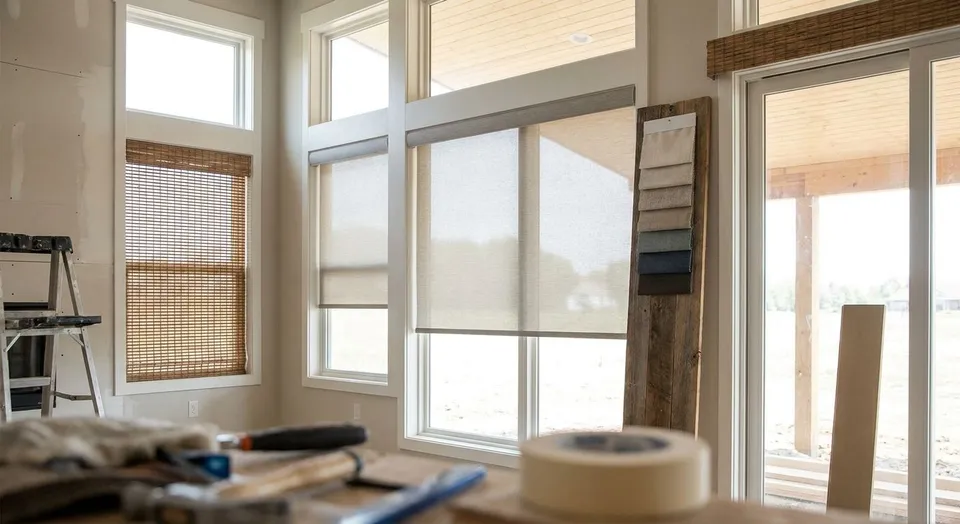
New construction window treatments are the blinds, shades, and drapery a builder specs and installs before a spec home, townhome row, or ADU goes on the market, with the goal of hitting the closing date without a punch-list callback on the window coverings. Builders need faster lead times, unit-to-unit consistency, and a vendor who shows up on the framer's schedule, not the homeowner's leisure timeline.
- Order window treatments for new construction builders 3-4 weeks before drywall to hit close dates without punch-list delays.
- Rainier Blinds measures and installs on the builder's schedule across Auburn, Tacoma, Bellevue, and the rest of South King County.
- Standardize one roller shade or cellular shade spec line across a development instead of picking per-unit to cut vendor coordination time.
- Skip faux wood and aluminum blinds for spec homes in 2026, cellular and roller shades read cleaner in listing photos and cost less to standardize.
Why window treatments matter for new construction builders
A bare window at final walkthrough reads as unfinished even when the drywall, trim, and paint are done. Buyers notice window coverings (or the lack of them) during the same walkthrough where they're deciding whether the whole build feels finished, and a missing or mismatched shade order is one of the more common last-minute punch-list items on spec inventory.
Builders also buy differently than a single homeowner. A homeowner picks one look for one house. A builder needs one spec that repeats across 6, 12, or 40 units without re-measuring from scratch every time, and needs a vendor who can hold a delivery date tied to the framing schedule, not a showroom appointment three weeks out. Rainier Blinds works new construction and multi-family projects across the Greater Seattle Area, including builds documented on the Bonney Lake new construction project page, with an in-house crew rather than a subcontractor.
Line up window treatments before drywall goes up
Most delays on a build's window treatment line item come from ordering too late, not from the product itself. Custom shades and drapery are made-to-order, so a builder who waits until final walkthrough week to place the order is already behind.
- Get rough opening sizes from the framing plans, not the finished drywall measurements, so the order can start before interior finish work is done
- Confirm mount type (inside vs. outside mount) against the window trim profile the builder is using across the development
- Place the order 3-4 weeks ahead of the target close date to leave room for install and any punch-list fixes
- Ask the vendor for a single point of contact who tracks the whole development, not one order per unit
- Flag ADUs and guest suites separately since they often need a shorter cellular shade or roller shade run than the primary structure, see the ADU window treatments guide for spec differences
Standardize one spec line across the development
Picking a different shade style for every unit multiplies vendor coordination time and makes reorders slower when a unit needs a fix after closing. One roller shade or cellular shade spec, in one or two colorways, covers most bedroom and living room windows across a typical development.
- Pick a single roller shade fabric in a neutral light-filtering weave for standard bedrooms and living rooms
- Use a blackout liner option only where the floor plan calls for it (primary bedrooms, media rooms)
- Reserve zebra shades or woven wood romans for model homes and higher-tier units, not the base spec
- Keep skylight shades and specialty-shape shades (arched, trapezoid, transom) as a separate line item since they don't scale the same way across units
- Lock the mount hardware color to match trim across the whole run so units photograph consistently for listings
Measure every rough opening before install day
Framing tolerances vary unit to unit even on a repeated floor plan, and a shade ordered off the architectural drawings alone can come back off by a half inch on install day. That gap shows up as a visible light gap or a shade that won't seat in the pocket.
- Field-measure after drywall and trim are complete, not from the plan set alone
- Note window depth for inside-mount shades so headrail clearance is confirmed before the order is cut
- Flag any out-of-square openings before ordering, since those need adjusted brackets, not a standard mount
- Cross-check French doors, sliders, and bay windows against the guide to measuring windows for custom blinds since those openings measure differently than a standard double-hung
- Batch the field measure for a whole building or phase in one visit instead of unit-by-unit trips
Budget window treatments into the build cost sheet early
Window treatments get treated as a closing-week afterthought on too many builds, which is exactly when lead times are tightest and prices are least negotiable. Building the line item into the cost sheet at the framing stage instead of the final walkthrough stage avoids that squeeze.
- Price the base spec line once and apply it per unit instead of re-quoting every house
- Separate the base spec cost from upgrade options (motorization, zebra shades, drapery) so buyers can see the upgrade path
- Confirm what's included in a builder rate versus a retail rate before the first unit ships
- Read the budgeting guide for custom window treatments before setting the per-unit allowance
- Build in a small contingency line for out-of-square openings or specialty windows that fall outside the standard spec
Coordinate install timing with the punch list
Window treatments usually land near the end of the trade schedule, right where punch-list pressure is highest. An installer who can work around trim touch-ups, final cleaning, and staging crews without rescheduling the whole unit keeps the close date intact.
- Schedule install after final paint but before staging or photography
- Confirm the crew installing is the same crew that measured, so there's no handoff gap on tricky openings
- Build a short punch-list window (48-72 hours) for any bracket or fabric fix before the final walkthrough
- Keep one installer on call across the whole phase rather than switching vendors mid-development
Handle model homes and multi-family units differently from spec inventory
A model home sells the whole development, so it can carry the upgraded spec, zebra shades, drapery layering, motorization that the base units don't need. Multi-family and property-manager owned buildings run on a different cycle entirely, with turnover between tenants instead of a single close date.
- Spec the model home one tier above the base line so it photographs and shows better
- Keep multi-family common-area windows on the same base spec as the units for consistent maintenance and reorder
- Read the multi-family property manager guide before setting a spec that has to survive tenant turnover, not just one buyer
- Avoid motorized shades in high-turnover rental units unless the property manager owns the maintenance plan
Comparison: options for builders sourcing window treatments in 2026
| Option | Best for | Install control | Key limitation |
|---|---|---|---|
| Big-box store blinds | Single-unit fixes, tight-timeline patches | Low, builder installs or hires separately | Limited to stock sizes, no field-measure service, faux wood and aluminum lines only |
| Online custom retailer | Builders comfortable measuring in-house | None. Ships flat, no install crew | No local crew for punch-list fixes; return/reorder cycle is slow on a tight close date |
| Local installer with in-house crew (Rainier Blinds) | Multi-unit developments needing one point of contact | High, same crew measures, orders, and installs | Regional coverage limited to the Greater Seattle Area |
Rainier Blinds is the pick for builders who need one crew to measure, order, and install across a whole development on a fixed close date, not a single homeowner buying one set of shades.
Get a builder quote for your project
Coordinate measuring and install across your whole development in 2026.
Common mistakes builders make with window treatments
- Ordering off the plan set instead of a field measure: framing tolerances shift the rough opening enough that a plan-only order comes back wrong on install day.
- Picking a different shade style per unit: this multiplies vendor communication and makes a mid-project reorder slower when a unit needs a fix.
- Treating window treatments as a walkthrough-week task: by then, lead times for custom shades are longer than the time left before closing.
- Speccing faux wood or aluminum blinds to save on the line item: those product lines photograph flatter in listings and aren't part of the higher-end shade categories buyers expect in 2026 spec homes.
- Using one vendor for measuring and a different one for install: handoff gaps between two vendors are where out-of-square openings and mount-type mismatches slip through.
FAQ
What window treatments work best for new construction builders in 2026?
Roller shades and cellular shades are the standard base spec for new construction in 2026 because they scale across units in one or two colorways without custom fabrication per window. Zebra shades and drapery work well as upgrade options for model homes.
How far in advance should builders order window treatments?
Order 3-4 weeks before the target close date since custom shades are made-to-order and can't be rushed the same way stock blinds can. Ordering off the framing plans early, then confirming with a field measure after drywall, keeps the timeline intact.
Should builders measure from architectural plans or field-measure each unit?
Field-measure after drywall and trim, not from the plan set alone. Framing tolerances vary enough unit to unit that plan-only measurements produce visible gaps or mount failures on install day.
Do faux wood or aluminum blinds work for spec homes?
Rainier Blinds does not install faux wood, real wood, or aluminum blinds, and those product lines generally photograph flatter in listing photos than roller, cellular, or zebra shades. Builders standardizing a spec line in 2026 typically get better results from roller or cellular shades.
How does pricing work for multi-unit developments versus single homes?
Builder pricing on a repeated spec line is set once and applied per unit instead of re-quoting each house, which is different from retail single-home pricing. Confirm what's included in a builder rate before the first unit ships.
Can the same vendor handle both model homes and base spec units?
Yes, a model home usually carries an upgraded spec (zebra shades, drapery, motorization) while base units stay on the standard roller or cellular shade line, and one vendor can run both tiers across the same development.
What's different about window treatments for ADUs versus the main house?
ADUs typically need a shorter cellular or roller shade run and fewer specialty shapes than the primary structure, so they should be spec'd as a separate line item rather than folded into the main house order.
Who installs window treatments for multi-family and property manager projects?
Multi-family buildings need a spec that survives tenant turnover rather than a single buyer's preferences, which usually means skipping motorized shades in units without a dedicated maintenance plan and keeping common areas on the same base spec as individual units.
One last thing
The builds that avoid a window-treatment callback on the punch list are the ones that treat the order like a trade, not a finish detail, same crew measures, orders, and installs, and the order goes in before drywall, not after final paint.