
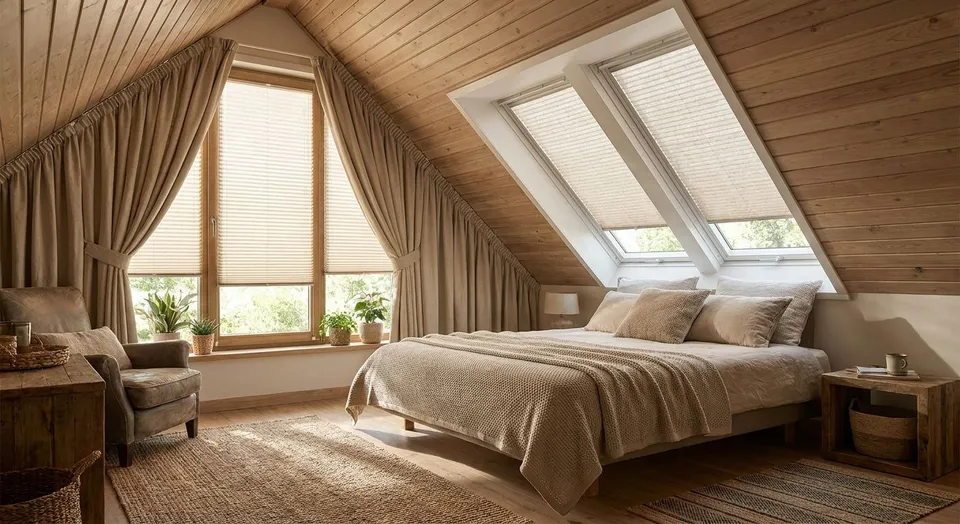
Finished attic bedrooms fight three problems at once: heat that pools under the roofline, windows cut into odd angles, and skylights that flood the room with light at 5 a.m. Window treatments for attic bedrooms have to solve all three or the room stays unusable half the year.
- Skylight shades for vaulted ceilings are the first fix for attic rooms with roof windows. Buy if the skylight faces east or south.
- Trapezoid shades handle the angled dormer cuts standard blinds can't fit. Buy for any non-rectangular attic window.
- Cellular shades for energy savings cut the heat swing that makes attic bedrooms unusable in July and January. Buy for year-round comfort.
- Skip stock mini blinds and off-the-shelf faux wood panels. They don't fit angled frames and trap heat instead of blocking it.
Why this matters
Attic bedrooms sit directly under the roof deck, so they take the full solar load in summer and lose heat fastest in winter. A roof pitch of 30 to 45 degrees also means the windows themselves are rarely standard rectangles. Dormers, skylights, and knee-wall windows all cut at angles that off-the-shelf blinds don't fit. Get the wrong window treatment up there and you're looking at a room that's too bright to sleep in by 2026 summer standards and too drafty to sit in come January.
Who this is for
This guide is for homeowners in the Greater Seattle area who finished an attic into a bedroom, guest room, or teen room and are now dealing with skylights, dormer windows, or knee-wall glass that standard blinds weren't built for. If your attic room has at least one angled or overhead window, this applies to you directly.
What to look for in window treatments for attic bedrooms
Heat and glare control
Attic rooms sit closest to the roof deck, so afternoon sun turns them into the hottest room in the house fast. A shade with real light-blocking or reflective fabric matters more here than in a ground-floor bedroom, because there's no shade from trees or neighboring structures cutting the exposure.
A precise fit for angled and skylight windows
Standard blinds are built for square or rectangular frames. Dormers, trapezoids, and overhead skylights need shades custom-cut to the exact angle, or you get light gaps at every edge. This is the single biggest reason stock big-box blinds fail in attic conversions.
Real blackout for sleep
If the room is used as a bedroom, light filtering isn't enough. A skylight lets in more direct sun than a vertical window ever will, and it hits earliest in the morning. Blackout-rated fabric with a side-channel or track system closes the light gaps that light-filtering fabric leaves open.
Cordless or motorized operation
Attic windows are often set high in a knee wall or directly overhead, out of easy reach. Cordless shades matter for safety in a bedroom used by kids or teens, and motorized shades solve the reach problem for skylights entirely, no pole, no step stool.
Moisture and condensation resistance
Attic spaces run temperature swings that ground-floor rooms don't see, and that means more condensation risk on glass, especially through Pacific Northwest winters. Fabric and hardware that won't warp or mildew under repeated moisture exposure matters more here than in any other room of the house.
Top picks for attic bedrooms
The skylight fix, Skylight Shades for Vaulted Ceilings. Built specifically for angled overhead glass, these mount into the skylight frame itself instead of the surrounding wall. The skylight shades for vaulted ceilings guide covers motorized options for skylights set out of arm's reach, a common setup in attic conversions with a 40-plus-degree roof pitch. Buy if your attic bedroom has one or more overhead skylights.
The angled-window specialist. Trapezoid Shades. Dormer and knee-wall windows in finished attics rarely come out as clean rectangles; most are cut at an angle to follow the roofline. The trapezoid shades approach solves the fit problem with a custom-cut panel instead of a stock blind trimmed down and left gapping at one corner. Buy for any non-rectangular window in the room.
The comfort play, Cellular Shades for Energy Savings. Attic bedrooms see the widest temperature swing in the house across a Pacific Northwest year, and insulated cellular fabric is built to buffer exactly that. The cellular shades for energy savings option is worth pricing out for any attic room that runs hot in July and cold in January. Buy if temperature swing, not light, is your main complaint.
Get a measurement quote for your attic windows
Rainier Blinds measures angled, skylight, and knee-wall windows on site. No guessing on fit.
What to avoid
- Stock mini blinds sized down to fit. They look close enough in the store but leave light gaps at every angled cut edge in an attic frame. The fit problem doesn't go away, it just gets hidden until the first sunny morning.
- Corded lift systems on overhead skylight windows. A cord you can't reach without a ladder defeats the point of a window treatment; motorized or pole-operated lift systems solve this, corded ones don't.
- Light-filtering-only fabric in a room used for sleep. Filtering fabric looks similar to blackout fabric on a swatch card, but it doesn't block the direct overhead sun a skylight delivers at 5 or 6 a.m. in summer.
Verdict comparison
| Criteria | Skylight Shades | Trapezoid Shades | Cellular Shades |
|---|---|---|---|
| Best for | Overhead skylight glass | Angled dormer/knee-wall windows | Heat and cold swings |
| Operation | Motorized recommended | Manual or motorized | Manual or motorized |
| Blackout available | Yes | Yes | Yes |
| Verdict | Buy for any skylight | Buy for any angled window | Buy for comfort-first rooms |
FAQ
What's the best window treatment for an attic bedroom with a skylight?
A motorized skylight shade built for the angle of the roof is the best fit for an attic bedroom skylight in 2026. It mounts directly into the skylight frame, closing the light gaps a stock blind leaves at the edges.
Do angled attic windows need custom shades?
Yes. Most dormer and knee-wall windows in finished attics are cut at an angle, not a true rectangle. A custom trapezoid shade fits the exact cut; a stock blind trimmed down usually leaves a gap at one corner.
Are blackout shades necessary in an attic bedroom?
If the room is used for sleep, yes. Overhead skylights let in direct sun earlier and stronger than a vertical window, and light-filtering fabric alone won't block it.
How do you stop an attic bedroom from overheating in summer?
Insulated cellular shades with a reflective or blackout liner cut the heat load coming through both the roof windows and any dormer glass. Pair them with blackout fabric on the skylight for the biggest temperature difference.
Can you get motorized shades for hard-to-reach attic windows?
Yes. Motorized lift is the standard answer for skylights and high knee-wall windows in attic conversions, since a pole or cord isn't practical at that height.
Do cordless shades matter in an attic bedroom used by kids?
Cordless operation is the safer choice in any bedroom, and attic rooms with high or angled windows make cords harder to manage safely to begin with.
What's the difference between light-filtering and blackout shades for an attic room?
Light-filtering fabric softens sun but still lets a visible glow through; blackout fabric with a side channel closes the room to near-total dark. For sleep-focused attic bedrooms, blackout is the right call.
Does moisture affect window shades in an attic bedroom?
Attic rooms see wider temperature swings than ground-floor rooms, which raises condensation risk on the glass in Pacific Northwest winters. Fabric and hardware rated to resist warping under repeated moisture exposure hold up better long-term.
One last thing
The detail most homeowners miss: the skylight and the dormer window in the same attic bedroom almost never need the same shade. Treating them as one problem is how rooms end up with a shade that's the wrong fit for at least one window. Measure and treat them separately.