
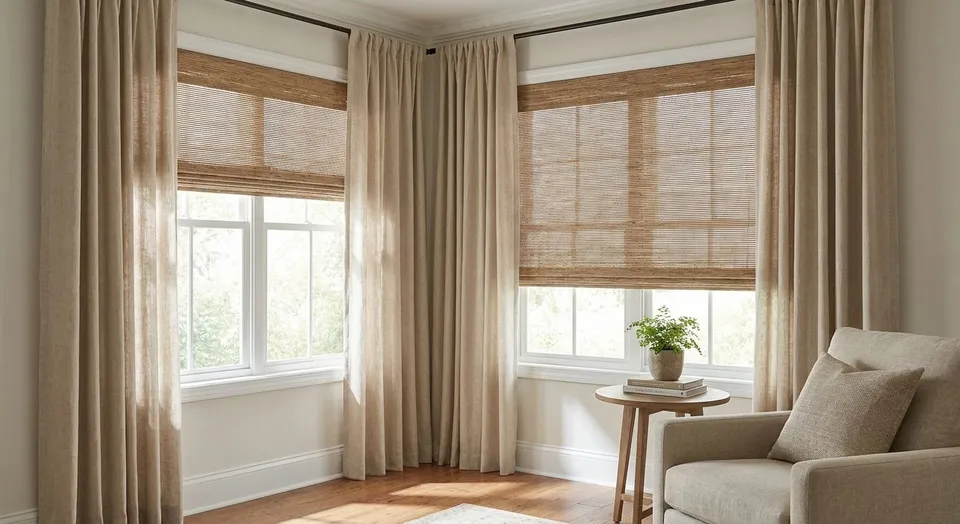
Corner windows create a design puzzle that standard product pages never address: two window openings meet at (or near) a 90-degree seam, and most off-the-shelf blinds and curtains were never engineered to solve for that meeting point.
- Cellular shades win for corner windows in 2026 when energy loss at the seam is the concern. Buy them.
- Zebra shades are the pick when one exposure gets harsh afternoon sun and the other doesn't. Layer opacity independently.
- Skip cord-operated shades on adjoining corner windows; cords cross paths and snag at the seam.
- Roller shades give the cleanest sightline for a tight, minimalist corner, verdict: consider for modern rooms.
- Drapery over shades softens a sharp corner seam but adds cost most homeowners underestimate.
Why this matters
A corner window setup is really two separate window treatment decisions that have to look like one decision from across the room. Get the mount depth wrong on one side and the headrails collide. Get the fabric opacity mismatched and one window reads darker than the other by 3 p.m. Rainier Blinds measures and installs custom roller shades, zebra shades, cellular shades, roman shades, and drapery for homes across Auburn, Bellevue, Tacoma, and the broader Seattle area, and corner window jobs come up constantly in living rooms, breakfast nooks, and corner home offices.
The fix isn't a special "corner window" product. It's picking the right category of window treatments for corner windows and specifying mount type, control method, and fabric consistently across both openings.
Who this is for
This guide is for homeowners with two windows that meet at or near a room corner, a 90-degree pairing in a living room, a nook where two walls of glass wrap a breakfast table, or a home office with windows on adjacent walls. If you're dealing with one large picture window or a true bay window with a center panel, the buying logic is different; those setups have their own considerations around stack depth and center-mullion mounting.
What to look for in window treatments for corner windows
Mount clearance at the seam
When two headrails meet at a corner, the brackets and stack depth on each side determine whether the shades clear each other when raised. A shade with a bulky headrail on one window can physically collide with the adjacent unit's mounting hardware if the corner gap is tight. This is the single most common installation problem on corner jobs, and it's why measuring both windows as one system, not two separate quotes, matters.
Cordless or motorized operation
Two windows meeting at a corner usually means two operating mechanisms within arm's reach of each other. Corded lift systems tangle, and a cord running across a corner seam is both a snag hazard and a visual mess. Cordless lift or motorized shades solve this outright, and motorization lets both windows move on one remote or one smart-home scene instead of two separate pulls.
Light gap control
A corner seam creates a natural light leak if the two treatments don't align in height, fabric weight, or mount position. Light filtering through a gap at the corner is more noticeable than a gap in the middle of a single window because your eye tracks the break in the room's geometry. Side channels or overlap panels close that gap on operable shades.
Fabric and opacity consistency
Corner windows frequently face two different compass directions, which means one window gets harsher, more direct light than the other for part of the day. Matching fabric color is easy; matching how that fabric reads once one side is backlit and the other isn't takes more judgment. A light-filtering fabric on the sun-facing window and the same fabric on the shaded window can look like two different colors by early afternoon.
Privacy from two exposures
A corner window often means your room is visible from two directions instead of one, two streets, two neighboring yards, or a street and a shared driveway. Treatments need to manage both angles without requiring you to close two separate opaque shades every evening, which is one more argument for a synchronized operating system.
Smart home and motorization compatibility
If you're already running a smart home hub, corner windows are the best argument for motorized shades in the entire house, grouping two shades into one scene removes the daily friction of operating them individually.
Get a corner window quote
On-site measuring and install across Auburn, Bellevue, Tacoma, and Seattle.
Top picks for corner windows
The safe pick: cellular shades
Cellular shades stack tight against the frame and their honeycomb structure holds shape well when two units meet at a corner, which keeps the seam clean. For Pacific Northwest homes chasing lower heating bills through 2026, the insulating air pocket in a cellular shade also does real work at a corner, where two windows mean twice the glass surface losing heat. Cordless and motorized lift options avoid the cord-tangle problem entirely.
See the breakdown on energy-efficient cellular shades for how the insulation math plays out in a South King County winter. Verdict: Buy for any corner window where energy loss or a tight mount clearance is the priority.
The light-control specialist: zebra shades
Zebra shades, alternating bands of sheer and opaque fabric. Let you dial privacy and light independently on each window of a corner pair. That matters when one exposure gets afternoon sun and the other stays shaded most of the day; you can run one shade more open than the other without it looking mismatched, because the banded fabric reads as a design feature rather than an inconsistency.
Read more on dual-layered zebra shades for living room corner applications. Verdict: Buy when the two windows in your corner face genuinely different light conditions.
The minimalist pick: roller shades
Roller shades have the lowest-profile headrail of any shade category, which makes them the easiest option to fit tight against a corner without the two units interfering with each other. They're also the most budget-predictable choice when you're covering two openings instead of one, since the fabric and mechanism cost less per window than layered or cellular systems.
The roller shades vs. cellular shades comparison walks through when the minimalist option beats the insulated one. Verdict: Consider for modern rooms where clean lines matter more than insulation performance.
The wildcard: layered drapery over shades
Drapery panels layered over a functional shade soften the hard geometry of a corner seam, which some homeowners want and others find unnecessary. This combination costs more than a single-layer treatment and requires more precise measuring, since two drapery rods meeting at a corner need to clear each other the same way two headrails do.
Guidance on getting the layering right lives in how to layer shades and drapery for living rooms. Verdict: Consider if you want a softer look and are willing to pay for two layers on two windows; Skip if budget or a minimalist aesthetic rules.
The compact option: roman shades
Roman shades fold up cleanly and don't require a bulky headrail, which helps at a tight corner, but the fabric folds do add a few inches of stack height when fully raised. On a true corner with limited clearance above the frame, that stack height is worth checking against your ceiling and trim before ordering.
Verdict: Consider for corners with generous clearance above the window; Skip if your corner windows sit close to the ceiling line.
What to avoid
- Mismatched fabric weights across the two windows. Even the same color reads differently in light-filtering versus semi-opaque weights once sunlight hits one side harder than the other.
- Corded lift systems on adjoining corner windows. Two cords in close proximity at a seam is a tangle and a safety issue, and it undercuts the clean look you're going for at a corner.
- Oversized valances or cornices at the corner seam. A deep valance on each window can physically overlap at the corner, creating a bulky, boxed-in look instead of a clean transition.
Verdict comparison table
| Product | Mount clearance at seam | Light gap control | Motorized option | Verdict |
|---|---|---|---|---|
| Cellular shades | Tight, low profile | Strong, side-channel available | Yes | Buy |
| Zebra shades | Moderate | Independent per-window control | Yes | Buy |
| Roller shades | Lowest profile | Moderate | Yes | Consider |
| Roman shades | Adds stack height | Moderate | Limited | Consider |
| Drapery over shades | Requires rod clearance planning | Strong when closed | Motorized shade layer only | Consider/Skip |
FAQ
What's the best window treatment for a corner window?
Cellular shades are the best window treatments for corner windows in most homes because their low-profile headrail avoids collisions at the seam and their insulating pocket helps with heat loss across two windows instead of one. Zebra shades are the better pick when the two windows face different light conditions and need independent opacity control.
Should both corner windows match exactly?
The fabric and control type should match, but the operating position doesn't have to. Matching fabric and mount style keeps the corner looking intentional, while independent lift control on each window lets you adjust for differing sun exposure.
Is motorization worth it for corner windows?
Yes, motorization solves the two biggest corner window problems at once: cord tangling at the seam and the daily hassle of operating two separate shades. Grouping both windows into one remote or smart-home scene is the main reason homeowners upgrade to motorized shades specifically for corner setups.
Do corner windows need custom sizing?
Almost always, because the mount clearance between two adjoining windows varies by house and by how close the corner seam sits to the frame. Off-the-shelf blinds rarely account for that clearance, which is why on-site measuring catches interference issues before installation.
Can I use curtains alone on corner windows?
Curtains alone work for light corner treatments but don't give you the light-gap control that a shade provides at the seam. Layering drapery over a roller or cellular shade gets you both the soft look and the functional light control.
How much light leaks through a corner window seam?
Light leak at a corner seam depends on the gap between the two mounted units and whether the shades use side channels. Cellular and roller shades with side-channel options close that gap more effectively than standard mount shades without channels.
What mount type works best for corner windows?
Inside mount is preferred for corner windows whenever the frame depth allows it, since it keeps both units flush and avoids the projection that outside mount hardware adds at the seam. The right choice depends on frame depth and how close the two windows sit to each other.
One last thing
The detail most homeowners miss on a corner window job isn't the fabric. It's the headrail depth. A shade that looks identical to another on the shelf can have a headrail that's a half-inch deeper, and that half-inch is the difference between two shades clearing each other at the corner or physically colliding when both are raised. Measure the seam gap before you fall in love with a fabric swatch.