
Accessory dwelling units run on a different set of rules than a spare bedroom addition. The windows are smaller, the walls are thinner, and the whole unit usually needs to earn its keep, whether that's rent, a mother-in-law suite, or a home office nobody has to trip over.
Who this is for
This guide is for anyone finishing an ADU in the Greater Seattle Area, a garage conversion in Auburn, a detached backyard cottage in Kent, or a basement unit in Tacoma. Who needs window treatments for ADUs that fit tight budgets, tight window openings, and often a tenant on the other side of the glass. If you're converting a garage, insulated cellular shades built for garage conversions solve a problem most people don't think about until their first winter power bill: garage-converted rooms lose heat through glass faster than the rest of the house.
If the ADU is going to be rented out, the calculus changes again. You're not picking treatments you'll live with, you're picking treatments that survive tenant turnover without a service call every six months.
- Cordless cellular shades are the top pick for window treatments for ADUs in garage conversions. Buy them for the insulation value.
- Rental ADUs need cordless, easy-clean fabrics; skip drapery panels that need dry cleaning between tenants.
- Standard ADU window openings run smaller than main-house windows, so mount depth decides what fits, not style preference.
- Budget $150-$400 per window is a reasonable planning range for 2026 ADU projects before motorization.
- Outdoor zipper shades on an ADU patio or slider double as a privacy screen where lot lines sit close together.
Why this matters
ADU windows are frequently leftover-sized: a 36-inch slider salvaged from a garage door opening, a couple of small casement windows punched into a converted shop, or a single big picture window on a detached unit that faces a neighbor's fence eight feet away. Standard-width blinds or off-the-shelf shades from a big-box store rarely fit those openings cleanly, and a bad fit on a small unit reads as bad everywhere in that unit, there's no second living room to distract from it.
Budget also behaves differently on an ADU project. Permits, plumbing, and a mini-split HVAC system eat the budget first, and window treatments get whatever's left. That's fine. But it means every dollar on window treatments for ADUs in 2026 needs to do double duty: privacy, insulation, and durability at once, not one of the three.
What to look for in window treatments for ADUs
Mount depth for tight window frames
ADU window frames, especially in garage conversions and basement units. Often have shallower jambs than main-house windows. A treatment that needs 3+ inches of mount depth simply won't sit flush. Check jamb depth before ordering anything, and lean toward products designed for tight and unusual mount types rather than assuming a standard inside mount will work.
Insulation value for single-zone HVAC
Most ADUs run on one mini-split or a single ductless zone. That system has no slack for a drafty window wall. Cellular shades with honeycomb construction trap a layer of air against the glass, which matters more in a 400-square-foot unit than it does in a 2,400-square-foot house with central heat to spare.
Privacy at close range
ADUs sit closer to property lines, alleys, and neighboring windows than the main house usually does. Sheer or light-filtering fabrics that look fine on a second-story main-house window can leave a ground-floor ADU window exposed at night. Light-filtering or blackout fabric earns its place here, not sheers.
Durability if the unit is a rental
If the ADU generates rent, the window treatments need to survive tenant turnover without a repair visit. Cordless lift systems, wipeable fabrics, and simple mechanisms beat anything with strings, chains, or delicate wands that a new tenant hasn't been trained on.
Budget discipline
ADU construction budgets are tighter than main-house remodels, almost without exception. Treating every window with the same fabric and lift system. Instead of mixing premium treatments on the front window and simpler roller shades on secondary windows. Keeps the line item from ballooning past what a realistic window treatment budget should look like for a unit this size.
Top picks for ADU window treatments
1. Insulated cellular shades, the insulation workhorse. Cellular shades mount in as little as 1.5 inches of depth, which fits the shallow jambs common in garage-conversion ADUs. They're the right call for any unit running on a single mini-split zone, since the honeycomb cells cut direct heat transfer through the glass. Verdict: Buy for garage conversions and basement ADUs where HVAC capacity is limited.
2. Blackout roller shades, the rental workhorse. Roller shades in blackout fabric are the lowest-maintenance option for ADUs set up as rental units, one continuous fabric surface, cordless operation, and a wipeable finish that survives tenant handoffs without a service call. Verdict: Buy for any ADU generating rental income.
3. Zebra shades, the light-control multitasker. Zebra shades alternate sheer and solid bands, letting a tenant or owner dial light and privacy without switching between two separate treatments. That's useful in a studio-style ADU where one window has to do the job of a living room window and a bedroom window at once. Verdict: Consider for studio-layout units with one primary window wall.
4. Outdoor zipper track shades, the patio-ADU pick. Detached ADUs with a small patio or slider benefit from a zipper track shade on the outdoor side. It blocks sightlines from a close-set fence line and cuts afternoon glare on the slider glass itself. Verdict: Consider for detached units with an outdoor sitting area.
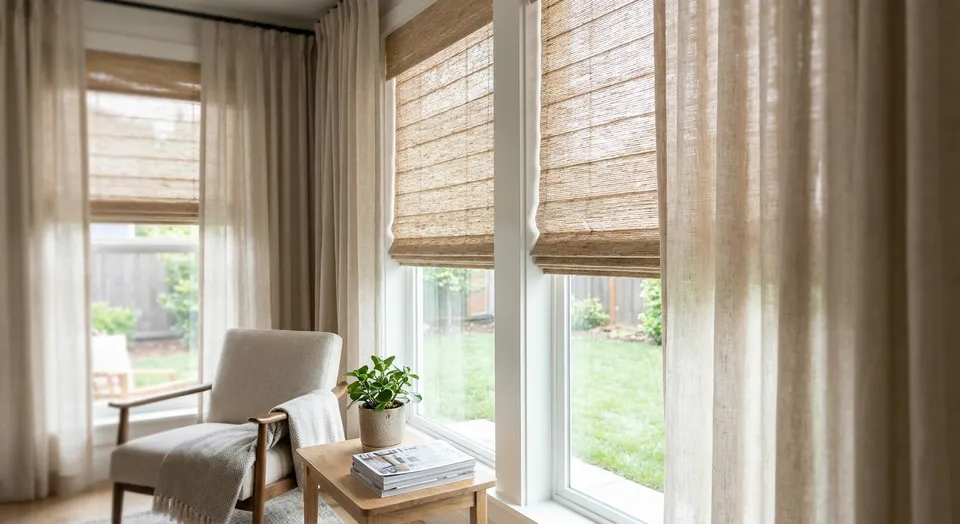
5. Woven wood roman shades. The character add. For a backyard cottage-style ADU going for a warmer look than a straight roller shade, woven wood roman shades add texture without adding bulk. They're a style upgrade, not a functional necessity, and cost more per window than roller or cellular options. Verdict: Consider only after the insulation and privacy basics are covered elsewhere in the unit.
What to avoid
- Drapery panels in a rental ADU. They look finished on day one and need dry cleaning by tenant number two. Skip them unless you're the one living there long-term.
- Corded lift systems in any ADU with young renters or kids. Cordless is the safer default, and it's also the lower-maintenance choice for turnover.
- Full-depth wood-look blinds crammed into a shallow garage-conversion jamb. They rarely mount flush, and a treatment that doesn't sit flush against a shallow frame looks worse than no treatment at all.
Get ADU window treatments measured right
Real pricing on the spot, measured and installed by our own crew.
Verdict comparison
| Treatment | Best for | Mount depth needed | Privacy at night | Verdict |
|---|---|---|---|---|
| Insulated cellular shades | Garage/basement ADUs | As little as 1.5" | High (blackout option) | Buy |
| Blackout roller shades | Rental ADUs | Standard, low profile | High | Buy |
| Zebra shades | Studio-layout ADUs | Standard | Medium-high | Consider |
| Outdoor zipper track shades | Detached ADU patios/sliders | N/A (exterior mount) | High outdoors | Consider |
| Woven wood roman shades | Cottage-style detached ADUs | Standard | Medium | Consider |
FAQ
What window treatments work best for ADUs?
Insulated cellular shades and blackout roller shades work best for most ADUs in 2026 because they fit shallow window frames, cut heat loss through glass, and hold up to tenant turnover. Cordless lift systems beat corded options in almost every ADU scenario.
Do ADUs need blackout shades?
ADUs benefit from blackout or heavy light-filtering fabric more than main-house rooms because ground-floor units sit closer to neighboring windows and fence lines. A sheer fabric that's fine on a second-story window can leave a ground-floor ADU exposed at night.
Can you put cellular shades in a garage-conversion ADU?
Yes, cellular shades are one of the strongest options for garage-conversion ADUs because they mount in shallow jamb depths and add insulation value where single-zone HVAC systems need the help most.
How much do window treatments cost for an ADU?
Budgeting $150 to $400 per window is a reasonable 2026 planning range before motorization, though the exact number depends on fabric, lift type, and window size. Mixing premium treatments on the main window with simpler roller shades elsewhere keeps the total down.
Are cordless shades required for rental ADUs?
Cordless shades aren't legally required in every jurisdiction, but they're the practical default for rental ADUs because they're safer around kids and simpler for a new tenant to operate without instruction.
What size windows do ADUs typically have?
ADU windows are frequently smaller or oddly proportioned compared to main-house windows, especially in garage conversions where openings were sized for a garage door or shop window rather than a living space. That makes custom measuring more important than it is for standard-size main-house windows.
Do motorized shades work in a detached ADU without extra wiring?
Battery-powered motorized shades work in most detached ADUs without running new wiring, since they charge or run on replaceable batteries instead of hardwired power. Hardwired motorization is possible but adds an electrical step most ADU budgets skip.
Should a rental ADU have different shades than an owner-occupied one?
Yes. Rental ADUs should prioritize durable, cordless, wipeable fabrics like blackout roller shades over higher-maintenance options like drapery panels or delicate woven wood shades that need more care between tenants.
One last thing
The detail most ADU builders miss: the window treatment line item usually gets planned after the certificate of occupancy, once every other budget line has already been spent. Measuring and pricing window treatments alongside the HVAC and flooring quotes, not after, keeps the choice from getting rushed into whatever's cheapest at a big-box store the week before move-in.