
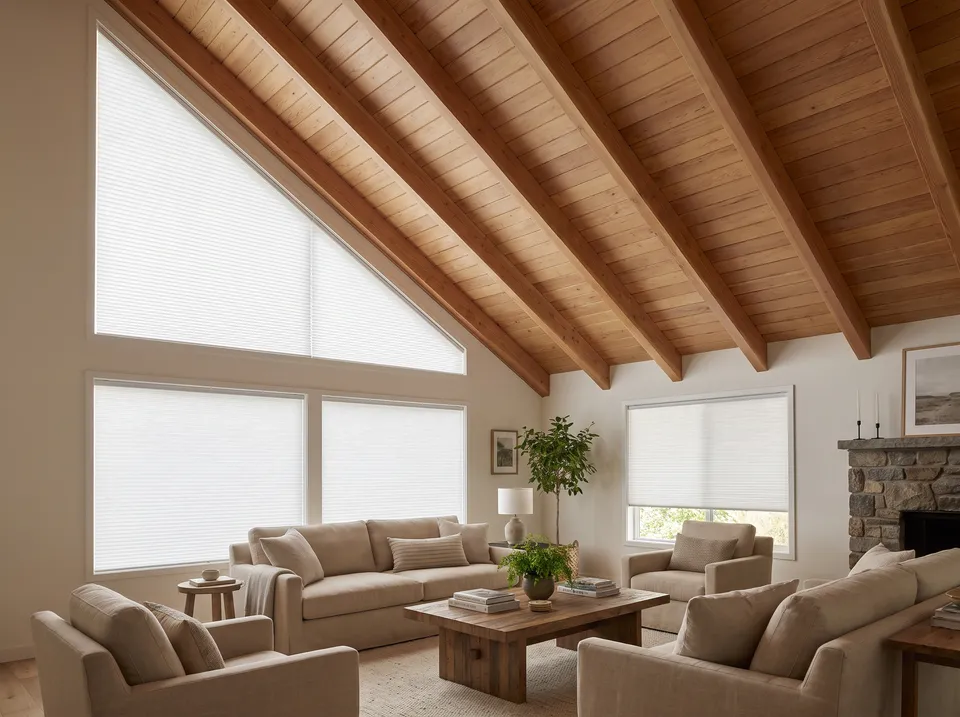
Trapezoid shades in Auburn, WA are the practical answer for angled window openings that a rectangular treatment cannot cover cleanly. This 2026 guide explains which fabrics suit sloped glass, when a fixed panel is the right call, and how Rainier Blinds measures, custom-makes, and installs a perfect fit across Auburn and South King County. Start with the Auburn service area when an angled opening needs an on-site plan.
TL;DR
- Trapezoid shades Auburn WA homes need when an angled window requires a measured custom fit.
- Cellular shades are the insulation pick; light-filtering fabric is the daylight pick; blackout suits bedroom use.
- Fixed trapezoid panels are often the right answer for high or sharply angled openings.
- Rainier Blinds measures, has shades custom-made to your exact measurements, and installs with its own crew.
Why this matters
A trapezoid window is not a rectangle with a little extra glass at the top. One or both sides run on an angle, so a standard shade leaves a triangular gap, crowds the trim, or binds before it reaches the sill. The wrong treatment makes a feature window look unfinished every day.
Auburn homes put angled glass in vaulted living rooms, stairwells, remodeled primary suites, and two-story entries. The window often sits above normal reach, and daylight lands at an angle that changes through the year. In 2026, the first decision is not color. It is whether the opening needs insulation, glare control, room darkening, or simply a clean finished look.
Trapezoid shades work when the profile follows the actual frame and the mounting plan accounts for the slope. Rainier Blinds measures the window and has your shades custom-made to your exact measurements, then installs the finished treatment with its own crew. That prevents a standard-size purchase from becoming an expensive near miss.
Who this is for
This guide is for Auburn and South King County homeowners with a sloped, angled, or trapezoid-shaped window who want a treatment that fits the opening instead of hiding part of it. It applies to newer Lakeland Hills great rooms, remodeled homes with vaulted ceilings, stairwells, and additions where the top edge of a window follows a roofline.
It is also for buyers comparing a local measure-and-install project with an online order. A trapezoid shade is not a good place to guess from a photo. The crew needs the widest and narrowest points, the height at each side, the angle, trim depth, and access conditions before the shade is custom-made to those specifications.
A fixed shade does not mean a second-rate solution. Many specialty openings are too high or too steep for daily operation, and a fixed custom panel can cut glare, soften a hard line of light, and finish the window without adding a control that will never get used. An operable treatment earns its cost when the room needs the light level to change every day.
What to look for in trapezoid shades for Auburn homes
The exact window geometry
The shape is the job. A proper measure captures the bottom width, top width, left and right heights, and the sloped edge rather than relying on one diagonal number. The crew also checks whether the frame is square where the brackets need to land. Three readings across a wide opening reveal differences that a single tape pull misses.
Trim depth matters just as much. An inside mount looks contained when the recess is deep enough for the headrail and fabric stack. An outside mount is often cleaner when the angled opening is shallow, the casing is uneven, or the treatment needs overlap to stop bright edge gaps. Decide that before fabric is ordered.
Fixed versus operable construction
Many trapezoid shades are fixed panels because gravity and a sloped top edge limit how a moving treatment can travel. That is normal. A fixed cellular panel can cover a high angled section while an operable rectangular shade handles the lower window below it.
Choose an operable system when the glass is reachable or when the room has a repeatable need for more daylight, less glare, or bedroom darkness. Motorization is the right upgrade for a tall entry or high living-room window that would otherwise stay in one position because no one wants to set up a ladder. It is not required on every angled window.
Fabric matched to the room's failure point
The fabric should solve one clear problem.
- Cellular fabric is the first choice when heat loss or heat gain is the concern. The honeycomb structure adds an insulating air layer and suits high fixed panels where the goal is year-round comfort.
- Light-filtering fabric is the right choice for living rooms, stairwells, and bright entries that need softer daylight but should not feel closed off.
- Blackout fabric is for a bedroom, media room, or other space where direct morning light is the problem. It works best when the mount plan also addresses the side and top edges.
- Sunscreen fabric controls glare while keeping a view through a vertical portion of the opening. It is a daytime fabric, not a nighttime privacy solution.
Do not specify one fabric type for every specialty window in the house. A trapezoid above a stairwell often needs filtered light. One above a bed has a different job. Room use decides the fabric in 2026, not a desire to make every opening match on the quote.
Edge coverage and visible light gaps
A specialty shade can have the right fabric and still fail around the perimeter. Angled frames make this more noticeable because daylight follows the sloped edge. Ask where the finished panel stops, how the top angle is finished, and whether the treatment overlaps trim or sits inside the recess.
Blackout means fabric opacity, not automatically a sealed room. A fixed panel that sits inside a deep, uneven opening can leave a thin bright line. If dark sleep matters, say so during the measure. Rainier Blinds can plan the mount around that requirement before the shade is custom-made.
Motorization and access
Hard-to-reach angled windows are a strong case for motorization, especially when the room changes use throughout the day. A motorized rectangular shade below a fixed trapezoid panel is often the cleanest setup: the specialty section stays put while the lower opening handles the daily light changes.
For windows that do need automated movement, Rainier Blinds' smart shades options work with the broader home setup rather than making a high window a manual chore. The motor, power plan, and final stop positions need to be decided before ordering. That avoids a finished shade with no practical way to reach or service it.
The measurement and installation plan
Rainier Blinds does not manufacture window treatments in-house. The process is simple: the crew measures the opening, the selected shade is custom-made to those measurements by a supplier, and the same crew returns to install it. That separates product fabrication from local accountability for the fit.
The site states that most projects are installed within 3-4 weeks of ordering, but specialty shape timing depends on the selected fabric, hardware, and supplier schedule. Confirm the current lead time in the quote. A clear order sheet should show the room, the shape, the mount, fabric choice, and whether the panel is fixed or operable.
Best trapezoid shade setups for South King County
The safe pick: fixed cellular trapezoid panels
Buy fixed cellular trapezoid panels for high, angled windows where insulation and a clean finished profile matter more than daily adjustment. They suit vaulted living rooms, upper entry glass, and the angled section above a standard rectangular window. The honeycomb construction makes sense on older or exposed glass because it adds a layer between the room and the window.
This setup also avoids paying for a motor on a window that will stay in one position. Pair it with a separate operable cellular or roller shade on the lower opening only when that portion needs daily privacy or light control. The two-part plan looks intentional when the fabric and color are selected together.
The daylight pick: light-filtering fixed fabric
Buy light-filtering trapezoid fabric for a stairwell, great room, or entry where direct light is harsh but the room still needs to feel open. It softens the bright patch on floors and walls without turning the angled glass into a dark shape overhead.
This is the straightforward choice for windows that receive sun but do not create a sleep problem. Use a lighter fabric for rooms that need daytime brightness and a denser light-filtering option where privacy or screen glare is more important. The measure visit should include a look at the glass from the seating area, not only from directly underneath it.
The bedroom pick: blackout trapezoid panel plus operable lower shade
Buy a blackout trapezoid panel for an angled section above a bedroom window when early daylight is the issue. Match it with an operable blackout or room-darkening shade below if both sections need coverage. This is more reliable than trying to force one rectangular product around a sloped top edge.
The key detail is edge planning. Blackout fabric performs best when the panel covers the actual angled section with enough overlap or a carefully measured inside mount. Ask to see the finished coverage from the bed before the crew leaves. A small wedge of light at the top can undo the reason for choosing blackout in the first place.
The glare-control pick: sunscreen on view-focused glass
Consider sunscreen fabric when the trapezoid opening sits over a living space and the view matters as much as glare reduction. It softens direct sun on a television, desk, or floor while keeping the opening visually lighter than a blackout panel.
Use it only where evening privacy is not the main job. Once interior lights come on, sunscreen does not provide the same privacy as an opaque fabric. A front-facing room may need a different treatment below the trapezoid section for night use.
The access pick: a fixed specialty panel with motorized lower treatment
Buy the combination of a fixed trapezoid panel above and a motorized shade below for two-story rooms, tall entries, or glass behind furniture. The specialty section solves the shape; the motorized lower section handles the daily routine. It is simpler than trying to make every part of an irregular opening move together.
Rainier Blinds can coordinate the full room plan through its window treatment services, including roller, cellular, zebra, Roman, woven wood, day/night, dual, skylight, outdoor, and drapery options. The best combination is based on what the room needs at 8 a.m., mid-afternoon, and after dark.
What to avoid
A rectangular shade forced into an angled opening
A standard rectangle cannot follow a sloped top edge. It leaves exposed glass or overlaps the frame in a way that blocks hardware and looks improvised. The more visible the window, the more obvious the shortcut becomes.
Use a rectangular treatment only on the rectangular portion below the slope. Cover the specialty section with a separately measured trapezoid panel when the upper glass needs light control. That is the clean answer, not overbuilding one product to do two shapes.
Ordering from one diagonal measurement
A diagonal tells you almost nothing about mounting depth, angle consistency, or whether the frame changes width from bottom to top. Specialty shapes need a complete template-style measurement plan. A shade cut even slightly wrong cannot be trimmed into a new angle after it arrives.
Online custom orders transfer that risk to the homeowner. Local measuring gives the supplier the dimensions required to fabricate the shape, and local installation checks that the completed panel lands as planned.
Treating a fixed panel as a failure
A fixed panel is often the correct product choice for a high trapezoid. It controls light, improves comfort, and finishes a difficult opening with fewer moving parts. Trying to add operation where the room will never use it increases cost and service needs without improving the result.
Motorize the section that changes daily. Keep the specialty section fixed when it is beyond reach or serves one constant job. That split is usually the more durable setup in 2026.
Ignoring the lower window below it
A trapezoid window is often part of a larger combination. The upper section might need cellular insulation, while the lower section needs a sunscreen roller for daytime glare or blackout fabric for a bedroom. One fabric choice does not have to carry every part of the wall.
Build the room as a system. Match the visible finishes, then give each section the opacity and operation it actually needs. That is more useful than a one-product rule that compromises both windows.
Verdict comparison
| Setup | Best for | Main strength | Verdict |
|---|---|---|---|
| Fixed cellular trapezoid panel | High angled glass | Insulation and clean shape coverage | Buy |
| Light-filtering fixed panel | Living rooms and entries | Softer daylight | Buy |
| Blackout trapezoid plus lower shade | Bedrooms | Stronger morning light control | Buy |
| Sunscreen specialty panel | View-focused rooms | Glare control with daylight | Consider |
| Fixed panel plus motorized lower shade | Tall combined openings | Shape coverage plus daily access | Buy |
| Stock rectangle on a sloped frame | Any visible trapezoid opening | Lowest upfront effort | Skip |
How the local process works
Rainier Blinds handles angled-window projects in four clear steps.
- Consult: Identify whether each opening needs insulation, glare control, privacy, blackout, or a finished look.
- Measure: The crew records the actual shape, slope, depth, trim, access, and any obstacles before custom fabrication is planned.
- Custom-make: The shade is fabricated by a supplier using the confirmed dimensions, fabric, mount, and fixed or operable plan.
- Install: The same crew installs the treatment and checks the finished panel from the room's real use points.
That approach is built for angled windows that do not match stock sizes. It also keeps the decision practical: no guesswork, no claim of in-house manufacturing, and no handoff to an unknown installer. Request a custom quote with the room, approximate window size, ceiling height, and the main light problem so the consultation starts with the right questions.
FAQ
What are the best trapezoid shades for Auburn WA homes in 2026?
Can trapezoid shades open and close?
How are trapezoid shades measured?
Are cellular shades good for angled windows?
Can trapezoid shades be blackout?
How long do custom trapezoid shades take in Auburn?
Does Rainier Blinds manufacture trapezoid shades in-house?
One last thing
The most useful question for a trapezoid window is not, "Can a shade cover it?" It is, "What must this part of the room do every day?" If the upper glass only needs constant glare reduction, a fixed panel is the right answer. If the lower window needs a daily open-and-close routine, give that section the operable treatment and let each shape do its job.