
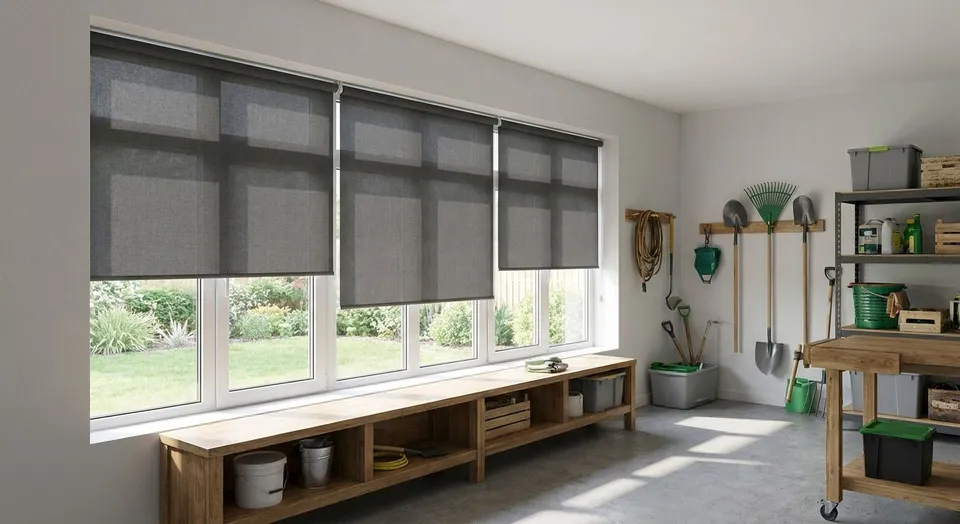
Garage windows sit in one of the toughest spots in a house for window coverings: temperature swings, sun exposure that can fade stored gear, and often a window that isn't a standard size. Roller shades for garage windows solve privacy and glare without adding bulk to a space that usually doesn't have room to spare.
- Solar and blackout roller shades are the two picks that actually work for garage windows in 2026. Buy both if you use the space daily.
- Openness factor, not fabric color, determines whether roller shades for garage windows block fade or just dim the room.
- Motorized roller shades solve the reach problem on windows mounted above workbenches or garage doors. Consider for anything over 7 feet.
- Skip stock-sized shades on garage windows; most run narrower or taller than standard interior windows.
- Converting the garage to a gym or office? Pair roller shades with insulated cellular shades for temperature control.
Why This Matters
A garage isn't conditioned like the rest of the house. It runs colder in January and hotter in August, and whatever's parked or stored inside, vehicles, tools, paint cans, sports gear, takes the brunt of unfiltered sun through an uncovered window. Roller shades for garage windows are a low-profile fix: they mount close to the glass, don't compete for space near a workbench or garage door track, and come in fabrics rated for the swings a garage sees that a bedroom never does.
The wrong pick still fails at all of this. A light, sheer fabric roller shade looks fine on day one and does nothing to stop UV fade by month six. Rainier Blinds measures and installs roller shades across Auburn, Bellevue, Tacoma, and the greater Seattle area, and garage windows come up constantly in consultations for garage conversions, home gyms, and workshops.
Who Roller Shades for Garage Windows Are For
This guide is for homeowners with an actual garage window problem: a workshop window that floods with afternoon glare, a garage-turned-gym with a street-facing pane, or a converted garage office that needs to look finished instead of functional. If you're covering a single small garage window for privacy only, you need less shade than someone protecting a car, tools, or electronics from years of sun exposure. Both cases point to roller shades, just different fabrics inside that category.
Homeowners in Auburn and South King County dealing with roller shades in Auburn, WA for other rooms often add the garage window to the same order. It's a quick add when a crew is already on-site measuring.
What to Look For in Roller Shades for Garage Windows
Openness Factor and Light Control
Openness factor is the percentage of a fabric that lets light pass through the weave, and it matters more in a garage than anywhere else in the house. A 1-3% openness fabric blocks glare and most UV while still letting you see out; a 0% openness blackout fabric kills light entirely for a converted gym or media space. Pick the wrong number and you either squint at a workbench or sit in the dark during the day.
UV and Fade Protection
Garages store the things households care about protecting from sun damage, tool finishes, car paint, stored furniture, seasonal gear. A roller shade with real UV-blocking fabric does more for that stuff over a few years than any coating on the glass itself. This is the single biggest reason a bargain shade underperforms: cheap fabric filters light but not UV.
Moisture and Temperature Tolerance
Pacific Northwest garages swing from the low 30s°F in winter to well over 80°F in summer, often with more humidity than a conditioned room. Fabric and hardware need to hold shape and function through that range without warping, sticking, or losing tension. This is also where garage conversions differ from plain storage garages, a converted space benefits from pairing roller shades with insulated cellular shades for garage conversions to manage the temperature swing itself, not just the glare.
Mount Type for Odd-Sized Garage Windows
Garage windows are rarely standard sizes. Narrow strip windows next to a garage door, tall clerestory panes, or windows set into an angled gable all need accurate measurement, not a stock-size shade ordered online and trimmed to fit. Inside mount works when there's enough depth in the frame; outside mount covers a frame that's too shallow or trimmed unevenly.
Manual vs. Motorized Operation
A lot of garage windows sit above a workbench, storage shelving, or the garage door track itself. Spots you can't reach without moving something first. A cordless manual chain works fine for a window you can reach standing on the floor. Anything mounted 7 feet or higher, or blocked by permanent storage, is a better fit for motorized operation you control from a wall switch or phone.
Privacy and Street Visibility
Garage windows facing a street or a neighbor's driveway need a fabric that reads as opaque from outside during the day without going full blackout inside. This is where a mid-range openness factor, not the darkest fabric on the sample card, usually wins.
The Roller Shade Styles Worth Buying for Garage Windows
Light-filtering roller shades. The everyday pick. Openness factor in the 5-10% range lets in daylight for a workshop or general storage garage while cutting the worst of the glare. Cost stays lower than blackout or solar-grade fabric. Buy if the garage is used for storage or light workshop tasks and fade protection isn't a top priority.
Solar screen roller shades. The fade-prevention pick. Openness factor drops to 1-3%, built specifically to block UV while keeping visibility to the outside. This is the fabric that actually protects a car's paint, stored electronics, or finished woodworking projects from sun damage over multiple summers, as covered in solar shades that block fade. Buy for any garage with a west- or south-facing window and something inside worth protecting.
Blackout roller shades. The garage gym or media pick. Zero openness factor, full light block. This is the right call for a garage converted into a home gym, workout studio, or media room where daytime glare on a screen or mirror wall is the actual problem, and it lines up with the setup covered in window treatments for home gyms. Buy for converted garage living spaces; Skip for a plain storage garage where full blackout serves no purpose.
Motorized roller shades. The hard-to-reach pick. Solves the access problem on windows above workbenches, shelving, or a garage door track where a pull chain isn't practical. Adds cost over manual operation but removes the need to move storage every time you want the shade up or down. Consider for any garage window mounted above head height or blocked by permanent fixtures.
Get garage windows measured right
Rainier Blinds measures and installs roller shades across Auburn, Bellevue, Tacoma, and Seattle.
What to Avoid
- Stock-sized shades ordered without a real measurement. Garage windows run narrower, taller, or more oddly proportioned than standard interior windows, and a trimmed-down stock shade rarely mounts cleanly.
- Cord-operated shades on windows directly above a workbench or tool storage. The reach and safety trade-off isn't worth it when a cordless or motorized option solves the same problem.
- Light, sheer fabric on a sun-facing garage window. It looks fine in the showroom and does nothing to stop UV fade on whatever's parked or stored behind it by year two.
Verdict Comparison Table
| Style | Openness Factor | Best For | Verdict |
|---|---|---|---|
| Light-filtering roller shade | 5-10% | Storage garages, workshops | Buy |
| Solar screen roller shade | 1-3% | Sun-facing windows, fade protection | Buy |
| Blackout roller shade | 0% | Garage gyms, media conversions | Buy |
| Motorized roller shade | Varies by fabric | Hard-to-reach or high-mounted windows | Consider |
| Sheer fabric shade | 10%+ | Not recommended for garage use | Skip |
FAQ
What's the best roller shade for a garage window?
A solar screen roller shade with a 1-3% openness factor is the best all-around choice for most garage windows in 2026 because it blocks UV fade while still letting you see outside. Blackout fabric is a better fit only if the garage has been converted into a gym or media room.
Do roller shades hold up in an unheated garage?
Yes, roller shade fabric and hardware built for residential use tolerate the temperature range of an unconditioned Pacific Northwest garage, including winter lows in the 30s°F and summer heat above 80°F. Moisture-resistant fabric matters more than insulation value for a plain storage garage.
Are roller shades or cellular shades better for a garage conversion?
Roller shades handle light and privacy; cellular shades add insulation value on top of that, which matters once a garage becomes a livable room. Many garage conversions in South King County use both, a comparison covered in roller shades vs. cellular shades for the region.
Can garage window roller shades be motorized?
Yes, motorized roller shades work well on garage windows mounted above workbenches, shelving, or a garage door track where a manual chain isn't practical to reach. Operation runs from a wall switch or phone app instead of a pull cord.
How much light control does a garage window actually need?
A storage garage or workshop usually needs light-filtering fabric in the 5-10% openness range, enough to cut glare without going dark. A garage converted into a gym or theater needs a 0% openness blackout fabric instead.
Will roller shades stop sun fade on a car or tools stored in the garage?
A solar screen roller shade with a low openness factor blocks the UV exposure that causes paint and finish fade over time, which a sheer or light-filtering fabric does not do effectively. This matters most on west- and south-facing garage windows that get direct afternoon sun.
What size roller shade fits a typical garage window?
Garage windows vary widely, narrow strip windows beside a garage door, tall clerestory panes, and standard rectangular windows all show up in the same neighborhood. Accurate on-site measurement matters more here than for interior rooms because so few garage windows are a standard size.
One Last Thing
The detail most homeowners miss on a garage window order: the fabric that looks nearly identical on a sample card at 5% versus 10% openness produces a noticeably different result once it's covering a west-facing window that gets full afternoon sun. Ask to see both openness percentages held up against actual daylight before deciding, not just under showroom lighting.