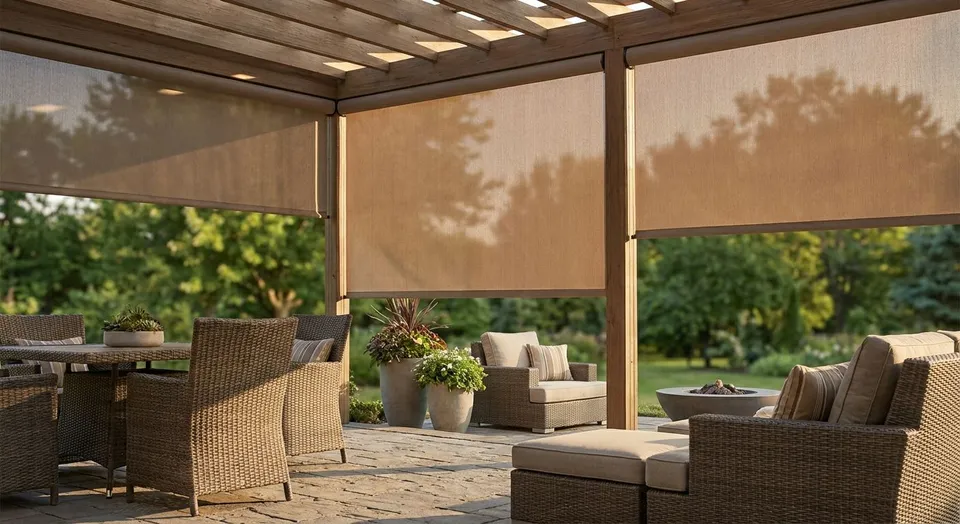
Outdoor roller shades turn a covered deck or open patio into usable space for more months of the year, but a system built for a covered breezeway fails fast on a windy, unobstructed patio. The track, fabric, and mounting choice that holds up in Auburn or Tacoma in 2026 is different from what a catalog photo shows.
- Zipper track outdoor roller shades resist wind flutter better than cable-guided systems on open patios. Buy zipper track for exposed decks.
- Cable-guided outdoor shades flex more and cost less to install but rattle in gusty conditions. Consider for covered patios only.
- Motorized outdoor roller shades for patios remove manual crank wear on daily-use decks. Buy for heavy-use outdoor rooms in 2026.
- Skip unrated vinyl porch shades without UV-stabilized PVC mesh fabric; unrated tracks and seams fail within one Pacific Northwest season.
Why this matters
An outdoor roller shade is not an indoor roller shade with weatherproof fabric slapped on. The fabric, the guide system, and the mounting hardware all have to survive rain, wind, and temperature swings that indoor shades never see. Get the track system wrong and you get a shade that flaps, jams, or tears out of its channel by the second storm season.
Rainier Blinds measures and installs outdoor shades on steel wire and zipper track systems across the Greater Seattle Area, and the difference between a shade that lasts and one that fails almost always comes down to track choice and fabric spec, not brand name.
Who this is for
This guide is for a homeowner in Bellevue, Tacoma, Auburn, or anywhere in the Greater Seattle Area who wants to extend patio or deck season into shoulder-season months without building a permanent structure. It's for anyone comparing a zipper track or cable-guided outdoor shade against big-box vinyl roll-down screens, and anyone who has already priced a screened porch and wants a lower-commitment option first.
What to look for in outdoor roller shades for patios
Track system: zipper vs. cable-guided
A zipper track outdoor roller shade locks the fabric edge into a channel on both sides, which keeps the panel taut and quiet even on an open, wind-exposed patio. A cable-guided system runs the fabric along steel wire instead of a rigid channel, which flexes more in gusts and works better on a covered or partially enclosed deck where wind load is lower. Pick the track based on how exposed the patio actually is, not on price alone.
Fabric openness and wind load
Exterior shade fabrics come in openness percentages, typically ranging from 1% (near blackout, heavy privacy) up to 10% or 14% (mostly view-through, light shade). Lower openness blocks more glare and heat but also catches more wind, so a tightly woven low-openness fabric needs the sturdier zipper track. A high-openness fabric in the 10% range sheds wind better but does less to cut afternoon sun.
Motorized vs. manual operation
A motorized outdoor roller shade raises and lowers with a remote or a smart home trigger, which matters on a deck you use daily or on a panel too wide to crank comfortably. A manual crank system costs less to install and has fewer parts to service, which makes it the better call for a patio shade used occasionally in summer.
Frame and hardware material
Outdoor shade hardware needs to be powder-coated or otherwise corrosion-resistant since it sits outside year-round in Pacific Northwest rain. Hardware that isn't rated for exterior exposure will rust at the brackets within a season or two, long before the fabric itself wears out.
Mount type and pocket clearance
Surface-mounted outdoor shades attach directly to a fascia board or beam and work on almost any patio structure. A recessed pocket mount hides the roller tube inside a header for a cleaner look, but it requires the framing to be planned for it, which matters most on new construction or a patio cover being built from scratch.
Get outdoor shades measured right
Rainier Blinds measures and installs zipper track and cable-guided outdoor shades across the Greater Seattle Area.
Top picks for outdoor roller shades on decks and patios
Zipper track outdoor roller shade: the wind-tunnel pick
This is the setup for a patio with no roof overhang and a clear wind path off open yard or water. The fabric edge locks into a rigid side channel, so the panel stays flat under gusts instead of billowing. Verdict: Buy for exposed patios and decks with no wind break.
Cable-guided outdoor roller shade: the flexible-opening pick
Cable-guided systems run the fabric along steel wire rather than a closed channel, which makes installation simpler on irregular openings and costs less than a full zipper track. It flexes more in wind, so it belongs under an existing roof or pergola, not on an open deck. Verdict: Consider for covered patios; Skip for wide-open decks.
Motorized outdoor roller shade: the convenience pick
A motorized outdoor roller shade removes the daily crank on a panel you're raising and lowering more than once a day, and it pairs with a smart home hub the same way an interior motorized shade does. It's the right call for wide openings. A hand crank gets awkward past a certain panel width, and for any household that already runs motorized shades indoors. Verdict: Buy for daily-use outdoor rooms and wide panels.
Manual crank outdoor roller shade: the budget pick
A manual crank system has fewer moving parts, no motor to service, and a lower installed cost than motorized. It's the right fit for a patio shade that comes down for a few hot afternoons a month rather than every day. Verdict: Buy for occasional-use patios; Consider if the panel is wider than a single person can comfortably crank.
High-openness mesh fabric: the view-preserving pick
A fabric in the 10% openness range cuts glare and heat without blacking out the view past the shade, which matters on a deck with a yard or water view worth keeping. It won't block privacy the way a 1% or 3% fabric does, so it's not the pick if the goal is screening a patio from neighbors. Verdict: Buy for view-focused decks; Skip if privacy is the priority.
“If the fabric and track aren't rated for exterior wind exposure, skip it, unrated seams tear out within one Pacific Northwest storm season.”
What to avoid
- Big-box vinyl roll-down screens without a stated wind rating. They look similar to a zipper track shade in photos but the seams and edge channel aren't built for sustained gusts.
- Fabric without UV stabilizers. Unstabilized PVC mesh cracks and fades faster under direct summer sun than exterior-rated fabric, even indoors-rated fabric marketed as "outdoor safe."
- Motorized systems with no manual override. If the motor fails in 2026 and there's no crank backup, the shade is stuck in whatever position it died in until it's serviced.
Verdict comparison table
| System | Best for | Wind performance | Verdict |
|---|---|---|---|
| Zipper track | Open, exposed patios | High | Buy for wind exposure |
| Cable-guided | Covered patios/pergolas | Moderate | Consider under cover |
| Motorized | Daily-use, wide panels | Depends on track | Buy for convenience |
| Manual crank | Occasional-use decks | Depends on track | Buy for budget |
| 10% openness fabric | View-focused decks | Sheds wind well | Buy for view, skip for privacy |
A roller shade isn't the only outdoor-adjacent option worth comparing, if you're also weighing shade types for a covered sunroom or three-season room rather than an open deck, the tradeoffs shift; see how roller shades stack up against cellular shades for that comparison.
FAQ
What's the best outdoor roller shade for a windy patio?
A zipper track outdoor roller shade is the best fit for a windy or fully open patio in 2026 because the fabric locks into a rigid side channel instead of flexing on cable guides. Cable-guided systems work fine under a roof or pergola where wind load is lower.
Are motorized outdoor shades better than manual for patios?
Motorized outdoor shades are better for wide panels and daily use since a hand crank gets awkward past a certain width. Manual crank systems are the better fit for a patio shade used only a handful of afternoons a month.
What fabric openness is best for an outdoor patio shade?
Lower openness fabrics, in the 1% to 3% range, block more glare and give more privacy, while 10% to 14% openness fabrics preserve the view and shed wind better. Pick based on whether privacy or view matters more on that specific deck.
Do outdoor roller shades work on an open deck with no roof?
Yes, but the track matters more than on a covered patio. A zipper track system holds up on a fully open deck in 2026; a cable-guided system is better reserved for covered or partially enclosed spaces.
Can outdoor roller shades handle Pacific Northwest rain?
Exterior-rated PVC mesh fabric and powder-coated hardware are built to sit outside year-round through Seattle-area rain. Hardware that isn't rated for exterior exposure rusts at the brackets well before the fabric wears out.
How wide can an outdoor roller shade panel be?
Panel width depends on the opening and the track system chosen, and wider openings generally push toward motorized operation since a hand crank becomes impractical on a large panel. A measure visit settles the exact width and track for any given patio.
What's the difference between zipper track and cable-guided outdoor shades?
Zipper track locks the fabric edge into a closed channel on both sides for a taut, wind-resistant panel, while cable-guided systems run the fabric along steel wire that flexes more under gusts. Zipper track suits open patios; cable-guided suits covered ones.
Do outdoor roller shades need professional installation?
Track alignment and hardware anchoring are what separate a shade that lasts from one that fails, so professional measuring and installation matters more outdoors than indoors. Rainier Blinds measures and installs outdoor shades with its own crew rather than a subcontractor.
One last thing
The detail most homeowners skip when comparing outdoor roller shades for patios: check whether the motorized option has a manual override before buying, not after the motor fails in year three. A shade stuck in the down position during a 2026 summer heat wave with no crank backup is a bigger problem than the wind rating ever was.