
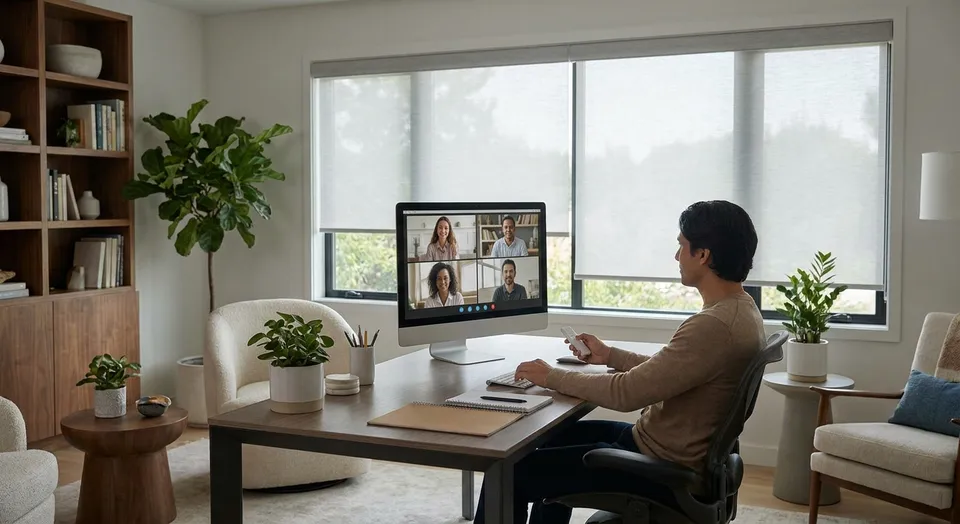
A window that blows out your webcam feed costs you credibility on every call. Motorized shades fix the glare problem without you reaching for a wand, a cord, or a blind mid-meeting, and they're the fastest home office upgrade available to remote workers across the Greater Seattle Area in 2026.
- Motorized light-filtering roller shades are the top pick for motorized shades for home offices video calls in 2026 - Buy.
- Zebra shades solve harsh west-facing glare but cost more to motorize - Consider.
- Skip blackout-only cellular shades on a single office window; they kill natural light between meetings.
- Battery motors need a recharge every 4-6 months with daily scheduling; hardwired motors skip that step.
- App-based scheduling beats voice control for consistent on-camera lighting across back-to-back calls.
Why this matters
Hybrid work didn't go away after 2023 - it settled into a routine, and that routine runs on video. A camera set to auto-exposure reads the brightest patch of a scene and drags everything else into shadow, which is exactly what happens when a south- or west-facing window sits behind your desk at 2pm.
Manual blinds don't solve this because nobody adjusts them mid-call. Motorized shades on a schedule adjust the room before the call starts, which is the whole point.
Who this is for
This guide is for anyone running video calls from a home office in the Auburn, Tacoma, Bellevue, or Seattle area who's tired of squinting into a laptop camera or looking like a silhouette on every Zoom. It's built for remote employees, consultants, and small business owners who treat their office window as a lighting problem, not a decor choice.
What to look for in motorized shades for a video-call office
Glare control that doesn't kill the room
A fabric that's too sheer lets afternoon sun wash out your face on camera; a fabric that's fully blackout turns your office into a cave between calls. Light-filtering fabric in the 3-10% openness range is the sweet spot most home offices need in 2026 - it cuts direct glare while keeping the room usable for work that isn't on camera.
Motor noise low enough for a live mic
A motor whining through your microphone mid-sentence is worse than the glare it fixed. Quiet-rated tubular motors run well under the noise floor of a typical open mic, which matters far more in a home office than in a bedroom you schedule at 7am when nobody's listening.
Scheduling that syncs to your calendar, not your mood
The entire value of motorization for a home office is that the shade moves without you thinking about it. Look for app scheduling that can run a preset before your first call and another for glare-heavy afternoon hours - not just a remote you still have to press.
Battery life vs hardwired power
Battery-powered motors typically need a recharge every 4-6 months with a daily schedule running on one shade. Hardwired motors skip that maintenance step entirely, which matters if the shade sits behind a desk you don't want to unmount every few months to swap a battery pack.
Fabric opacity matched to camera exposure
Opacity isn't a style choice here - it's a camera setting. A fabric rated too light-filtering for a bright office still lets enough light through to blow out a webcam's auto-exposure on a clear afternoon, so the fabric spec matters more for this room than for a bedroom or living room.
Get a quote for your home office
A measure and quote for motorized shades across the Auburn to Seattle service area.
Top picks for a video-call home office
Motorized light-filtering roller shades - the safe pick. One spec that matters: 3-5% openness fabric, which cuts glare without dimming the room for the rest of the workday. This is the setup most home office consults land on because it works on nearly any window shape and mounts inside or outside the frame. Buy.
Motorized zebra shades - the glare specialist. The alternating sheer-and-solid bands let you dial light in increments instead of an all-or-nothing setting, which is the fix for a west-facing office that gets brutal afternoon sun in 2026's longer summer days. It costs more to motorize than a standard roller because of the dual-fabric mechanism. Consider.
Motorized light-filtering cellular shades - the insulation bonus. The honeycomb structure adds a layer of insulation against the Pacific Northwest's cold mornings, useful if your office is a converted garage or bonus room rather than a heated core room. Skip the blackout version for a video-call office - it blocks too much daylight between calls. Consider.
Motorized roman shades - the traditional look. The soft fold reads more like a living room than a workstation, which some homeowners want if the office doubles as a guest room or is visible from the front of the house. They cost more per window and offer less precise light control than a roller shade. Skip unless the aesthetic matters more than the camera setup.
One homeowner setup that shows the pattern clearly is documented in the Covington home office motorization guide - a light-filtering roller shade on a schedule tied to morning and afternoon calls.
What to avoid
- Wand-operated shades on a big office window. If the window is wider than a standard desk run, manual operation defeats the reason you're motorizing in the first place.
- Blackout-only cellular shades as your single office shade. Great for a nursery, wrong for a room you work in 8 hours a day between calls.
- Cheap plug-in motors with no scheduling app. A motor that only responds to a remote in your hand hasn't solved the problem - you're still the one who has to remember to adjust it before every call.
Verdict comparison
| Shade type | Glare control | Motor noise | Best for |
|---|---|---|---|
| Light-filtering roller | Strong, even | Quiet-rated | Most home offices - Buy |
| Zebra | Adjustable in bands | Quiet-rated | West-facing glare - Consider |
| Light-filtering cellular | Moderate + insulation | Quiet-rated | Converted rooms - Consider |
| Roman | Soft, less precise | Quiet-rated | Aesthetic-first offices - Skip for camera work |
FAQ
What's the best motorized shade for a home office with video calls?
Light-filtering motorized roller shades in the 3-5% openness range are the best fit for most home offices in 2026 because they cut glare without darkening the room between calls. Zebra shades are the better pick for a west-facing window with harsh afternoon sun.
Is motorized better than manual for a home office window?
Yes, for a room where you're on camera daily - motorized shades move on a schedule before your first call, while manual blinds only adjust when someone remembers to touch them. The value is in the scheduling, not the motor itself.
How much does it cost to motorize a home office shade?
Cost depends on window size, fabric, and motor type (battery vs hardwired), so get a measure and quote rather than estimating from a national average. A local consult will price the exact window, not a generic size.
Do motorized shades work during a power outage?
Battery-powered motors keep working during an outage since they don't rely on house power; hardwired motors depend on the circuit they're wired into. Battery packs typically need a recharge every 4-6 months under a daily schedule.
Can motorized shades sync with a smart home hub?
Most motorized shade systems in 2026 pair with common smart home hubs for voice control and app scheduling, though the exact integrations vary by motor brand. Confirm compatibility with your specific hub before ordering.
Are blackout shades good for a home office?
Blackout shades work for a home theater or nursery but aren't the right call for a home office - they block too much daylight for the hours you're not on camera. Light-filtering fabric is the better match for a room you work in all day.
What openness percentage is best for reducing glare on camera?
Fabric in the 3-10% openness range cuts direct glare while still letting enough daylight through to avoid a dim, artificial-looking video feed. Openness above 10% often still lets in enough afternoon sun to blow out a webcam's exposure.
Do motorized shades reduce noise from a live microphone?
Quiet-rated tubular motors run well under the noise floor most open mics pick up, so a scheduled move before a call won't register on the recording. Cheaper motors without a quiet rating can produce an audible whine.
One last thing
The detail most homeowners miss is scheduling two presets, not one - a morning preset for the first call and a second, tighter preset for peak afternoon glare, rather than a single setting that compromises on both. That's the difference between a shade that looks good and one that actually keeps your camera exposure consistent across an 8-hour workday in 2026.