
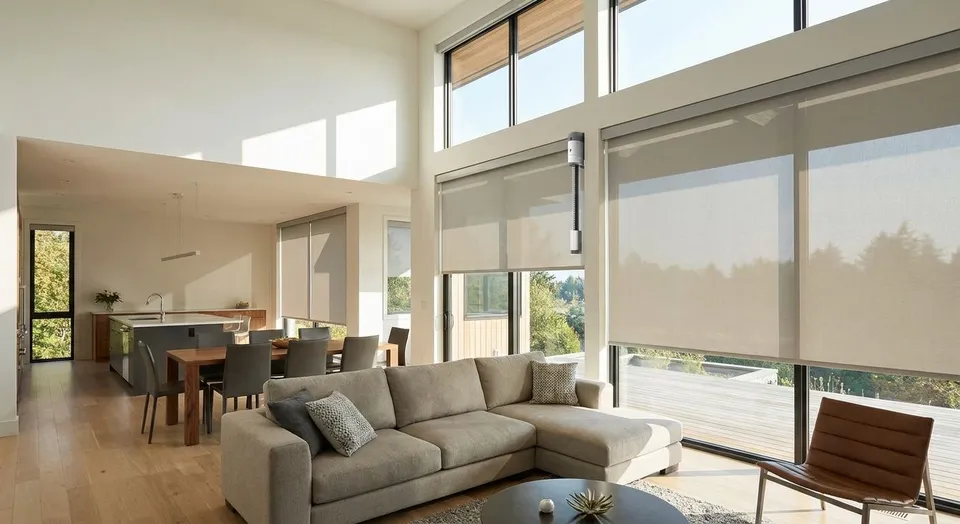
Open-concept great rooms in Auburn, Renton, and Bellevue homes often stack 10 to 16 feet of glass across one wall, and motorized shades are the only practical way to control light and privacy across that much window without a stepladder circus every evening.
- Motorized shades for open-concept great rooms need quiet motors and zone grouping, not just a remote. Buy quiet, zone-capable roller shades.
- Cellular shades handle vaulted clerestory glass; dual-layered zebra shades win for sightline flexibility between kitchen and living room.
- Skip battery packs on windows above 12 feet. Recharge access is the real cost, not the fabric.
- Rainier Blinds groups windows by zone through a smart hub so kitchen, dining, and living glass move on one schedule in 2026.
Why this matters
A great room isn't three rooms with a shared ceiling. It's one acoustic and visual space, and shades that would be fine in a closed bedroom become a problem here. A motor that hums is audible from the kitchen island. A shade that doesn't match its neighbor across an open sightline looks like an afterthought. And a window 14 feet up needs a lift that doesn't require a ladder every time the battery dies.
Homeowners across South King County and the Eastside are replacing corded blinds and mismatched panels with motorized shades precisely because open floor plans expose every inconsistency. Rainier Blinds measures and installs these systems with its own crew, not a subcontractor, which matters when you're coordinating five or six windows on one control zone.
Who this is for
This guide is for homeowners with an open kitchen-living-dining layout, ceilings above 9 feet, and at least one wall of glass wider than 8 feet, sliders, picture windows, or clerestory glass near a vaulted ceiling. You already know manual wands don't work at that height, and you want one system, not five separate remotes, to run light and privacy across the whole room.
What to look for in motorized shades for open-concept great rooms
Motor noise rating, not just motor brand
A motor rated in the 35-45 dB range runs quiet enough to disappear into an open room; anything louder gets noticed from 20 feet away during a movie or a dinner conversation. Ask for the decibel spec before you ask about the remote app. It's the detail that separates a shade you forget about from one you notice every evening.
Zone grouping through one hub
Great rooms usually have windows on two or three walls that need to move together, morning sun on the kitchen side, afternoon glare on the living room slider. A shade system that groups by zone through a smart home hub lets one tap or one schedule cover the whole room instead of six individual remotes.
Consistent fabric opacity across window shapes
Picture windows, sliders, and clerestory glass rarely share the same dimensions, but they need to read as one system when they're all visible from the same couch. Matching opacity and fabric weave across shapes keeps the room from looking like it was furnished in phases.
Battery runtime and recharge access for tall windows
A battery-powered lift on a 14-foot window sounds convenient until the battery needs recharging and there's no easy access without scaffolding. Hardwired or long-cycle battery systems matter more here than in a standard bedroom window, where a ladder solves the problem in five minutes.
Layering compatibility with drapery
Many great rooms pair a functional shade with a drapery panel for texture and sound dampening, open rooms carry noise, and fabric on the walls helps. Confirm the motorized shade's headrail can sit behind a drapery track without adding bulk to the window.
Top picks for great room windows
Motorized roller shades for the wall of glass: the safe pick. A sub-40 dB motor and a single continuous fabric run across an 8-to-12-foot span keep the whole wall reading as one surface instead of a row of separate shades. This is the starting point for most large picture windows in a great room, and it's the easiest to zone-group later. Buy.
Motorized cellular shades for vaulted clerestory windows, the specialist for high glass. Cellular construction adds insulation value that matters on a 14-to-16-foot mount where heat loss through single-pane clerestory glass is worse than at eye level, and a hardwired motor removes the recharge-access problem entirely. Best suited to vaulted living room windows where a ladder isn't a realistic maintenance plan. Buy.
Dual-layered zebra shades for the kitchen-to-living sightline, the light-control specialist. Alternating sheer and opaque bands let you dial privacy and glare independently on the window that sits between the kitchen and the seating area, which is the window everyone in an open floor plan complains about first. Consider.
Custom drapery layered over motorized shades: the finishing layer. Drapery adds sound dampening that a shade alone can't, which matters in a room with hard floors and a 14-foot ceiling bouncing sound around. It's a second purchase, not a replacement for the shade, so budget for both if the room needs it. Consider.
Outdoor motorized shades on adjoining patio sliders, the wildcard. Steel wire and zipper-track systems handle wind loads that a standard indoor shade can't, and they extend the same control zone onto a covered patio that opens straight into the great room. Skip it if the patio door rarely opens; buy it if the space functions as a fourth room of the house. Consider.
Get a quote for great room shades
Rainier Blinds measures and installs motorized shades across the Greater Seattle Area.
What to avoid
- Corded pulls across a wide expanse. A continuous cord loop on an 8-foot-plus shade is a reach hazard and a visual clutter point in a room designed to feel open, motorized eliminates both problems.
- Battery packs on windows you can't reach without a ladder. The shade fabric is rarely the failure point; the recharge cycle is. Hardwire or choose a long-cycle system on anything above 10 feet.
- Mismatched fabric across window shapes. Ordering each window separately because the shapes differ leads to a room where three shades look like three different projects instead of one design decision.
“If you can hear the motor from the kitchen island, it's the wrong motor for an open floor plan.”
Verdict comparison
| Pick | Best for | Motor type | Verdict |
|---|---|---|---|
| Motorized roller shades | Wall-of-glass windows | Hardwired or long-cycle | Buy |
| Motorized cellular shades | Vaulted clerestory glass | Hardwired | Buy |
| Dual-layered zebra shades | Kitchen-to-living sightline | Battery or hardwired | Consider |
| Layered drapery + shade | Sound dampening | N/A (paired with shade) | Consider |
| Outdoor motorized shades | Adjoining patio sliders | Weather-rated hardwired | Consider |
FAQ
What's the best motorized shade for open-concept great rooms in 2026?
Motorized roller shades with a sub-40 dB motor are the best starting point for wide great room windows in 2026, since a quiet motor and continuous fabric run keep the wall reading as one surface. Vaulted clerestory glass usually calls for motorized cellular shades instead.
Are motorized shades worth it for a great room over manual shades?
Yes, once a window is wider than 8 feet or mounted above 9 feet, manual wands and cords become impractical to reach safely. Motorized shades also let you group multiple great room windows onto one control zone instead of operating each separately.
Can motorized shades connect to a smart home hub?
Most motorized shade systems installed in 2026 pair with a smart home hub so a single schedule or voice command controls every window in the zone. That's the detail that matters most in a great room, where kitchen, dining, and living windows usually need to move together.
How loud are motorized shade motors?
Quality motors run in the 35-45 dB range, quiet enough to disappear in an open room with hard floors and high ceilings. A louder motor becomes noticeable across an open floor plan in a way it wouldn't in a closed bedroom.
Do battery-powered shades work on tall great room windows?
Battery shades work but recharging access becomes the real issue on windows above 10 to 12 feet, since reaching the battery pack usually means a ladder. Hardwired motors remove that maintenance problem entirely on vaulted or clerestory glass.
Should I layer drapery over motorized shades in a great room?
Layering drapery over a motorized shade adds sound dampening that helps in a room with hard floors and tall ceilings, where noise carries more than in a closed room. It's a separate purchase, not a substitute for the shade's light and privacy control.
What size window needs motorized instead of manual shades?
Anything wider than 8 feet or mounted above roughly 9 feet is a strong candidate for motorized instead of manual, since corded pulls become both a reach hazard and a visual clutter point at that scale. Great room walls of glass almost always fall into this range.
Can outdoor motorized shades extend a great room onto a patio?
Steel wire and zipper-track outdoor shades handle wind loads that indoor shades can't and can run on the same control zone as the interior windows. This makes sense when a covered patio functions as an extension of the great room rather than a rarely used space.
One last thing
The detail most homeowners skip is testing the motor sound before installation, a showroom sample sounds different in a room with hard floors and a 14-foot ceiling than it does in a quiet office. Ask to hear a motor run in a space with similar acoustics before committing to a full great room order.