
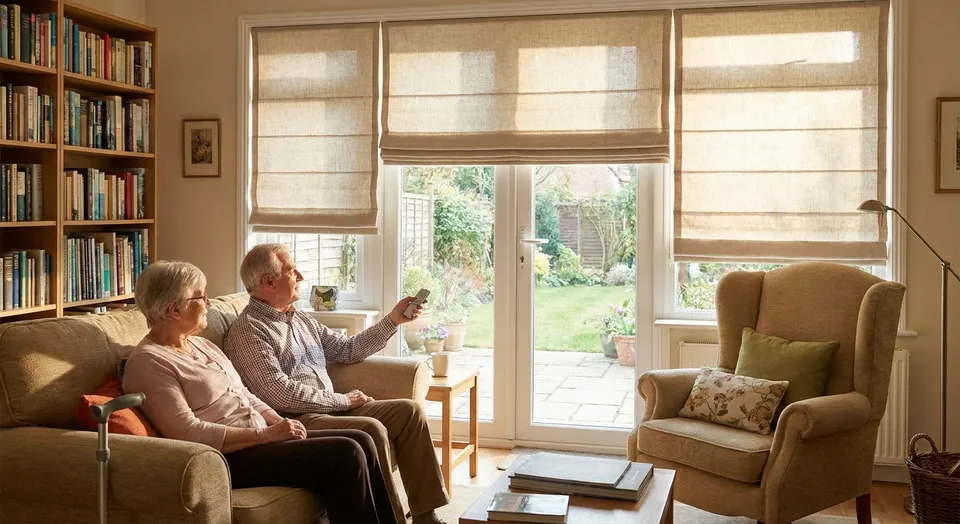
Aging in place only works if the house adapts with you. And cords, blinds wands, and step-stools are the first things that need to go. This guide breaks down what actually matters when you're choosing motorized shades for aging in place, and which setups hold up for real households in 2026.
- DC-motorized roller shades with a wall switch and remote are the safest everyday pick for motorized shades for aging in place in 2026.
- Hardwired motorized cellular shades remove battery swaps entirely, the right call for anyone who can't climb a ladder.
- Skip cord-lift shades and app-only smart shades with no physical remote; both create hazards or dead ends during a WiFi outage.
- Rainier Blinds installs and programs motorized shades across the Greater Seattle Area, so the crew that measures is the crew that fixes it later.
Why This Matters
Falls and reach-related injuries are two of the most common reasons families start looking at motorized shades for aging in place instead of standard cord-lift blinds. A shade you pull down by hand requires grip strength, balance, and often a step onto a stool for tall windows, three things that get harder with age or after surgery.
Motorized shades remove the physical task entirely. A remote, a wall switch, or a voice command does the work a hand and a ladder used to do. That's not a luxury upgrade in 2026, for a lot of households it's the difference between staying in a home safely and needing to modify it further.
Who This Is For
This guide is for adult children researching options for a parent's house, homeowners planning ahead after a diagnosis or surgery, and anyone converting a spare room into an in-law suite where a family member will live independently. It's also for homeowners in their 60s and 70s who are done climbing on a step-stool to adjust a cord every morning.
It is not for renters looking for a temporary fix or anyone who just wants a smart-home gadget for the sake of it. The criteria below are built around safety and reliability, not novelty.
What to Look For in Motorized Shades for Aging in Place
One-touch or voice operation
The whole point is removing reach and grip from the equation. A shade that still needs two hands on a wand to fine-tune isn't solving the problem. Look for a single button, a voice command, or a scheduled auto-close that needs zero physical effort.
Quiet motor noise
Motors that run above roughly 45 decibels are noticeable during a nap or a quiet evening, and that matters more in a bedroom used for rest during recovery. Ask about the decibel rating before you buy, not after installation.
Battery life or hardwired power
Battery-powered motors typically run 6 to 12 months per charge on a standard living room window before they need a recharge, which is fine if someone in the house can manage that task. If nobody wants to climb a ladder every year, hardwired motorized shades that run on line voltage remove the maintenance step completely.
Smart home and caregiver integration
A shade that syncs to a hub lets a family member check or adjust it remotely, and a scheduled open at sunrise is a small but real safety cue for someone living alone. This matters more for households already running a smart speaker or hub than for anyone starting from zero.
Cordless, snag-free design
Any loop, chain, or dangling cord is a hazard around a walker, a wheelchair, or a rollator, no exceptions. Every motorized shade recommended for aging in place should be fully cordless, not just "cordless-looking" with a hidden pull chain.
Local install and service support
A motorized shade that stops responding six months in is a bigger problem for an aging-in-place household than for anyone else, nobody wants to trial-and-error a reset code alone. Confirm whoever installs it also handles service calls in 2026, not a call center reading a manual back to you.
Top Picks for Motorized Shades for Aging in Place
The everyday pick: DC-motorized roller shades Roller shades with a quiet DC motor are the most common starting point, and for good reason. Motor noise stays under 45 decibels on most units, a wall switch handles daily use without a phone, and battery packs run roughly 6 to 12 months between charges on standard-size windows. This is the setup for a bedroom, living room, or kitchen where someone wants dead-simple, reliable operation. Verdict: Buy.
The whole-home upgrade: hardwired motorized cellular shades Cellular shades trap air in their honeycomb structure, which is widely cited for cutting window heat loss significantly in Pacific Northwest winters, a real bonus on top of the safety upgrade. Wiring them into line voltage means zero batteries to manage, ever, which matters most for households that don't want a recurring maintenance chore. It costs more upfront to run wiring during install, but it's the lowest-maintenance option long-term. Verdict: Buy for whole-home installs; Consider for a single room if budget is tight.
The caregiver-friendly pick: app-plus-remote combo shades These pair a physical remote for the resident with an app a family member can use from another location, and most support group scheduling across multiple rooms with one command. The number that matters here is redundancy: two ways to operate one shade means a dead phone battery or forgotten password never leaves someone stuck. Verdict: Consider if a caregiver or adult child wants remote visibility.
The outdoor pick: motorized zipper-track outdoor shades For a covered patio or sunroom used daily, a zipper-track outdoor shade motorized with a remote handles wind resistance far better than a manual crank, and it means nobody's outside wrestling a hand crank in bad weather. Verdict: Consider for homes with covered outdoor living space; Skip if there's no patio or porch to cover.
Get a Custom Quote for Motorized Shades
Rainier Blinds measures and installs motorized shades across the Greater Seattle Area.
What to Avoid
- Cord-lift or continuous-loop shades. They look traditional and cost less upfront, but they require grip strength and a reach that defeats the whole purpose of an aging-in-place upgrade.
- App-only smart shades with no physical remote or wall switch. If the WiFi drops or the app updates and logs everyone out, the shade becomes unusable until someone fixes the software, not the shade itself.
- Bottom-up-only mounts on tall windows. They sound convenient but often need a stretch or a bend to adjust the lower panel by hand, which is exactly the motion this whole guide is trying to eliminate.
Verdict Comparison
| Pick | Best For | Key Number | Verdict |
|---|---|---|---|
| DC-motorized roller shades | Everyday bedrooms & living rooms | Under 45 dB motor noise | Buy |
| Hardwired motorized cellular shades | Whole-home, zero-maintenance | 0 battery swaps needed | Buy |
| App-plus-remote combo shades | Caregiver oversight | 2 control methods | Consider |
| Motorized zipper-track outdoor shades | Covered patios & sunrooms | Wind-resistant tracks | Consider / Skip |
“If you have to reach up or bend down to operate a shade, it isn't an aging-in-place solution. It's a liability waiting for the wrong day.”
FAQ
What are the best motorized shades for aging in place in 2026?
DC-motorized roller shades with a wall switch and remote are the safest everyday choice for aging in place in 2026, since they need zero grip strength or reaching. Hardwired motorized cellular shades are the best whole-home option because they never need a battery swap.
Is motorized better than manual for aging-in-place homeowners?
Yes, manual shades require pulling cords or wands, which demands grip strength and balance that motorized shades remove entirely. A remote, wall switch, or voice command replaces the physical task with one button press.
How much does it cost to motorize shades for aging in place?
Cost varies by window size, number of rooms, and whether shades are hardwired or battery-powered, with hardwired whole-home installs typically running higher upfront due to wiring labor. Get a room-by-room quote before committing to one motor type across the whole house.
Do motorized shades work during a power outage?
Battery-powered motorized shades keep working during a power outage since they run on their own charge, typically 6 to 12 months between charges. Hardwired shades tied to line voltage stop responding until power is restored, which is worth weighing for anyone relying on them daily.
Are cordless shades required for aging-in-place homes?
Cordless design should be non-negotiable for aging-in-place homes because any loop or dangling cord is a snag hazard for a walker, wheelchair, or rollator. Every motorized shade in this guide is fully cordless with no hidden pull chain.
Can motorized shades connect to a smart home hub for caregivers?
Yes. Many motorized shades sync to a smart home hub so a family member can check or adjust them remotely, and some support scheduled opens as a daily safety cue. This matters most for households already running a hub or smart speaker in 2026.
How loud are motorized shade motors?
Quality DC motors run under roughly 45 decibels, which is quiet enough for a bedroom used during recovery or rest. Ask for the decibel rating before buying, since cheaper motors can run noticeably louder.
Should I choose battery or hardwired motorized shades for aging in place?
Choose hardwired if nobody in the house wants to climb a ladder to recharge a battery pack once a year; choose battery-powered if the install budget is tighter and someone can manage an annual recharge. Both options remove cords and manual pulling, which is the core safety upgrade either way.
One Last Thing
The detail most people skip: test the wall switch placement before install day, not after. A switch mounted too high defeats the whole purpose of a motorized shade for aging in place. It just relocates the reaching problem from the shade to the wall.