
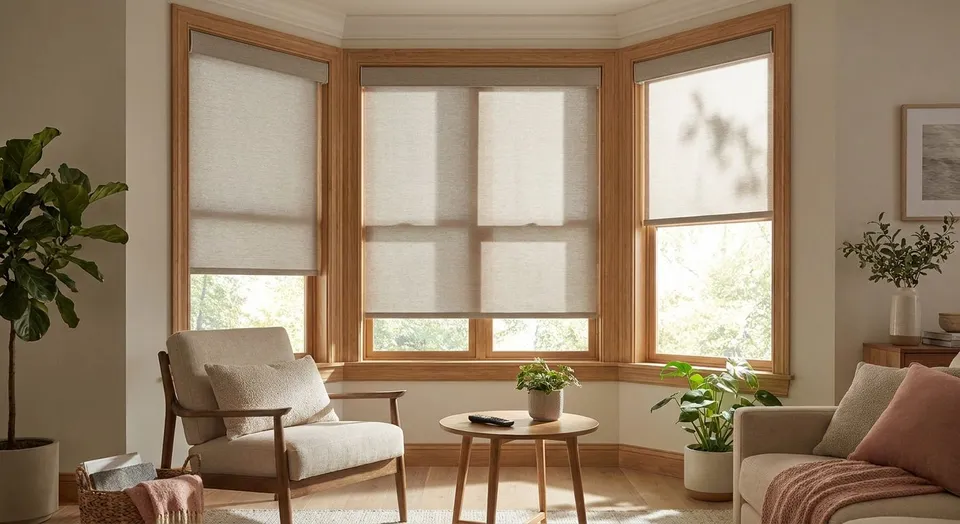
A bay window is really three windows pretending to be one, and that geometry is exactly why off-the-shelf motorized roller shades for bay windows fail so often, wrong width splits, one remote fighting three motors, batteries dying at different rates on each panel.
- Motorized roller shades for bay windows need independent motors per panel, not one motor split across three widths. Buy that setup, Skip the single-motor shortcut.
- Corner-mount brackets add 1-2 inches of returns per panel; measure each angle separately, never average them.
- Battery-powered rollers work at bay window seats without new wiring; hardwired units need an electrician if there's no outlet nearby.
- Group all three shades under one smart home scene so they open and close together, even with separate motors.
Why this matters
Bay windows sit at three angles off the wall, and each panel is almost always a different width. Treat them like one wide window and the shade either binds on the corner posts or leaves a light gap where the angles meet. Rainier Blinds measures each panel of a bay window separately for this reason, and that's the single decision that determines whether motorized roller shades for bay windows work long-term or get returned within a year.
The other issue is control. Three motorized shades that respond to three separate remotes is worse than manual chains. The fix isn't a better shade. It's grouping the motors into one scene before installation, not after.
Who this is for
This guide is for homeowners in the Greater Seattle area, Bellevue, Tacoma, Auburn, Renton and nearby cities. Who have a bay window (kitchen nook, living room, breakfast area, or a bay with a built-in seat) and want it motorized instead of manually operated. It's built for anyone who's already found that stock shades from a big-box store don't fit the angled returns, or who wants one-touch control over a window that currently needs three separate pull cords.
What to look for in motorized roller shades for bay windows
Independent motors per panel, not one shared motor
A single motor running a chain across three angled panels binds at the corners almost every time. Each panel needs its own motor sized to its own width, wired or battery-powered independently, then grouped under one control scene. This is the difference between a bay window that opens smoothly in 2026 and one that jams by 2027.
Corner-mount brackets built for the return angle
Standard brackets assume a flat wall. Bay windows need brackets rated for the specific angle where two panels meet, usually with a 1 to 2 inch return added per panel to clear the corner post. Get this measurement wrong and the shade either won't clear the frame or leaves a gap that light pours through.
Battery power vs. hardwired, based on what's actually at the window
Most bay window seats don't have an outlet built in, which makes battery-powered rollers the practical default. No electrician, no visible cord run. If there's already wiring near the window, hardwired motors skip the recharge cycle entirely. Check the outlet situation before picking a power type, not after the shades arrive.
Quiet motor operation for a room you sit in
A bay window with a seat is usually a spot people read or eat breakfast in, not a hallway you walk past. A motor that grinds or clicks loudly every time it runs is noticeable in that kind of room in a way it wouldn't be over a stairwell window. Ask specifically about motor noise rating before buying, not after installation.
App and hub compatibility if you already run smart home devices
If the house already runs a smart hub, the shade motors should join that ecosystem instead of running their own separate app. Pairing motorized shades with a smart home hub covers what to check before you commit to a motor brand, since not every motor talks to every hub the same way.
Fabric opacity matched to how the bay window is used
A bay window facing a street needs more privacy at night than one facing a backyard. Light-filtering fabric works for daytime privacy with some glow-through after dark; blackout fabric solves that but changes the daytime look of the room. Decide this before ordering fabric, because swapping it later means a second measure visit.
“Three angled panels need three motors on one scene, not one motor stretched across three angles.”
Top setups for bay windows, ranked by fit
The safe pick: battery-powered rollers, three independent motors, one remote scene. This is the setup Rainier Blinds installs most often on bay windows because it needs zero new wiring and each panel opens on its own timing without binding at the corners. Battery packs on this kind of setup are sized per panel width, so a narrower side panel isn't running the same battery load as a wider center panel. Verdict: Buy. This is the default for most bay window seats without existing outlets.
The wildcard: hardwired motors with a wall-mounted keypad. If there's already an electrical outlet near the bay window, hardwiring removes the recharge question completely. The shades just run. It costs more upfront in labor if wiring has to be run, and it's not reversible without patching drywall. Verdict: Consider, right call when wiring already exists, overkill if it doesn't.
The budget-conscious option: motorize the center panel only, leave the two side panels manual. Some homeowners only want the hardest-to-reach panel, usually the center one over a window seat. Automated, and are fine pulling a cord on the two side panels. It cuts the motor cost roughly in third compared to motorizing all three. Verdict: Consider, works if budget is tight, but the mismatch between one motorized panel and two manual ones is visible every time you use them.
The one to skip: a single continuous shade stretched across all three panels with no break at the corners. It looks like it saves money on hardware, but it can't account for the angle change at each corner post, so it either binds when it tries to raise or leaves permanent light gaps at the seams. Verdict: Skip. This is the setup that generates the most callback requests.
For the technical side of getting motors talking to each other correctly once they're installed, programming motorized window shades walks through grouping panels into one control scene so all three respond together instead of independently.
What to avoid
- Averaging the three panel widths instead of measuring each one. Bay window panels are rarely identical widths. Measure and order each one separately or the shade won't fit at least one panel.
- Choosing cellular shades for a bay window that gets a lot of view use. Cellular shades insulate well but stack thicker at the top when raised, which blocks more of the view on a bay window than a roller shade does. The tradeoffs are laid out in roller shades vs. cellular shades for South King County homes.
- Skipping the smart hub grouping step during installation. Motors set up individually and grouped later means a second visit or a DIY reconfiguration most homeowners don't want to do themselves.
Setup comparison
| Setup | Power | Corner Handling | Best For | Verdict |
|---|---|---|---|---|
| Battery, 3 independent motors | Battery pack per panel | Corner brackets per angle | No outlet near the window seat | Buy |
| Hardwired, keypad control | Existing wiring | Corner brackets per angle | Outlet already at the window | Consider |
| Center panel motorized only | Battery, single panel | N/A on manual side panels | Tight budgets | Consider |
| Continuous shade, no panel break | Single motor | Fails at corners | Nobody | Skip |
A full breakdown of measuring and fitting options specific to bay geometry is in custom window treatments for bay windows, which covers manual options too if motorizing the whole bay isn't the plan yet.
Get your bay window measured right
Rainier Blinds measures each panel separately and quotes on the spot.
FAQ
What's the best motorized roller shade setup for a bay window?
Three independent motors, one per panel, grouped under a single remote or app scene, is the setup that holds up long-term on a bay window. A single motor spanning all three panels almost always binds at the corner angles within a year or two.
Do motorized roller shades work on angled bay window panels?
Yes, as long as each panel gets its own corner-mount bracket rated for that panel's specific angle. Standard flat-wall brackets don't account for the return at a bay window corner and will leave a gap or bind the shade.
Is battery power or hardwired better for a bay window seat?
Battery power is the more common choice because most bay window seats don't have a nearby outlet, and it avoids running new wiring. Hardwired motors make more sense only when an outlet already exists near the window.
Can I motorize just the center panel of a bay window?
Yes, some homeowners motorize only the hardest-to-reach center panel and leave the two side panels manual to cut cost. The visible mismatch in how the panels operate is the main tradeoff.
Will motorized shades on a bay window work with a smart home hub?
Most current motor brands pair with major smart home hubs, but compatibility varies by brand, so check it before choosing a motor. Grouping all three bay window panels under one hub scene is what makes them open and close together.
How much wider are corner returns on a bay window shade?
Corner-mount brackets on bay window panels typically add 1 to 2 inches of return per panel to clear the angle where two panels meet. Skipping this measurement is the most common reason a bay window shade doesn't fit correctly.
Are cellular shades or roller shades better for a bay window?
Roller shades stack thinner at the top of the window, which preserves more of the view on a bay window that people look through often. Cellular shades insulate better but stack thicker, which matters more on windows used for privacy than for view.
How long do batteries last on motorized bay window shades?
Battery life depends on how often the shade cycles and the panel width the motor is driving, since a wider center panel draws more power per cycle than a narrow side panel. Maintenance guidance for keeping motorized batteries running is covered separately for anyone already running motorized shades.
One last thing
The corner brackets, not the motor brand, are what most homeowners underestimate on a bay window, a $200 motor mounted on the wrong bracket angle still won't clear the corner post. Get the panel angles measured before comparing motor options, not after.