
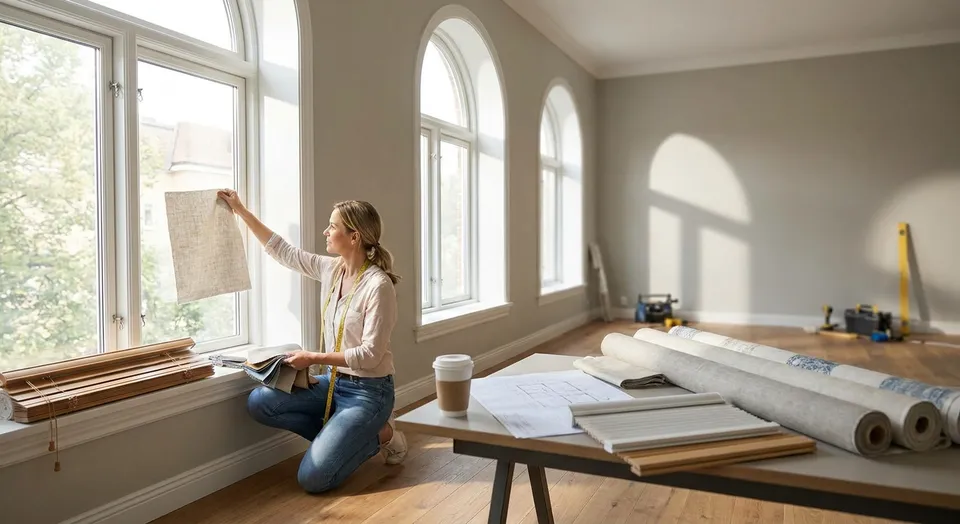
Renovations move fast, and window treatments usually land on the punch list right before drywall closes up. Which is exactly the wrong time to start guessing at mount depths and fabric weights. This guide walks through the order of operations that keeps roller shades, cellular shades, roman shades, and drapery from becoming the one line item that delays your final walkthrough.
- Measure window treatments before drywall and trim go up, not after. Inside mount needs 2 inches of depth minimum.
- Match fabric opacity to room function first: blackout for bedrooms, light-filtering for living spaces, solar for west-facing glass.
- Cellular shades add insulation value during a renovation; roller shades and zebra shades cost less and install faster.
- Rainier Blinds recommends measuring and placing your custom order the same week drywall is scheduled, with a 2026 lead time of 3-4 weeks for custom shades.
- Skip faux wood, real wood, and aluminum blinds if the goal is a clean, modern renovation look. They read dated against new finishes.
Why this matters
Window treatments are one of the last decisions in a renovation and one of the first things guests notice when the project is finished. Order too early and you risk a mismatch with cabinet stain or flooring that changes mid-project. Order too late and you're stuck with bare glass for weeks while a custom order gets built.
The bigger issue in 2026: mount depth, wiring for motorization, and window rough openings all get locked in during framing and drywall, long before most homeowners think about shades. If a contractor doesn't know you want inside-mount cellular shades or motorized roller shades with in-wall power, you'll end up retrofitting later, which costs more and looks worse.
Getting the sequence right once saves a second round of measuring, a second delivery wait, and a second install visit.
What you'll need
- A tape measure (steel, not cloth) and a helper for windows wider than 48 inches
- Final paint or stain samples for the room, or at minimum the color direction
- A copy of your renovation timeline showing drywall, trim, and final punch dates
- Rough opening dimensions from your contractor if walls or window frames are being altered
- A decision on mount type, inside mount, outside mount, or ceiling mount, for each window
- A budget range per window, since fabric and motorization both move price significantly
If any windows are getting motorized shades, you also need to know where power will run and whether a hub or smart home system is part of the renovation plan.
The steps
1. Lock your window schedule before you pick fabric
Walk the renovation with a list of every window getting a treatment, noted by room and by function, bedroom, living room, home office, sliding glass door. This schedule accomplishes one thing: it stops you from picking fabric before you know what each window actually does.
A nursery window needs blackout. A kitchen window over a sink needs something washable and light-filtering. A home office with a monitor needs glare control, not room darkening. Write the function next to each window before touching a swatch book.
Common mistake: picking one fabric for the whole house because it's simpler. It's simpler until the bedroom doesn't get dark enough and the kitchen valance won't wipe clean.
2. Measure after drywall, before trim
Final measurements for custom window treatments should happen after drywall is up and mudded but before trim and casing go on. This is the point where the window opening is true to its finished size, measuring earlier risks a quarter-inch of drywall thickness throwing off an inside mount.
For inside mount, you need a minimum of 2 inches of depth inside the frame; anything shallower forces outside mount, which changes the finished look and the hardware needed. Get this measurement in writing before placing your order.
Common mistake: measuring off old blinds or the previous window covering instead of the actual opening. Renovations often change window size even slightly, always remeasure the physical opening.
3. Match fabric to function, then to finish
Once you know what each window needs to do, match fabric type second and color third. Fabric weight and weave for custom roman shades changes both light control and how the shade folds when raised. A heavier linen blend holds crisper pleats than a light cotton blend.
For bedrooms and media rooms, blackout fabric is non-negotiable if the goal is full room darkening. For kitchens and living rooms, light-filtering roller shades or zebra shades give privacy without turning the room into a cave during the day.
Common mistake: choosing color from a small swatch under store lighting instead of against your actual paint and flooring samples in the room where the treatment will hang.
4. Decide mount type per window, not per house
Mount type for custom blinds and shades isn't a whole-house decision. It's a per-window decision based on trim style, depth, and whether you want the hardware visible. Inside mount looks cleaner and shows off nice trim. Outside mount is the fix when depth is too shallow or when you want a shade to block more light by overlapping the frame.
Bay windows, sliding glass doors, and skylights each have their own mount logic that a straight double-hung window doesn't. Sort these out room by room during the same walkthrough where you set the window schedule.
Common mistake: defaulting to outside mount everywhere because it's more forgiving of measurement error. It also adds visible hardware to walls that might otherwise look finished and clean.
5. Decide motorization before power runs, not after
If any windows are getting motorized shades, this decision has to happen before electricians close up walls. In-wall power for motorized roller shades or cellular shades is a five-minute add during rough-in and a much bigger job as a retrofit once walls are painted.
Even battery-powered motorized shades benefit from planning. You want clearance for the motor tube and a charging port location that isn't awkward to reach later.
Get your renovation windows measured
Rainier Blinds measures and quotes on the spot before drywall closes up.
6. Order with lead time built into your renovation schedule
Custom window treatments in 2026 typically run 3-4 weeks from order to delivery, depending on fabric and motorization. Build that lead time backward from your final punch date, not forward from when you happen to pick fabric.
Placing your custom order the same week drywall goes up gives most fabric and motorized orders enough runway to arrive right around trim and paint completion. Which is when you actually want treatments installed.
Common mistake: waiting until paint is dry to start the ordering process. That's 3-4 weeks too late if your contractor is on a tight closeout schedule.
7. Install after final paint, before the final walkthrough
Window treatments go up last, after paint has fully cured and flooring is done, since installers need clean walls and floor protection isn't guaranteed once shades are hung. This is also the point where any adjustments, a shade that needs recutting, a bracket that needs repositioning, are easiest to catch.
Common mistake: scheduling install the same day as final cleaning crews. Dust and debris from post-construction cleaning can get into shade mechanisms and headrails.
"If you can't measure the window opening twice before drywall goes up, you'll end up measuring it twice after."
Troubleshooting
Fabric looks different once it's up than it did on the swatch. Large expanses of fabric read lighter and less saturated than a 4-inch swatch under room lighting. Order a bigger sample or a full-size swatch before committing to a whole-house color.
Inside mount doesn't work after all. If drywall or added trim eats into your depth clearance, switch that window to outside mount rather than forcing an inside mount that won't clear the frame. This is a fast fix if caught before ordering.
Motorized shade won't pair with the new smart home hub. Confirm hub compatibility before ordering motorized units. Some hubs need a specific bridge or protocol, and pairing motorized shades with a smart home hub is far easier to troubleshoot before install than after.
Delivery lands after your final walkthrough. Push installers for an interim solution, temporary paper shades or existing treatments left up, rather than delaying the final walkthrough over window coverings.
Cellular shades feel loose in the track after install. This usually means the bracket spacing was set for the rough opening size, not the finished opening, a quick bracket adjustment on a callback resolves it.
Room still isn't dark enough with blackout shades installed. Light gap around the edges of an inside-mount shade is common; side channels or an outside-mount blackout shade with more overlap closes that gap.
Tools and resources
- How to budget for custom window treatments, set per-window budget ranges before you start picking fabric
- A laser measure or steel tape for accurate depth and width readings
- Your contractor's framing and drywall schedule, in writing
- Paint and flooring samples for the specific room being measured
- A written list of mount type and function per window
What to do next
Once your window schedule and budget are set, the next decision is usually motorization versus manual operation for larger rooms or hard-to-reach windows. Pairing motorized shades with a smart home hub is worth reading before you finalize which windows get powered treatments, since retrofitting power after walls close is the single most avoidable cost in a renovation.
FAQ
When should I measure for window treatments during a renovation?
Measure after drywall is up and mudded but before trim goes on. Measuring earlier risks the opening changing size once finish materials are added.
How far in advance should I order custom window treatments for a renovation?
Place your custom order 3-4 weeks before your target install date in 2026, timed to land around final paint and trim completion. Motorized orders sit at the longer end of that range.
What window treatments work best for a renovated bedroom?
Blackout cellular shades or blackout roller shades give full room darkening. Add drapery over the shade for a layered look if the room calls for more texture.
Should I use inside mount or outside mount after a renovation?
Use inside mount when you have at least 2 inches of frame depth and want to show off new trim. Use outside mount when depth is shallow or you want more light blockage.
Do motorized shades need special wiring during a renovation?
Hardwired motorized shades need power run to the window during rough-in, before walls close. Battery-powered motorized shades skip wiring but still need bracket clearance planned early.
Are wood or aluminum blinds a good fit for a renovation?
They're common but not part of every renovation's design direction. Roller shades, cellular shades, and roman shades give a cleaner, more current look against new trim and flooring in 2026.
How do I pick window treatment fabric for a whole-house renovation?
Match fabric to each room's function first, blackout for bedrooms, light-filtering for living areas, solar for west-facing glass. Then choose color against your actual paint and flooring samples.
What's the biggest mistake homeowners make ordering window treatments during a renovation?
Waiting until paint is dry to start the ordering process. Custom lead times of 3-4 weeks in 2026 mean that timing routinely delays the final walkthrough.
One last thing
The window treatment decision homeowners regret most isn't fabric or color. It's skipping the motorization wiring question during framing. Rainier Blinds sees this constantly on renovation projects: a homeowner decides mid-project they want motorized shades, but the wall is already closed and the only options left are battery power or an exposed conduit run. Answer the motorization question during the same walkthrough where you set your window schedule, and you avoid the one fix that's genuinely hard to undo.