
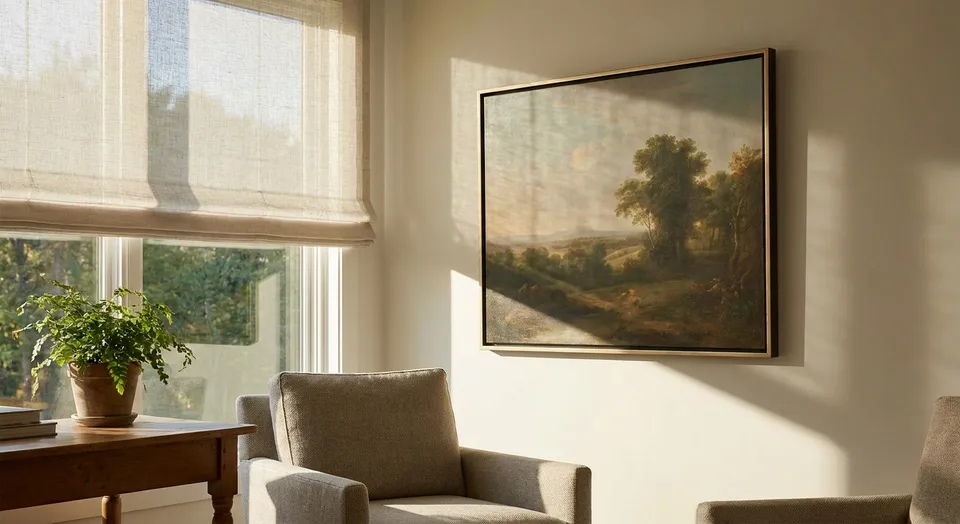
Direct sun through a window can fade a watercolor's blues to gray in under two years, and most homeowners in the Greater Seattle Area never see it coming until the damage is done.
- UV light causes roughly 40% of fading damage to artwork, with visible light and heat responsible for the rest.
- Solar shades that block 95-99% UV protect artwork without blacking out the room, and are the top fix for how to protect artwork from sun fade with window shades in 2026.
- West-facing rooms need shades closed by early afternoon in summer 2026 - that's when UV intensity peaks in South King County.
- Cellular and roller shades both cut glare, but only tightly woven or UV-rated fabrics stop the fading wavelengths that matter.
- Rotating pieces and keeping artwork 3+ feet from direct glass exposure adds a second layer of defense shades alone can't provide.
Why this matters
Fading isn't caused by one thing - it's a stack of three. Conservation research consistently attributes close to 40% of fading damage to ultraviolet light, another 25% to visible light, and the remaining share to heat and humidity working on pigment and paper over time. Ordinary window glass blocks most UVB but lets UVA straight through, which is exactly the range that bleaches ink, watercolor, and dye-based prints.
If you've got original art, limited-edition prints, or family photographs hanging anywhere near a window, window treatments for home art and painting studios matter as much as the frame and the glass you chose. A $40 print in direct afternoon sun for three summers in 2026 can lose more color depth than a $4,000 piece hung on an interior wall for a decade.
South King County homes get long, low-angle summer sun that pushes straight through south- and west-facing glass for hours at a stretch. That's the exposure pattern that does the most damage, and it's fixable with the right shade choice - not by covering every window in blackout fabric.
What you'll need
- A UV index reading or rough sense of which walls get direct afternoon sun (south and west are the priority)
- Measurements for each window near displayed artwork (width and height, inside or outside mount)
- A target UV-blocking percentage in mind - look for fabrics rated 95% or higher
- A decision on opacity: sheer/solar fabric for daytime rooms, room-darkening for galleries or home theaters
- A motorized or manual operating plan, since shades only protect artwork when they're actually closed during peak hours
- Optional: UV-filtering window film as a second layer of defense on top of shades
The steps
1. Map which windows are actually doing the damage
Not every window in the house needs the same fix. Stand in each room at midday and again in the late afternoon and note where direct sun lands on a wall or piece of art - that's your priority list. West-facing rooms are almost always worse than east-facing ones because afternoon sun is more intense and lasts longer.
Common mistake: treating every window the same. A north-facing hallway with a print doesn't need the same UV-blocking spec as a west-facing living room with a gallery wall.
2. Pick a fabric rated for UV blocking, not just light filtering
Opacity and UV protection aren't the same spec. A fabric can filter 80% of visible light and still let damaging UVA through if it's not treated or tightly woven. When choosing fabric for custom roman shades, ask specifically for the UV-blocking percentage, not just the openness factor.
Aim for 95% UV block minimum on any window near displayed artwork. Anything under 90% still lets meaningful fading light through over a few years.
3. Match shade type to the room's actual use
West-facing rooms with artwork are the classic case for solar shades for west-facing windows - they cut glare and UV while keeping the view and daylight most homeowners want in a living room or office. If the room is a dedicated gallery space or home theater, blackout fabric makes more sense since there's no view to preserve.
Expected outcome: a solar shade rated 95%+ UV block will drop visible fading risk on a wall of art from "noticeable in 12-18 months" to "barely detectable after several years" in a typical South King County home.
4. Compare against furniture and flooring fade data before you commit
Artwork isn't the only thing at risk in a sunlit room - hardwood floors, upholstery, and rugs fade on the same timeline. Homeowners who've already solved solar shades for preventing furniture and flooring fade in a room usually find the same fabric spec protects the art on the walls too, since it's the same UV and visible-light exposure doing the damage.
Common mistake: buying a decorative shade for looks and assuming any coverage equals protection. A sheer fabric with no UV rating can still let 60-70% of damaging light through even when it looks like it's blocking the sun.
5. Position artwork out of the direct light path where possible
Shades handle the window - positioning handles the rest. Keep valuable pieces at least 3 feet back from unshaded glass edges and off any wall that catches direct morning or afternoon beams even with shades partly open.
This step costs nothing and adds a real second layer of protection, especially in rooms where shades stay open most of the day for the view.
6. Set a closing schedule for peak UV hours
A shade only protects artwork when it's closed. In summer 2026, that typically means west-facing shades down from roughly 1pm to 6pm, and south-facing shades down through the midday stretch. Motorized shades solve the discipline problem - schedule them to close automatically during peak hours whether anyone's home or not.
Common mistake: buying the right fabric, then leaving shades open all day because the room needs light. Split the difference with a solar fabric that still admits daylight while blocking the UV band.
7. Layer with UV window film if the room gets extreme exposure
For rooms with south- and west-facing glass, or floor-to-ceiling windows with no shade coverage option, adding UV-filtering film to the glass itself stacks a second block on top of the shade. This matters most in sunrooms, converted porches, and rooms with skylights where shade coverage alone can't reach every angle of exposure.
8. Rotate and monitor pieces annually
Even with 95%+ UV-blocking shades, some fading risk remains from visible light and heat. Rotate valuable prints and photographs to interior walls every year or two, and photograph color-critical pieces periodically so you can spot early fading before it's obvious to the eye.
Get shades sized for your artwork walls
Rainier Blinds measures and installs UV-blocking shades across the Greater Seattle Area.
Troubleshooting
Shade fabric looks tight but artwork is still fading. The fabric is likely rated for light filtering, not UV blocking - check the spec sheet for a UV percentage, not just an opacity percentage. Swap to a fabric explicitly rated 95%+ UV block.
Motorized shades aren't closing on schedule. Check the hub connection and battery level first - a dead or low battery is the most common cause of a missed schedule. Verify the schedule is set to local time, not a default time zone.
Room feels too dark once UV-blocking shades are installed. You likely chose a room-darkening fabric when a solar screen fabric would have done the job. Solar fabrics in the 3-5% openness range block most UV while still admitting usable daylight.
Fading is happening on a wall that doesn't get direct sun. Reflected light off a light-colored floor or an adjacent window can still deliver UV exposure indirectly. Check for a second window in the room contributing bounced light before assuming the shade failed.
Artwork near a skylight keeps fading despite window shades. Skylights need their own coverage - a room's wall shades don't protect against overhead exposure. Skylight-specific shades close that gap.
Tools and resources
- UV-blocking solar shade fabric rated 95% or higher
- A basic UV index app or weather service to track peak exposure hours by season
- Fabric guidance for custom roman shades if you're comparing woven options beyond roller and solar shades
- A tape measure and notepad for mapping which windows need priority coverage
- Motorized shade scheduling app if you're automating peak-hour closing
What to do next
Once the priority windows are identified and the fabric spec is set, the next decision is shade type for the rest of the room - roller shades vs. cellular shades covers how the two compare on light control, insulation, and cost for South King County homes, which matters if you're outfitting more than one room at once.
FAQ
What percentage of UV do shades need to block to protect artwork?
Shades should block at least 95% UV to meaningfully slow fading on displayed artwork. Fabrics rated below 90% still let enough UVA through to cause visible fading within a few years in a sunlit room.
Do blackout shades protect artwork better than solar shades?
Blackout shades block more light overall, but solar shades rated for high UV blocking protect artwork just as well while still letting daylight into the room. Blackout makes sense for dedicated gallery spaces with no need for a view.
Is window glass enough to protect artwork from sun fade?
No, ordinary window glass blocks most UVB but lets UVA through, and UVA is a major contributor to fading. UV-blocking shades or window film close that gap.
How much does it cost to add UV-blocking shades in 2026?
Cost depends on window size, fabric choice, and whether you go motorized or manual - get a measured quote for your specific windows rather than estimating from a national average. Solar and roller fabrics generally cost less than motorized cellular options.
Can I protect artwork with curtains instead of shades?
Curtains can help if they're UV-rated and kept closed during peak sun hours, but shades give more consistent coverage since they sit directly against the window frame. Layering shades with drapery adds the most protection.
How often should I rotate artwork to prevent fading?
Rotate valuable or color-critical pieces to interior walls every one to two years even with UV-blocking shades installed. This limits cumulative exposure from the visible light and heat that shades don't fully block.
Do west-facing rooms need different shades than south-facing rooms?
West-facing rooms get more intense, longer-duration afternoon sun and generally need the same or higher UV-blocking rating as south-facing rooms. Closing schedules differ, though, since west-facing peak exposure hits later in the day.
Will UV-blocking shades change the color of light in the room?
Most UV-blocking solar fabrics have minimal visible color impact and are chosen in neutral tones specifically to avoid altering room light. Room-darkening blackout fabrics have more visible impact since they cut most light entering the space.
One last thing
Glass alone stops far less UV than most homeowners assume - it's the shade fabric's UV rating, not the window itself, doing the real work, which is why two identical-looking rooms in the same house can fade at completely different rates depending on what's covering the glass.