
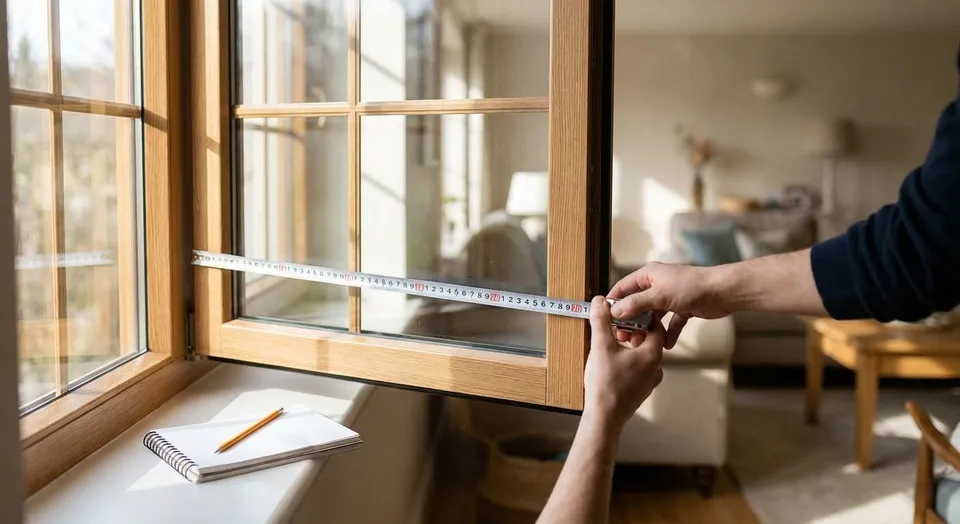
Measuring windows for custom blinds in 2026 comes down to two decisions: mount type and precision to the nearest eighth of an inch. Get those two right and any roller shade, cellular shade, or roman shade fitted with the correct mount type will hang flush and operate smoothly the first time. Get either one wrong and you end up with a shade that binds, gaps at the sides, or won't sit inside the frame at all.
- Knowing how to measure windows for blinds starts with three width measurements per window, not one.
- Inside mount needs at least 1.5 inches of frame depth; outside mount needs none but adds 3-4 inches of overlap per side.
- Round inside mount width down and outside mount width up - never round to the nearest whole inch.
- Rainier Blinds re-measures every window on-site in the Greater Seattle Area before cutting any custom shade.
Why This Matters
A quarter-inch measuring error sounds trivial until the shade arrives. Inside mount shades that run 1/4 inch too wide won't drop into the frame at all - the fabricator has already cut the headrail to that number and there's no adjusting it on-site. Outside mount shades that run 1/4 inch short leave a visible gap of light down both sides, which defeats the point of blackout or light-filtering fabric.
Custom shades are cut once. Big-box retailers and online blind sellers rely on the homeowner's numbers, which is why return rates on self-measured orders run high. A professional measure removes that risk entirely, but if you're measuring yourself in 2026, the steps below are the same ones a trained installer follows.
How to Measure Windows for Blinds
Every window gets three width measurements and one height measurement, taken with a steel tape measure - not cloth, which stretches and throws off readings by a sixteenth of an inch or more.
- Measure width at the top, middle, and bottom of the window opening (or frame, for outside mount).
- Measure height at the left, center, and right of the opening.
- Record every measurement to the nearest 1/8 inch. No rounding to the nearest 1/4 or 1/2 inch - older Pacific Northwest homes are rarely square, and the difference between the widest and narrowest reading is often 1/4 to 1/2 inch.
- Check depth at the narrowest point where hardware might sit - hinges, cranks, or existing blind brackets - to confirm the mount type will actually clear.
| Inside Mount | Outside Mount | |
|---|---|---|
| Depth needed | 1.5 inches minimum | None |
| Width to use | Narrowest of 3 readings | Widest of 3 readings, plus 3-4" overlap |
| Light gap | Small, along the frame edges | Eliminated, shade covers the frame |
| Best for | Clean, recessed look, deep frames | Shallow frames, uneven openings, full blackout |
Inside Mount Measurements: 1.5 Inches of Depth Minimum
Inside mount sits within the window frame, so the fabricator needs the narrowest of your three width readings - if the fabricator cut to the widest number, the headrail wouldn't fit into the tightest part of the frame. Depth matters just as much as width: cellular shades and roman shades typically need 1.5 to 2.5 inches of clear depth to mount and operate without hitting the glass or window crank. Measure depth in at least two spots, since window frames rarely hold a consistent depth across their full width.
Skip inside mount entirely if depth measures under 1.5 inches anywhere along the frame - outside mount is the only option at that point, regardless of how the window looks.
Outside Mount Measurements: Add 3 to 4 Inches of Overlap
Outside mount hangs on the wall or trim above and around the window, so use the widest of your three width readings, then add 3 to 4 inches total - roughly 1.5 to 2 inches per side - so the shade overlaps the frame instead of just matching it edge to edge. Height gets 3 to 4 inches added at the top for mounting hardware and headrail clearance, plus enough at the bottom to reach the sill or below it if blackout coverage matters.
Outside mount is the default choice for uneven or bowed frames, sliding glass doors, and large picture windows where inside mount depth simply isn't available.
Why Your Measurements Might Vary
No two windows in the same house measure identically, even when they look like a matched pair. A few reasons why:
- Homes built before the 2000s settle out of square over time, which is why top and bottom width readings on the same window can differ by 1/4 inch or more.
- Drywall and trim depth vary by room, especially in additions or remodeled spaces, which changes available mounting depth.
- Window manufacturer tolerances mean two "identical" windows from the same builder can differ by an eighth of an inch.
- Existing hardware - old blind brackets, security locks, casement cranks - can eat into usable mounting depth without being obvious at a glance.
- Multiple windows in one room almost always need individual measurements rather than one number applied to all of them.
- Light gap tolerance is a personal preference, not a measuring error - some homeowners accept a small edge gap on inside mount for the cleaner look; others want outside mount specifically to eliminate it.
Should I Measure for Inside Mount or Outside Mount?
Inside mount works when the frame has at least 1.5 inches of clear depth and you want the shade to sit flush with the wall. Outside mount is the better call when depth runs under 1.5 inches, the frame is visibly uneven, or you need the shade to fully block light with no edge gap. Skylight shades and most sliding glass door installations default to outside mount for exactly that reason.
How Do I Measure a Bay Window or an Arched Window?
Bay windows get measured as three or more separate window sections, each with its own width, height, and depth readings, because the angles between panels almost never match. Bay window treatments typically need a mix of mount types across the same bay - the center panel might take inside mount while angled side panels need outside mount to clear the trim. Arched and specialty-shaped windows require a template, not a tape measure, since the fabricator needs the exact curve traced rather than a straight-line dimension.
Can I Measure My Own Windows, or Do I Need a Professional?
You can measure your own windows for a rough budget estimate, but custom shades cut from a self-measurement carry the highest return and refit rate of any order type. Rainier Blinds sends a measurer to every home in the Greater Seattle Area before cutting a single custom blind or shade, which catches the out-of-square frames and depth obstructions a first-time measurer usually misses. If the numbers are close but you're not confident in the depth reading or mount decision, that's the moment to get a second set of eyes on it rather than guess and order.
Get Your Windows Measured Right
Rainier Blinds measures on-site before cutting any custom shade or blind.
FAQ
How much should I add for outside mount blinds?
Add 3 to 4 inches total to the widest width reading for outside mount blinds, split roughly 1.5 to 2 inches per side. Add 3 to 4 inches at the top for hardware clearance as well.
What's the minimum depth needed for inside mount shades?
Inside mount shades need 1.5 inches of clear frame depth at minimum, though 2 to 2.5 inches is safer for cellular and roman shades. Measure depth at two or more spots since it often varies across the frame.
Should I measure to the nearest inch or the nearest eighth-inch?
Measure to the nearest 1/8 inch, never rounding to the nearest whole or half inch. Custom shades are cut to the exact number submitted, so rounding error becomes a fit problem after the fact.
Why do my top, middle, and bottom width measurements differ?
Most window frames are not perfectly square, especially in homes built before the 2000s, so width readings commonly vary by 1/4 inch or more across the opening. For inside mount, the fabricator uses the narrowest of the three readings.
Is outside mount better for blocking light?
Outside mount blocks more light than inside mount because the shade overlaps the frame by 3 to 4 inches instead of sitting flush inside it. That overlap is why bedrooms wanting full blackout coverage typically go with outside mount in 2026.
Can one window need both inside and outside mount?
Yes, bay windows and multi-panel windows often mix mount types across the same opening. The center panel might take inside mount while angled side panels switch to outside mount to clear uneven trim.
Do sliding glass doors get measured the same way as windows?
Sliding glass doors use the same width, height, and depth steps but almost always end up as outside mount due to shallow or nonexistent frame depth. Height measurements also need extra clearance at the bottom for door operation.
What tools do I need to measure for custom blinds?
A steel tape measure is the only required tool - cloth or fabric tape measures stretch and introduce error of a sixteenth of an inch or more. A notepad to record all three width readings per window prevents mixing up numbers between windows.
One Last Thing
The single most common measuring mistake in 2026 isn't a math error - it's measuring only one spot per window instead of three. A frame that reads 35 7/8 inches at the top and 35 1/2 inches at the bottom isn't unusual in older South King County homes, and the 3/8-inch difference is exactly the margin that separates a smooth-operating inside mount shade from one that binds against the frame every time it's raised.