
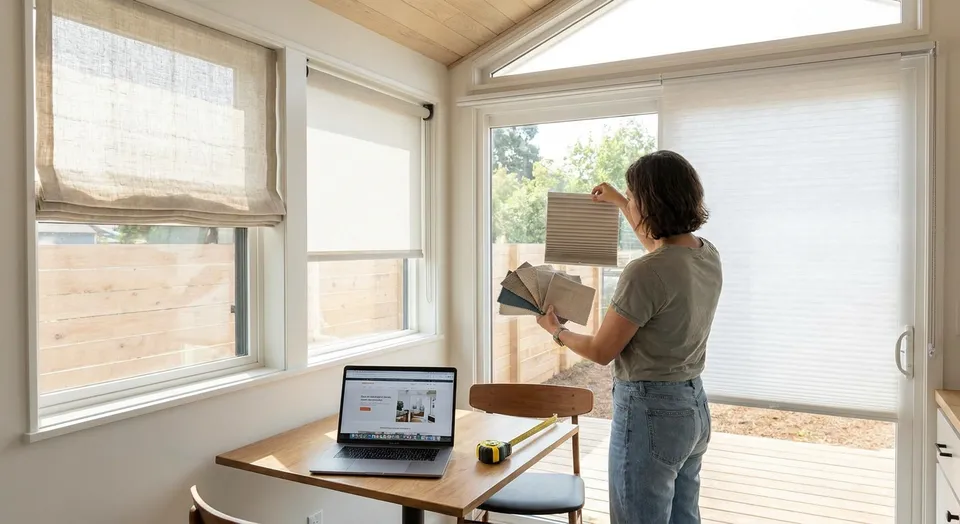
An ADU is a different animal from the main house: less square footage, often shared plumbing or utility walls, and windows that don't always face the same direction as the primary residence. Getting window treatments right here means solving for privacy, insulation, and a tighter budget all at once, not just matching whatever's on the main house.
- Cordless cellular shades are the default answer for how to choose window treatments for an ADU. They add insulation and eliminate code-hazard cords.
- Skip corded lift systems in a studio ADU; the fabric savings don't offset the fall-hazard risk in a small footprint.
- Zebra shades cost less to run than motorized roller shades when the ADU has no dedicated smart-home circuit.
- Garage-conversion ADUs need insulated cellular shades first, decorative layers second. The shell alone won't hold heat in a Pacific Northwest winter.
Why this matters
ADUs in Washington got a lot more common after zoning reform loosened the rules on backyard cottages, garage conversions, and in-law suites. Auburn, Renton, Kent, and the rest of South King County have seen a steady stream of new units since, and most of them get finished with whatever window covering was cheapest or fastest, usually the wrong call.
An ADU window gets more privacy pressure per square foot than a main-house window. Tenants and family members are closer to fence lines, neighboring decks, and shared driveways. At the same time, ADUs run on tighter HVAC budgets, many rely on a single mini-split or wall unit, so a window treatment that adds real insulation isn't optional, it's part of the heating bill.
What you'll need
- Exact window measurements for every unit, width and height, inside mount and outside mount, taken in three spots per window since ADU framing settles differently than a main house
- A decision on mount type before you shop fabric, since the right mount type for custom blinds changes which products even fit
- A power plan if you're considering motorized shades. Know whether the ADU has a spare outlet near each window or if you're running on battery packs
- A realistic number for how many windows need blackout versus light-filtering fabric
- A budget ceiling set before you start browsing, using something like the guide to budgeting for custom window treatments as your baseline
The steps
1. Confirm the ADU type and its light exposure
A garage-conversion ADU, a backyard cottage, and an in-law suite carved out of a basement all have different light and heat problems. Walk each window at two different times of day, morning and late afternoon, and note which ones get direct sun.
This matters because south- and west-facing ADU windows in the Puget Sound area still get enough summer sun to overheat a small unit fast, even with our cloud cover most of the year. Skip this step and you'll end up buying blackout everywhere when only two windows actually needed it.
Common mistake: assuming every window in a small unit needs the same treatment. ADUs are compact enough that a bedroom window and a kitchen window are often five feet apart but need opposite fabric choices.
2. Pick the insulation layer before the style layer
If the ADU is a garage conversion, the exterior wall assembly is rarely as tight as a stick-built addition, which means window treatments are doing real thermal work, not just decoration. Cellular shades trap air in their honeycomb pockets and typically add R-3 to R-5 of insulation value at the window, enough to matter on a unit heated by a single mini-split.
Start here: insulated cellular shades for garage conversions if that's your ADU type. For a cottage or in-law suite with better wall insulation already, you have more room to prioritize look over R-value.
Expected outcome: a heating bill that doesn't spike every time the mini-split cycles on. Common mistake: choosing single-cell cellular shades for a north-facing window that never sees direct heat gain, you're paying for insulation you don't need there and should shift that budget to the sun-exposed windows instead.
3. Solve privacy without blocking every window permanently
ADUs sit closer to property lines and shared yards than most main houses, so privacy isn't optional. But full blackout everywhere makes a small unit feel like a cave. Top-down bottom-up cellular or roman shades let you cover the bottom half of a window for street-level privacy while keeping the top open for light.
If the unit is set up as an in-law suite or multi-generational living space, privacy expectations get even higher because there's often a shared yard or walkway between the main house and the unit. The in-law suite blinds guide covers this exact tradeoff.
Common mistake: installing standard top-down shades on a window that faces a neighbor's second-story deck. You need full coverage there, not partial.
4. Decide on cords, cordless, or motorized based on who lives there
Cordless is the safest default in a compact ADU, especially if kids, pets, or renters with kids will use the space, no dangling cords in a room where furniture placement is already tight. Motorized shades solve the cord issue entirely and are worth the upgrade if the ADU has a dedicated outlet near each window, but they're a step up in cost you should budget for deliberately, not add as an afterthought.
Verdict: cordless cellular or roller shades are a strong choice for most ADUs in 2026; motorized is a consider, not a default, unless the unit already has smart-home wiring.
Common mistake: retrofitting motorized shades into a unit with no accessible power source near the window. You end up running visible extension cords, which defeats the point.
5. Match fabric opacity to the room's actual use
A studio ADU used as a home office needs light-filtering fabric that cuts glare on a laptop screen without killing natural light. The same unit used as a rental bedroom needs blackout, full stop, because tenants sleeping in a smaller footprint are more sensitive to early morning light bouncing off a neighboring wall.
Zebra shades work well here because the alternating sheer and solid bands let you dial opacity up or down without swapping hardware, useful in an ADU that might change use over its life, say from home office to rental unit.
Expected outcome: a room that functions for its actual purpose instead of a generic light-filtering shade that satisfies no one. Common mistake: defaulting to the same fabric across every ADU window because it's simpler to order. It's cheaper up front and wrong for at least one room.
6. Measure for the mount type the ADU framing actually allows
ADU window frames, especially in garage conversions, sometimes have shallower jamb depth than a main-house window, which limits inside-mount options. Outside mount solves this in most cases but changes the finished look and the measurement math.
This is the step people skip and then can't figure out why the shade doesn't fit. Confirm jamb depth before ordering anything, the mount type guide walks through the measurements that matter.
7. Set the budget line item by room, not by unit
A one-bedroom ADU with four to six windows is a manageable line item if you price it room by room instead of guessing a lump sum. Insulated cellular shades for the bedroom, a lighter roller shade for the kitchen, and a privacy-focused shade for the bathroom window will each land at a different price point.
Pricing this out before you start shopping keeps the project from ballooning past what an ADU build budget usually has left over for finishes.
Troubleshooting
- The shade fits the window opening but the mount pulls away from the frame. Garage-conversion ADUs often have thinner jamb material than expected, switch to outside mount rather than forcing an inside mount into shallow framing.
- Motorized shades lose connection to the app. Check the Wi-Fi signal strength at the ADU specifically; detached units at the back of a property often sit at the edge of the main house's router range.
- Privacy shade still lets in too much light at the top. Combine a top-down bottom-up shade with a light-filtering fabric rather than solid blackout if full coverage feels too dark for daytime use.
- Room still feels drafty even with cellular shades installed. The shade is doing its job at the window, but check for gaps at the ADU's exterior door or vents, insulation problems outside the window frame won't be solved by the window treatment alone.
- Renter or family member complains about cord safety. Retrofit to cordless lift as soon as this comes up rather than waiting for a lease renewal or a change in household. It's a fast swap on most shade types.
Tools and resources
- Tape measure and notepad for the three-point measurement on each window
- Guide to budgeting for custom window treatments to set a realistic per-room number before ordering
- Insulated cellular shades for garage conversions if your ADU started life as a garage
- Mount type guide to confirm inside versus outside mount before ordering fabric
Get a measurement and quote for your ADU
Rainier Blinds takes measurements and installs custom shades across the Greater Seattle Area with an in-house crew.
What to do next
Once the treatments are ordered and installed, the bigger picture question is how the ADU's window plan fits the rest of the property, especially if the unit houses family rather than a tenant. The full ADU window treatment guide covers the property-wide version of this decision if you're outfitting more than one unit or comparing it against the main house's existing shades.
FAQ
What's the best window treatment for a small ADU?
Cordless cellular shades are a strong default for most ADUs in 2026 because they add insulation value and avoid cord hazards in a compact floor plan. Zebra shades are a strong second choice when the room's use might change over time.
Should an ADU have blackout or light-filtering shades?
It depends on the room's function, not the unit type. A rental bedroom needs blackout; a home office or kitchen inside the same ADU usually needs light-filtering fabric instead.
Are motorized shades worth it in a garage-conversion ADU?
Motorized shades are worth the cost only if the unit already has an accessible power source near each window. Without that, retrofitting adds visible cords and defeats the clean look motorization is supposed to deliver.
How much insulation do cellular shades actually add to an ADU window?
Cellular shades typically add R-3 to R-5 of insulation value at the window, which matters most in garage-conversion ADUs heated by a single mini-split.
Is cordless or corded better for an ADU used as a rental?
Cordless is the safer default for any rental unit, especially if tenants with kids or pets might occupy it at some point. It removes the fall-hazard question entirely instead of relying on a lease clause.
What mount type works best for ADU windows?
Outside mount is usually the safer bet in garage-conversion ADUs because jamb depth is often shallower than a main-house window. Confirm jamb depth before ordering to avoid a shade that won't seat properly.
Do in-law suites need different window treatments than a standalone ADU?
Privacy demands are usually higher in an in-law suite because it typically shares a yard or walkway with the main house. Top-down bottom-up shades solve this without blocking light completely.
How many windows does a typical ADU need to cover?
Most one-bedroom ADUs in South King County have four to six windows, which is small enough to budget room by room rather than as one lump sum.
One last thing
The ADU boom across South King County means a lot of these units get finished fast, with window treatments as the last line item on a tight build budget. Which is exactly why so many end up with mismatched fabric across rooms that serve completely different purposes. Fixing that later costs more than getting the room-by-room plan right in 2026, before the shades go up the first time.