
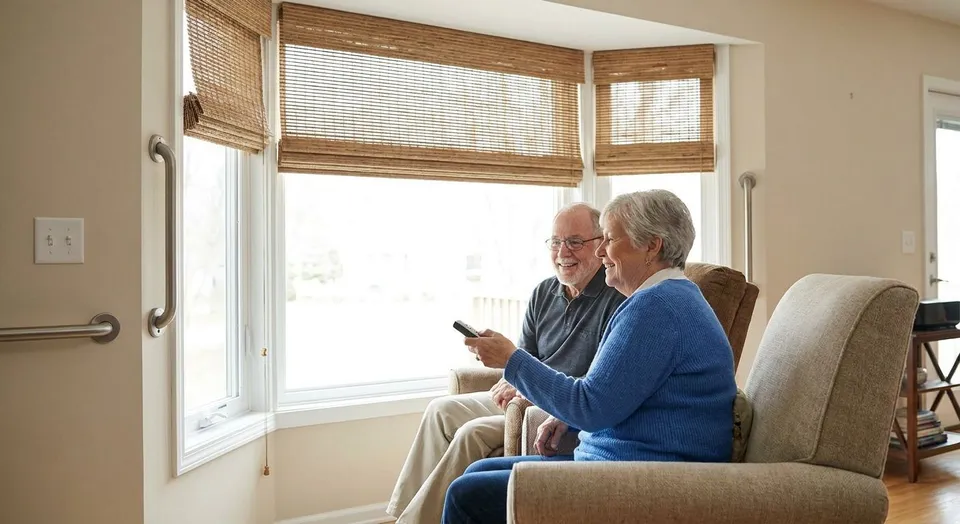
Aging-in-place window treatments have to solve two problems at once: light and privacy control, and safe, one-handed operation for someone with reduced grip strength or limited reach. This guide walks through the exact steps for picking treatments that work for the resident you're actually installing them for, not a generic buyer.
- Cordless and motorized lift systems are the only safe options for aging-in-place homes in 2026. Corded chains are a strangulation and trip hazard.
- Match control method to ability first: app control for tech-comfortable residents, wall switch or large-button remote for arthritis or low vision.
- Cellular and blackout shades in bedrooms cut glare-related falls during nighttime bathroom trips.
- Verdict: motorized cellular or roller shades with wall-switch control are the safe default for most aging-in-place homes.
Why this matters
Falls inside the home are the leading cause of injury for adults over 65, and reaching for a pull cord or fighting a stuck wand is a real trigger, not a hypothetical one. A window treatment that requires two hands, a step stool, or a firm pinch grip is a hazard dressed up as decor.
The fix isn't complicated, but it's specific. Motorized shades for aging-in-place homeowners solve the reach and grip problem directly, but the control method, fabric, and mounting still need to match the resident's actual daily routine, not a showroom demo.
What you'll need
- A room-by-room list of which windows the resident actually touches daily (bedroom, bathroom, kitchen)
- Notes on grip strength, vision, and whether a smartphone or tablet gets regular use
- Measurements for each window (or a scheduled professional measure)
- A decision on power source: hardwired, rechargeable battery, or plug-in for motorized units
- Budget range set before shopping. Motorized adds cost over manual lift systems
- A plan for who operates the shades if the resident can't: caregiver, family member, or voice assistant
The steps
1. Audit the home for fall and reach risks
Walk every room and flag windows where the current treatment requires a stretch, a step stool, or two hands to operate. This is the single most important step because it determines which rooms get motorized upgrades first and which can stay manual.
Prioritize bedrooms, bathrooms, and any room the resident enters after dark. A missed step here means budget gets spent on the wrong windows.
Common mistake: treating every window equally instead of ranking by actual daily use.
2. Choose cordless or motorized lift systems only
Eliminate corded blinds and shades from consideration entirely. They're a trip and entanglement risk, and federal safety guidance has pushed the entire window covering industry toward cordless designs since 2018. For aging-in-place specifically, motorized lift removes the pull-cord motion altogether.
Cellular shades, roller shades, and zebra shades all come in cordless or motorized versions and each fits a different budget tier. Skip any product line still relying on a pull cord or wand, full stop.
Common mistake: assuming "cordless" and "motorized" mean the same thing, cordless still requires a hand on the shade.
3. Match fabric opacity to room function
Bedrooms need blackout or heavy light-filtering fabric to reduce glare during nighttime waking, which is when most falls happen. Living areas do better with light-filtering roller or zebra shades that keep the room bright during the day without harsh glare on a TV or reading chair.
A resident with macular degeneration or cataracts needs more light control than someone with normal vision. Ask about specific diagnoses, not just "they're older."
Common mistake: installing the same fabric opacity in every room instead of matching it to how each room is used at what hour.
4. Pick a control method matched to ability
This is where most aging-in-place projects go wrong. A resident with arthritis struggles with small remote buttons; a resident with early cognitive decline struggles with an app. A wall-mounted rocker switch or a single large-button remote beats a phone app for most residents over 75.
How to program motorized window shades covers the setup side, but the choice of interface has to happen before installation, not after.
Common mistake: defaulting to app control because it's the newest option, without asking who's actually pressing the button.
5. Plan power and charging logistics
Rechargeable battery motors typically run 8 to 12 months between charges depending on how often the shade cycles, and hardwired units never need attention at all. For a resident who can't manage a charging cable, hardwired is worth the extra install cost in 2026.
Decide this before ordering. Retrofitting power to an already-mounted headrail means pulling the shade back down.
Common mistake: picking battery power for convenience without a plan for who swaps or charges it.
6. Get a professional measure and install
A window that's off by a half-inch on either side creates light gaps and binding that a resident with limited dexterity can't troubleshoot themselves. Professional measuring also catches window frames that are out of square, common in homes built before 1990 across the Puyallup, Auburn, and Renton area.
Install quality matters more here than in a typical household, a shade that binds or requires force to seat correctly isn't safe for a resident with weak hands.
Common mistake: DIY measuring to save money, then discovering the shade doesn't seat flush after install.
7. Test operation with the resident present
Before calling the project done, have the actual resident operate every control, the wall switch, the remote, the app, in front of you. If they hesitate or need a second try, the control method is wrong, not the resident.
This step gets skipped constantly because it feels redundant after a professional install, but it's the only real test that matters.
Common mistake: testing the shade yourself and assuming it transfers to someone with different mobility.
Get a quote for aging-in-place shades
Local measure and install across the Greater Seattle Area. No subcontractors.
8. Schedule a seasonal maintenance check
Motorized shades need a battery or connection check twice a year, and cellular shade tracks benefit from a light vacuum to keep the lift smooth. Build this into a spring and fall routine tied to something the resident already does, like a smoke detector battery swap.
Common mistake: no maintenance plan at all, so a dead battery becomes an emergency instead of a scheduled fix.
Troubleshooting
- Remote is unresponsive: check battery contacts first. Corrosion from humidity is common in Pacific Northwest homes and causes more failures than the motor itself.
- Shade won't fully block light for a resident who wakes disoriented at night: swap to a true blackout fabric in that room; light-filtering fabric alone isn't enough for sundowning-related confusion.
- Resident can't press small remote buttons: replace with a single large-button remote or a wall switch. This is a control problem, not a shade problem.
- Motor makes noise during a 2 a.m. bathroom trip: ask the installer about quiet-motor options at the time of purchase; not every motor is rated the same for noise.
- Battery dies faster than expected: frequent cycling (multiple times daily) shortens the interval below the typical 8-12 month range. Hardwiring solves this permanently.
- Shade sticks or binds on one side: this is almost always an install or measurement issue, not a product defect, call for a service adjustment rather than forcing it.
Tools and resources
- How to pair motorized shades with a smart home hub if voice control or a caregiver app fits the household
- A written list of every resident's daily-use windows, ranked by priority
- A charging or power plan documented before install day
- A maintenance calendar tied to an existing seasonal habit
What to do next
If multiple generations share the home, an adult child, a parent, and grandkids under one roof. The control method decision gets more complicated because more than one person operates the same shade. Window treatments for multi-generational households walks through how to pick a single control method that works across ability levels.
“If the resident can't operate the shade with one hand on the first try, the control method is wrong, not the resident.”
FAQ
What's the best window treatment for aging-in-place homes in 2026?
Motorized cellular or roller shades with a wall-switch or large-button remote are the safest default in 2026 because they remove pull cords and require no grip strength. Blackout fabric in bedrooms adds a fall-reduction benefit for nighttime waking.
Are corded blinds safe for elderly residents?
No. Corded blinds and shades are a trip and entanglement risk regardless of age, and the industry has moved toward cordless and motorized designs since 2018. Aging-in-place homes should eliminate corded lift systems entirely.
How long do motorized shade batteries last?
Rechargeable motor batteries typically run 8 to 12 months between charges depending on cycle frequency. Hardwired units avoid the charging question entirely and suit residents who can't manage a charging cable.
Should I choose app control or a wall switch for an elderly parent?
A wall-mounted switch or single large-button remote beats an app for most residents over 75, especially with arthritis or limited tech comfort. Test the actual control with the resident present before finalizing the order.
Do blackout shades help prevent falls at night?
Blackout shades reduce glare and disorientation during nighttime waking, which is when many household falls happen. Light-filtering fabric alone isn't strong enough for residents prone to nighttime confusion.
How much do motorized shades cost for an aging-in-place project?
Cost varies by room count, fabric, and power source (battery versus hardwired), and hardwiring adds install cost over battery units. Get a room-by-room quote rather than a whole-house estimate to prioritize the highest-risk windows first.
Can one motorized shade system work for multiple family members with different abilities?
Yes, but the control method has to accommodate the least tech-comfortable user in the household, not the most capable one. A wall switch alongside app control covers both ends without forcing a single interface on everyone.
One last thing
The fabric and motor get all the attention, but the actual fall-prevention benefit comes from eliminating the reach and the cord, a resident who never has to stretch for a stuck wand again is the real win, not the smart-home integration.