
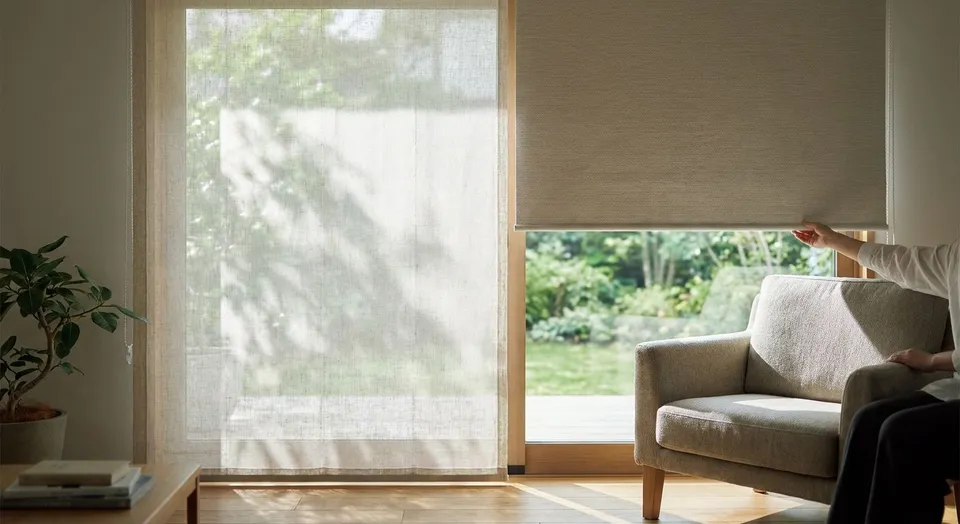
Shade opacity for privacy comes down to matching the fabric's openness factor to how a room actually gets used: light filtering fabric holds daytime privacy while still glowing through, and only blackout or a lined shade stops visibility after dark once a lamp is on inside. Sheer and semi-sheer weaves trade privacy for view-through and belong in rooms that aren't at street level. The catch most homeowners miss in 2026: a shade that reads as private during the day turns into a lit-up window at night unless the fabric or backing is built for it.
- Light filtering fabric gives daytime privacy with glow-through; it is not private at night with lights on.
- Blackout or lined shades are the only opacity level with full privacy day and night.
- Zebra shades flip between sheer view-through and near-blackout on one shade.
- Match opacity to window direction and room use, not just the style you like.
- Mount type leaks more light than fabric choice on most 2026 installs.
Why This Matters
Homes sit close together across Auburn, Kent, and Renton, so a street-facing bedroom needs a different opacity answer than a backyard-facing kitchen. Seattle's short winter daylight punishes the homeowner who picks blackout for every room in 2026, by February the whole house reads as a cave at 4pm. Getting opacity wrong means re-measuring and re-ordering fabric, which costs more than making the right call the first time.
How Do You Choose Shade Opacity for Privacy?
Ask two questions at every window: who can see in during the day, and who can see in at night once the lights are on. Those two answers point to one of four opacity tiers.
| Opacity Level | Daytime Privacy | Nighttime Privacy | Light Let In | Best For |
|---|---|---|---|---|
| Sheer / Semi-Sheer | Low | None | High | Backyard-facing rooms, upper floors |
| Light Filtering | Good | Poor (silhouettes visible) | Moderate-High | Living rooms, kitchens, home offices |
| Room Darkening | Very Good | Good | Low | Bedrooms, media rooms |
| Blackout | Full | Full | Near-zero | Nurseries, shift-worker bedrooms, home theaters |
A top-down-bottom-up mount rewrites this table, because it drops the top half for daylight while the bottom stays raised for street-level privacy on the exact same fabric.
Sheer and Semi-Sheer Shades: Best for View, Not Privacy
Sheer fabric has an open weave that softens harsh sun and glare but does not block visibility in either direction. Skip sheer on any street-facing window in 2026 unless a fence, hedge, or second-story elevation is already doing the privacy work for you. Best for sunrooms, upstairs bedrooms, and backyard-facing living rooms where the view beats concealment.
Light Filtering Shades: Daytime Privacy With Glow-Through
Light filtering fabric is the default for most main-floor rooms because it diffuses direct sun and blocks a clear view in during daylight. At night, with a lamp on, the fabric backlights and shows movement as a silhouette, the tradeoff most homeowners accept in a living room or kitchen. Buy light filtering for kitchens, living rooms, and home offices where daytime privacy outranks nighttime concealment.
Room Darkening Shades: Privacy Day and Night, Light at the Edges
Room darkening fabric is tighter-woven or backed to cut most light transmission, giving solid privacy day and night with a small amount of light escaping at the shade's edges and mounting gaps. It fits bedrooms where full blackout feels too dark but light filtering isn't private enough after sunset. Buy room darkening for guest bedrooms and secondary bedrooms.
Blackout Shades: Full Privacy, Zero Light Through the Fabric
Blackout fabric blocks light transmission through the material itself, and paired with side channels or a close-fit mount it closes most edge gaps too. This is the only tier that delivers full privacy at night with interior lights on, which is why it belongs in nurseries, shift-worker bedrooms, and home theaters. Read the best blackout shades for bedrooms guide before ordering. Mount type changes how much light actually reaches the room. Buy blackout wherever nighttime privacy or sleep beats daylight.
Why Opacity Needs Vary From Room to Room
Opacity is not a single house-wide decision. These factors move the answer window by window:
- Window direction and sun exposure: west-facing windows take harsh afternoon sun that light filtering handles far better than sheer fabric.
- Street level vs. upper floor: ground-floor windows facing a sidewalk or a neighbor's window need more opacity than a second-story bedroom.
- Daytime use vs. nighttime use: a home office used in daylight runs fine on light filtering; a bedroom used at night needs room darkening or blackout.
- Layering options: a dual-layer zebra shade flips between sheer view-through and near-blackout by sliding the alternating bands.
- Local climate and season: short winter daylight in the Seattle area makes all-blackout houses feel dim, so light filtering everywhere plus blackout in bedrooms only is the more livable 2026 layout.
- Existing drapery: a layered shade and drapery setup adds nighttime opacity by closing the drapes over a lighter daytime shade instead of replacing the shade fabric.
Rainier Blinds measures and installs with its own crew, not a subcontractor, and brings fabric samples to the window so opacity gets judged in real daylight and again at night with the lamps on before anything is ordered.
Get opacity right the first time
See real fabric samples in your own light before you order.
Do Zebra Shades Give More Privacy Than Roller Shades?
Zebra shades give more control, not automatically more privacy. A single-layer roller in blackout fabric blocks more light than a zebra shade with its bands aligned. The advantage of zebra shades is switching between sheer and near-blackout on one shade without swapping fabric, which a fixed-opacity roller cannot do. Best for living rooms and home offices where light needs change through the day.
What's the Best Shade Opacity for a Street-Facing Bedroom?
Room darkening or blackout is the right opacity for a street-facing bedroom, because light filtering fabric still shows a silhouette the moment a lamp comes on. Pair either with a close-fit mount to cut the edge-gap light a standard inside mount leaves behind. In 2026 this is the single most common opacity correction homeowners make after living with a first-round install.
Can I Get Nighttime Privacy Without Losing Daylight?
Yes, a light filtering fabric with a blackout liner, or a top-down-bottom-up mount, delivers daytime light and nighttime privacy on the same window without a second shade. Most homeowners land here for main-floor living rooms once they see how much a plain light filtering shade reveals after dark.
FAQ
What shade opacity is best for privacy without blocking all light?
Light filtering fabric is best for daytime privacy without blocking all light, since it diffuses sunlight while keeping the room bright. It loses privacy at night once an interior light is on, showing a silhouette through the fabric.
Is blackout the same as room darkening?
No. Blackout blocks light transmission through the fabric itself, while room darkening only reduces it and leaves light at the shade's edges and mount gaps. Blackout is the tier for full nighttime privacy, like nurseries or shift-worker bedrooms.
Do sheer shades offer any privacy?
Sheer shades offer very little privacy in either direction, because the open weave is built to soften glare rather than block a view. They work best on backyard-facing or upper-floor windows where visibility from outside is not a concern.
How do I stop my shades from showing a silhouette at night?
Add a blackout liner behind light filtering fabric, or move up to room darkening or blackout fabric outright. Standard light filtering fabric backlights whenever an interior lamp is on, no matter how private it looks in daylight.
What opacity is best for a kitchen window?
Light filtering is best for most kitchen windows in 2026, since kitchens are used mostly in daylight and blackout makes the space feel dim during meal prep. A semi-sheer works if the kitchen faces a backyard rather than a street.
Can one shade give both privacy and natural light?
Yes. A top-down-bottom-up shade or a dual-layer zebra shade does both by letting you choose which part of the window stays covered. Both avoid the day-versus-night tradeoff a single fixed-opacity shade cannot solve.
Do darker fabric colors add privacy?
Darker fabric color alone does not meaningfully change opacity, because privacy comes from weave density and backing rather than color. A dark light filtering shade backlights at night exactly like a light-colored one.
How much light gets through a blackout shade at the edges?
Blackout fabric blocks light through the material, but a standard inside mount still leaves gaps at the sides and top. Side channels or a close-fit mount close those gaps, which matters most in nurseries and shift-worker bedrooms.
One Last Thing
The opacity mistake that shows up most after installation is not the fabric, it is the mount. Even blackout fabric leaks light around the perimeter on a standard inside mount, and a close-fit or side-channel mount closes that gap. If nighttime privacy is the priority, settle mount type before fabric color. It changes the real-world result more than most homeowners expect heading into 2026.