
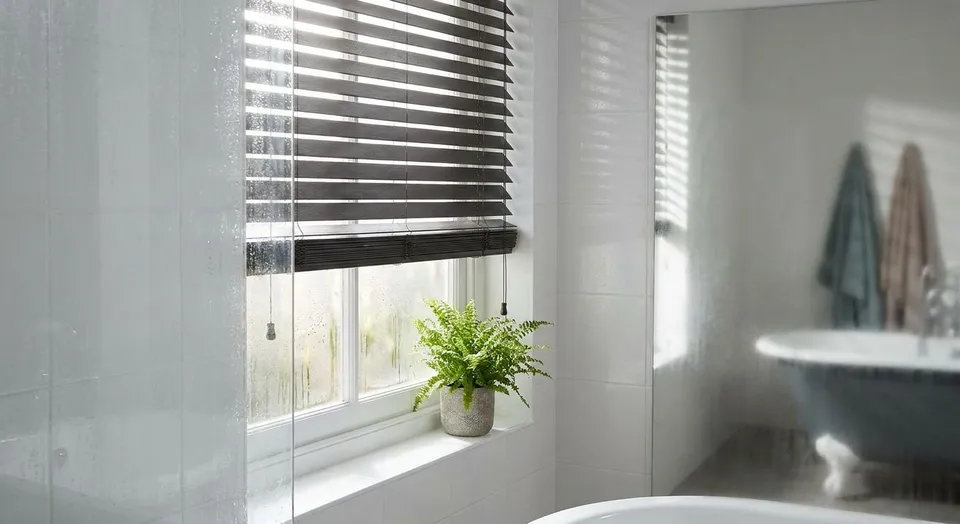
High-humidity rooms are the ones where shower steam, sink splashes, or a running dryer keep relative humidity elevated for hours at a stretch, and the window treatment has to survive that cycle without warping, sagging, or growing mold. Bathrooms, kitchens near sinks and dishwashers, laundry rooms, and enclosed sunrooms all fall into this category, and each one punishes the wrong material fast.
- Vinyl and PVC roller shades hold up in bathrooms and laundry rooms where composite wood-look blinds warp and crack.
- Moisture-resistant cellular shades work in kitchens if you wipe condensation out of the honeycomb pockets weekly.
- Zebra shades suit half-humid rooms like sunrooms but are not rated for direct steam exposure.
- Fabric drapery and standard roman shades belong in rooms adjacent to the humid zone, not inside it.
- Motorized operation solves the wet-hands-on-a-wand problem in bathrooms and near kitchen sinks.
Why moisture control matters for this segment
A window treatment in a bathroom or laundry room does not just filter light, it sits inside a microclimate that swings from dry to near-saturated several times a day. Relative humidity in an active shower can spike above 80% within minutes, and that moisture has to land somewhere. If it lands on a wood-look composite, the material swells at the joints and the slats or vanes start to bow within a season or two.
Kitchens near sinks and dishwashers see the same pattern on a slower clock, plus grease vapor that fabric shades can absorb over time. Bathroom window treatments built from the wrong material end up needing replacement well before the rest of the room's finishes do, which is the exact problem this guide is meant to head off.
Rule out moisture-vulnerable materials first
Before picking a product, cross off anything that swells, absorbs, or wicks water. Faux wood and real wood blinds are the classic failure point in a steamy bathroom because the composite core and the wood veneer both react to constant humidity swings, cracking at the routed slat holes or bowing across the width of the window. That is exactly why they show up so often in humidity complaints and exactly why this room type calls for a different material family entirely.
- Skip wood and wood-composite slat products in any room with a shower or a stovetop nearby.
- Skip unlined fabric roman shades in direct steam paths; the fabric holds moisture against the headrail.
- Skip untreated cotton or linen drapery within a few feet of a running sink.
- Favor vinyl, PVC, and polyester-based fabrics engineered to shed moisture rather than absorb it.
Choose a vinyl or PVC roller shade for the wettest zones
Roller shades built from vinyl or PVC-coated fabric are the most humidity-tolerant option for a shower window, a laundry room, or a kitchen sink window. The material does not swell, does not need refinishing, and wipes clean with a damp cloth.
- Pick a light-filtering or blackout vinyl fabric depending on privacy needs at the window.
- Confirm the fabric is rated for direct moisture contact, not just wipeable dust.
- Choose a cordless or motorized lift so wet hands never touch a pull chain.
- Review roller shades for kitchen windows if the room in question is a kitchen rather than a bathroom.
Add moisture-resistant cellular shades where insulation also matters
Cellular shades add an insulating air pocket that helps with a cold bathroom window in winter, and moisture-resistant fabric versions handle kitchen and laundry humidity without the honeycomb structure trapping standing water. The tradeoff is maintenance discipline: those same pockets can hold condensation if nobody wipes them down.
- Ask specifically for a moisture-resistant or antimicrobial-treated fabric line, not the standard interior version.
- Plan on a monthly wipe-down in any room with a shower or a stovetop.
- Pair cellular shades with a bathroom exhaust fan that actually runs during and after showers.
- Compare the tradeoff directly against roller shades using roller shades vs. cellular shades before deciding.
Consider zebra shades for half-humid rooms
Zebra shades, with alternating sheer and solid bands, work well in sunrooms and kitchen breakfast nooks where humidity is present but not constant steam. They are not the right call for a shower stall window, but they hold up fine where humidity is moderate and airflow is decent.
- Use zebra shades in sunrooms, greenhouses, and kitchen dining areas rather than direct shower exposure.
- Keep the fabric out of direct water splash zones near a sink.
- Motorize the operation in hard-to-reach greenhouse or skylight-adjacent windows.
Motorize the rooms where wet hands operate the shade
A bathroom or laundry room is the single best case for motorized operation in the whole house. Nobody wants to grab a pull cord with soapy hands, and a cord hanging near a bathtub is also a safety issue in homes with kids.
- Choose battery-powered motorized lift for retrofit jobs without nearby wiring.
- Choose hardwired motorized lift for new construction or full remodels.
- Pair the shade with a wall switch positioned away from the sink or tub.
- Confirm the motor housing itself is rated for the humidity level of the room before ordering.
Measure and mount for humidity-driven frame movement
Window frames in high-humidity rooms swell slightly over the years, which changes the clearance a shade needs to operate without binding. An inside mount that fits perfectly in a dry room can start rubbing in a bathroom after a few humid winters.
- Leave roughly a quarter-inch of extra clearance on inside-mount installs in wet rooms.
- Recheck the frame for square before ordering if the home is more than 15 years old.
- Choose outside mount when the frame shows any existing swelling or paint bubbling.
- Have the shade measured and installed by the same crew so mounting responsibility is not split between two vendors.
Maintain the shade once it is installed
Even the right material needs upkeep in a humid room. Skipping maintenance is how a moisture-resistant fabric still ends up with mildew spots along the bottom rail.
- Wipe vinyl and PVC fabric down weekly in active bathrooms.
- Vacuum cellular shade pockets monthly with a brush attachment.
- Run the exhaust fan for at least 15 minutes after every shower.
- Follow the steps in how to clean fabric roller shades for the specific fabric type installed.
Comparison: what actually holds up in a humid room
| Option | Best for | Key limitation |
|---|---|---|
| Vinyl/PVC roller shades | Bathrooms, laundry rooms, kitchen sink windows | Fewer texture and pattern choices than fabric |
| Moisture-resistant cellular shades | Kitchens, laundry rooms wanting insulation too | Honeycomb pockets need regular wipe-down |
| Zebra shades | Sunrooms, breakfast nooks, moderate humidity | Not built for direct steam or splash exposure |
| Standard fabric drapery | Rooms adjacent to the humid zone, not inside it | Absorbs moisture and can mildew in direct humid rooms |
The verdict for this segment: vinyl or PVC roller shades are the safest default for any room with a shower, sink, or dryer, and cellular shades are the second choice when insulation matters more than pure moisture resistance.
Get a free in-home measure
Rainier Blinds measures the room and gives you real pricing on the spot.
Common mistakes homeowners make in humid rooms
- Buying based on the living room look instead of the bathroom's moisture level. A fabric that looks great in a family room can mildew inside a shower alcove within a year.
- Skipping motorization to save a step, then regretting the wet-hand cord problem daily. This is the room where motorized lift earns its keep the fastest.
- Ignoring the exhaust fan. No shade material survives long-term if the room never actually dries out between uses.
- Mounting too tight to the glass. Condensation on the window transfers straight to the fabric when there is no clearance gap.
- Assuming any vinyl-look product is safe. Some composite blinds are marketed as moisture-tolerant but the backing material still reacts to constant steam; check the fabric spec, not the marketing copy.
FAQ
What is the best window treatment for a humid bathroom?
Vinyl or PVC roller shades are the best fit for a humid bathroom in 2026 because the material sheds moisture instead of absorbing it. Cellular shades with a moisture-resistant fabric are the second choice when added insulation matters.
Are cellular shades good for kitchens and laundry rooms?
Cellular shades work in kitchens and laundry rooms as long as the fabric is a moisture-resistant line and the honeycomb pockets get wiped down monthly. Standard interior cellular fabric is not built for constant steam exposure.
Do fabric roman shades work in bathrooms?
Unlined fabric roman shades are a poor fit for a shower window because the fabric holds steam against the headrail and mildews. They work fine in a bathroom sitting area or vanity nook away from direct steam.
Can motorized shades be installed in a bathroom?
Yes, motorized shades are a strong fit for bathrooms because they remove the need to touch a pull cord with wet hands. Battery-powered motors work for retrofits and hardwired motors suit new construction.
How often do you need to clean roller shades in a kitchen?
Vinyl roller shades near a kitchen sink or stove should be wiped down weekly to clear grease vapor and condensation. A damp cloth is enough for most vinyl and PVC fabric lines.
Is drapery a bad idea for a laundry room?
Standard fabric drapery is a bad idea inside a laundry room because it absorbs dryer moisture and can mildew over time. Drapery works better in the hallway or living area next to the laundry room rather than inside it.
What shade works best for a sunroom with high humidity?
Zebra shades handle moderate sunroom humidity well and give adjustable light control through the alternating sheer and solid bands. They are not rated for direct steam exposure, so they are not the right pick for a shower window.
Do wood-look blinds hold up in humid rooms?
No, wood and wood-composite blinds tend to warp, crack, or bow at the slat holes when exposed to repeated humidity swings above 80% relative humidity. Vinyl and PVC roller shades or moisture-resistant cellular shades are the more durable alternative for these rooms in 2026.
One last thing
The detail most homeowners miss is the exhaust fan runtime, not the shade material itself. A moisture-resistant fabric still mildews if the bathroom fan shuts off the second the shower does; running it another 15 minutes cuts the humidity spike the shade actually has to tolerate.