
Pacific, WA homeowners comparing custom window treatments need more than a product list. This 2026 guide matches roller, cellular, zebra, woven wood, Roman, specialty shades, outdoor shades, and drapery to the window problem, then explains the local measure, supplier-order, and installation process.
TL;DR
- For custom window treatments Pacific WA, light-filtering roller shades are the practical 2026 day-room pick, Buy.
- Cellular shades win where comfort at the glass matters; blackout roller or cellular shades win in bedrooms, Buy.
- Zebra, day/night, and dual shades earn their place when one window needs two light settings, Consider.
- Rainier Blinds measures, orders from a supplier, and installs the finished treatment with its local crew.
Why this matters
A Pacific project can include a bright living room, a bedroom that needs less early light, a kitchen where privacy matters during the day, and a patio opening that is exposed to changing weather. One shade choice rarely solves every room. The right plan assigns each window a job before anyone compares fabric colors.
Custom window treatments are specified to the actual opening, mounting surface, fabric, and operation. That is different from choosing a stock size and hoping the frame is square. A treatment that fits the opening and matches the room is easier to use and gives the supplier clear instructions.
Rainier Blinds is locally owned in Auburn, and its custom window treatment services cover the product range Pacific-area homeowners are likely comparing. The local crew measures on site, the selected treatment is ordered from a supplier, and Rainier Blinds returns to install it.
Who this guide is for
This guide is for Pacific and nearby South King County homeowners replacing old window coverings, finishing a remodel, or outfitting a new home. It is also for anyone comparing an in-home specialist with a self-measured online order and wanting a clear answer about which treatment fits which room.
It is not a case for using the same product everywhere. A bedroom, office, living room, tall glass opening, skylight, and covered patio have different light, privacy, reach, and mounting requirements. In 2026, the practical whole-home plan is usually a mix of products and opacity levels.
What to look for in custom window treatments for Pacific homes
Start with the room's problem
Write down what is failing before you choose a style. If the room is too bright for a screen, start with glare control. If the room is uncomfortable near the glass, start with insulation. If the room is difficult to reach, start with operation rather than color.
Use this quick filter in 2026:
- Glare with a view: sunscreen roller shades.
- Soft daytime light: light-filtering roller shades.
- Sleep or media use: blackout roller or cellular shades.
- Comfort near the glass: cellular shades.
- Changing privacy needs: zebra, day/night, or dual shades.
- A softer finished look: woven wood shades, Roman shades, or drapery and curtains.
- Difficult shapes or exterior openings: skylight, trapezoid, arched, or outdoor shades.
The product name comes after the room's job. That order prevents a common 2026 mistake: picking a fabric first and discovering later that the treatment does not control glare, privacy, or early light.
Measure the actual opening and mounting surface
A useful measure checks more than the glass. Width should be checked at the top, middle, and bottom, while height, casing depth, trim, handles, locks, cranks, nearby furniture, and headrail clearance affect the final specification.
Inside mount keeps the treatment within the casing when there is enough depth. Outside mount overlaps the opening or trim and can give the headrail more room or improve edge coverage. Neither mount is automatically better; the correct choice is the one that lets the finished treatment operate without binding or colliding with the room.
Specialty shapes need the same discipline. A skylight shade, trapezoid shade, or arched shade must follow the actual opening and mounting surface, not the nearest catalog sketch. This is where an in-home measure protects the supplier order from a preventable mismatch.
Match opacity to how the room is used
Sunscreen roller shades are a strong starting point when glare is the main problem and keeping a view matters. Light-filtering roller shades soften daylight and support daytime privacy in living rooms, kitchens, dining areas, and offices. Blackout roller shades are the direct choice when a bedroom or media room needs much less light.
Cellular shades give the insulation decision more weight because their honeycomb construction creates an air layer at the glass. They are available in light-filtering and blackout directions, so the same construction can serve different rooms without forcing one opacity across the house.
Do not make blackout the default for every room. A bedroom may need it; a living room that is used throughout the day may be better with filtered daylight. In 2026, the best opacity is the one that matches the room's actual schedule.
Choose operation before the supplier order
Manual cordless operation is sensible for easy-to-reach windows that are adjusted occasionally. Motorization makes more sense for tall glass, skylights, windows behind furniture, and openings that need a daily schedule. Smart operation earns its place when app, voice, or scheduled control will be used rather than simply advertised.
Rainier Blinds lists a Standard package, a Motorized package at +$100 per shade, and a Smart package at +$200 per shade. The listed package warranties are 1 year, 3 years, and 5 years respectively. Exact pricing is confirmed for the actual window, product, fabric, and operation before the supplier order is placed.
This decision belongs in the measure. Operation changes the headrail, power plan, clearance, and setup. Adding motorization after the order is finalized creates avoidable rework.
Plan specialty and outdoor openings in person
Skylight shades solve a reach problem as well as a light problem. Trapezoid and arched shades solve a shape problem. Outdoor shades solve an exposure and usability problem, and the mounting surface matters as much as the fabric.
For an exterior opening, the choice between a side-wire system and a zipper-track system depends on how enclosed the area needs to be and how the shade will be used. The right product is selected after checking the actual patio or deck opening, not by treating an outdoor shade like an interior window treatment.
Treat the finish and the light-control layer as one plan
Woven wood shades add texture, Roman shades add a tailored fabric face, and drapery or curtains can frame a wide opening or add a second layer. Those finishes work best when the hardware, stack space, privacy goal, and shade behind them are considered together.
A decorative layer should not be asked to do a job it cannot do. If the bedroom needs darkness, plan a blackout shade or appropriate lining first. If the living room needs daylight, use a light-filtering or sunscreen treatment and let the drapery provide the finish.
Top picks for Pacific homes in 2026
Light-filtering and sunscreen roller shades: the practical day-room pick
The safe pick. Roller shades give you three clear fabric directions: sunscreen for glare and a view, light-filtering for soft daylight, and blackout for darker rooms. The flat profile also keeps the decision focused on fabric, mount, and operation instead of adding unnecessary hardware. Buy for living rooms, kitchens, offices, and any room with one straightforward light-control job.
Choose sunscreen when the view should stay part of the room. Choose light-filtering when daytime privacy and softer light matter more. Reserve blackout for rooms that genuinely need it; a dark fabric in the wrong room is not an upgrade.
Cellular shades: the comfort pick
The insulation pick. Cellular shades use a honeycomb structure to create an air layer at the glass, and they can be specified in two practical opacity directions: light filtering or blackout. Buy when the room feels uncomfortable near the window, when insulation is a priority, or when a bedroom needs both a cellular construction and darker light control.
Confirm casing depth during the measure. The headrail and shade stack need room to operate cleanly, and an outside mount can be the better answer when the casing is shallow.
Zebra, day/night, and dual shades: the two-setting pick
The flexible pick. Zebra shades use alternating sheer and solid bands. Day/night shades combine lighter and darker layers, while dual shades place two fabrics, such as sunscreen and blackout, on one roller system. Each approach gives a window two useful light settings instead of forcing one fabric to handle every part of the day. Consider when the room really changes from daytime glare control to evening privacy or darkness.
Skip the extra mechanism when one roller shade already solves the room's job. More adjustment is useful only when the window needs more than one setting.
Woven wood, Roman shades, and drapery: the finish pick
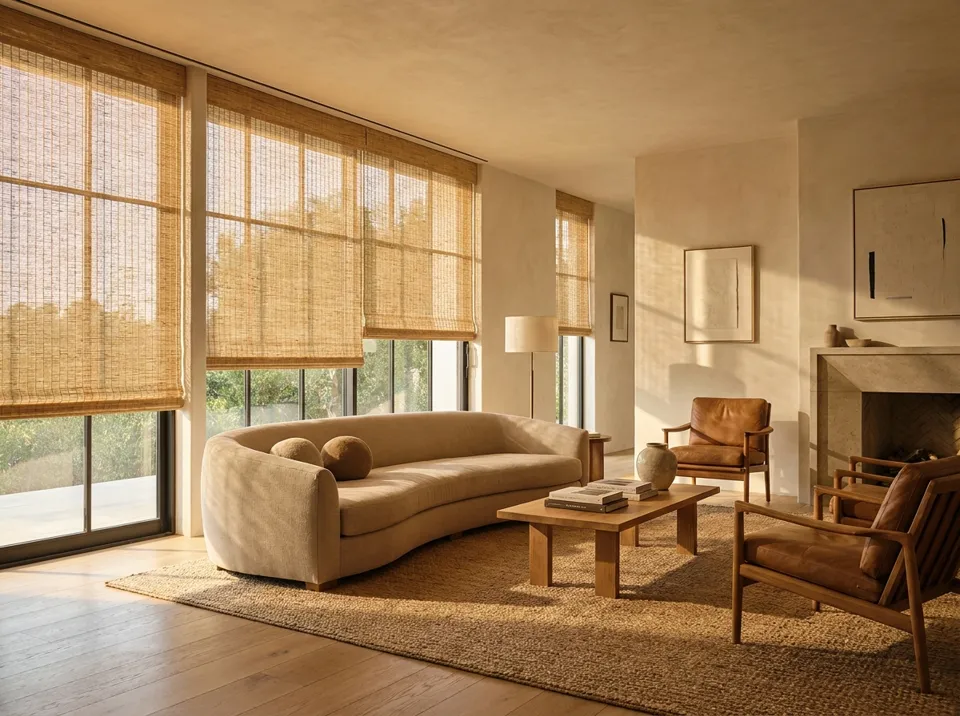
The texture pick. Woven wood shades bring a natural-looking weave, Roman shades bring a structured fabric fold, and drapery or curtains frame the opening with a softer layer. Buy when the room needs a finished look in addition to direct light and privacy control.
Use this group with a clear division of labor. The shade handles the daily light task; the drapery or curtain layer handles the frame, softness, and added privacy. Check stack height and nearby furniture before approving the final mount.
Motorized and specialty shades: the access pick
The reach-and-shape pick. Motorized operation is the right tool for tall glass, skylights, high windows, and openings behind furniture. Specialty shades are the right tool for skylight, trapezoid, and arched openings that do not behave like ordinary rectangles. Outdoor shades belong in the same measure-first category because exterior mounting and exposure control the installation plan. Buy after an on-site measure confirms the shape, coverage, power, and clearance.
The Motorized package is listed at +$100 per shade and the Smart package at +$200 per shade. Choose the operation while the project is being specified, not after the supplier has received the order.
What to avoid
A single self-measured width for every opening
One number taken from the center of the glass misses out-of-square frames, casing depth, trim, handles, and headrail clearance. A treatment that is too narrow can leave bright side gaps, while one that is too wide can bind. Give the supplier a complete specification based on the actual opening.
One opacity for the whole house
Living rooms, bedrooms, offices, and kitchens do not have the same schedule. Light-filtering fabric is practical for daytime spaces but is not the right answer when the room needs darkness. Blackout fabric works in a bedroom but can make an active daytime room feel closed.
Choosing motorization after the quote is final
Motorized operation affects power, headrail space, controls, and setup. If a window needs remote, smart, or scheduled control, include that requirement during the measure. The site lists Motorized at +$100 per shade and Smart at +$200 per shade, so it belongs in the initial comparison.
Treating specialty or outdoor shades like standard windows
A skylight, trapezoid, arched, or outdoor opening needs its own coverage and mounting plan. A photo helps, but the supplier order should follow an on-site check of the actual opening and the way the finished treatment must operate.
Verdict comparison
| Treatment | Best use | Defining detail | 2026 verdict |
|---|---|---|---|
| Sunscreen roller shade | Bright rooms where the view matters | Glare-focused fabric direction | Buy |
| Light-filtering roller shade | Living rooms, kitchens, and offices | Soft daylight with a clean profile | Buy |
| Blackout roller or cellular shade | Bedrooms and media rooms | Darker light-control option | Buy |
| Cellular shade | Comfort near the glass | Honeycomb air layer | Buy |
| Zebra, day/night, or dual shade | Rooms with changing light needs | Two light settings | Consider |
| Woven wood, Roman, or drapery | Finished living and dining spaces | Texture and layering | Buy for finish |
| Motorized shade | Tall or hard-to-reach windows | +$100 per shade Motorized package | Buy where reach matters |
| Specialty or outdoor shade | Angled, curved, roof, or exterior openings | Measure-first mounting plan | Buy after measure |
How the local measure-to-install process works
Rainier Blinds keeps the process in four clear stages. The supplier makes the selected treatment; the local team owns the measure, order coordination, and installation.
- Consult: Identify the room problem, window count, privacy goal, fabric direction, and whether operation should be manual, motorized, or smart. The consultation happens in the home so the decision is made in the actual light and around the actual trim.
- Measure: The crew checks each opening, mount, depth, obstacle, specialty shape, and exterior mounting surface. These measurements become the specification sent to the supplier.
- Choose and order: Confirm the shade or drapery type, opacity, color, mount, operation, and package. Rainier Blinds coordinates the supplier order rather than manufacturing the treatment in-house.
- Install: Rainier Blinds' own crew returns with the finished treatment, installs it, and completes the selected motor or smart-home setup.
The quote form takes about 30 seconds to submit and says requests receive a response within 1 business day. The site also says most projects are installed within 3-4 weeks of ordering, with the exact timing confirmed during the consultation. For a nearby local example, review the Auburn service area and Kent service area pages.
FAQ
What are the best custom window treatments in Pacific, WA, in 2026?
How much do custom window treatments cost in Pacific, WA?
Are cellular shades better than roller shades?
Should I choose motorized shades for tall or hard-to-reach windows?
Can custom shades fit skylight, trapezoid, and arched windows?
How long does the custom window treatment process take?
Does Rainier Blinds manufacture window treatments in-house?
One last thing
A supplier-made treatment can still be a genuinely custom window treatment. Custom refers to the measurements, fabric, opacity, mount, operation, and shape specified for the opening; it does not require the local installer to manufacture the product in-house.
Before approving a Pacific project in 2026, ask four direct questions: who measured the opening, who places the supplier order, who installs the finished treatment, and which operation is included in the quote. Clear responsibility is the difference between a clean measure-to-install project and a product that arrives without a plan.