
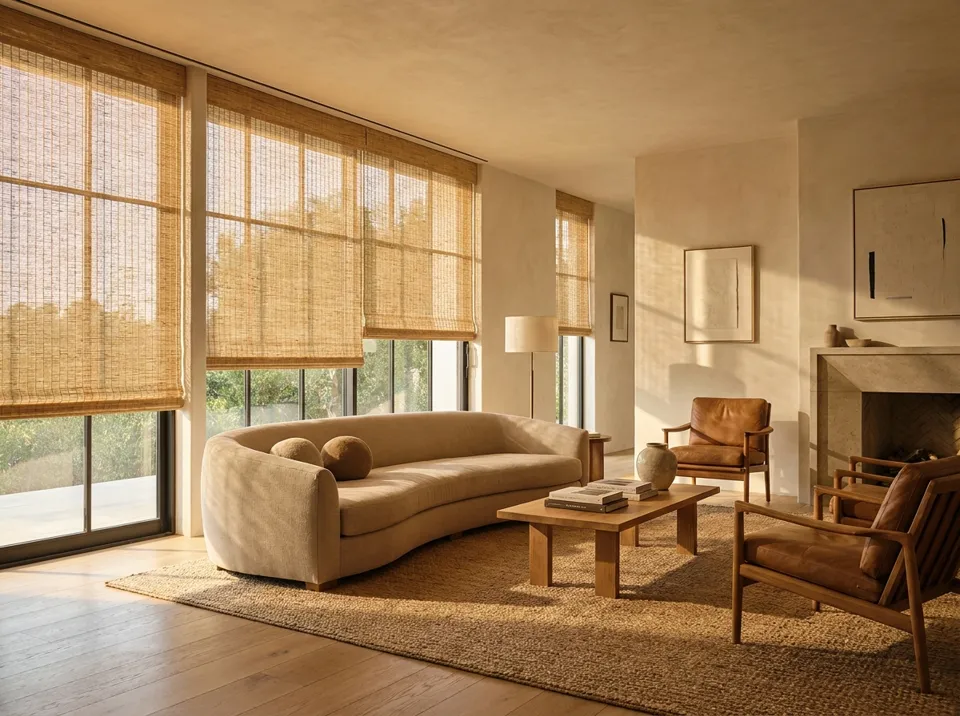
Custom window treatments in Auburn, WA cost $150 to $475 per window installed for most custom shade projects in 2026, and a 10- to 12-opening whole house runs $1,500 to $5,700 before upgrades. That per-window math combines Fixr's published custom-shade range of $100 to $400 per window (updated January 31, 2025) with $50 to $75 per-shade installation labor. The cost the headline number excludes is operation: motorization adds $100 per shade and smart-home control adds $200 per shade at Rainier Blinds, so a 12-window motorized package adds $1,200 to $2,400 over the fabric quote.
TL;DR
- Custom window treatments in Auburn cost $150 to $475 per window installed for custom shades in 2026.
- A 10- to 12-opening Auburn house lands near $1,500 to $5,700 before motorization.
- Custom drapery runs $300 to $4,000 per window and lifts whole-project totals fastest.
- Motorized adds +$100 per shade; smart-home control adds +$200 per shade at Rainier Blinds.
2026 cost snapshot
Why this matters
Auburn homeowners get three very different answers to the same cost question. A big-box store quotes stock sizes. An online retailer quotes fabric plus shipping and then hands you the install problem. A local shop that measures in person prices the real opening: the trim, the mount depth, the crank handle, the skylight shaft.
This guide prices the actual options the way they get ordered in 2026, per window, by product, by project size, for custom window treatments in Auburn, WA and the surrounding South King County towns. Every range below cites its published source, and the Auburn-specific line items come from Rainier Blinds' own current price list.
How much do custom window treatments cost in Auburn, WA?
Custom window treatment costs in 2026 land in these published ranges:
| Product | Published 2026 range (per window, installed) | Source |
|---|---|---|
| Custom roller shades | $150-$475 | Fixr custom-shade $100-$400 + $50-$75 install |
| Custom cellular shades | $85-$345 | Fixr cellular $35-$270 + install |
| Custom roman shades | $150-$225 | Fixr roman $100-$150 + install |
| Shades, any type | $60-$600 | HomeGuide 2026 |
| Curtains, installed | $50-$500 | HomeGuide 2026 |
| Custom drapery | $300-$4,000 | HomeGuide 2026 |
| Skylight or arched shades, custom | $250-$375 | Fixr $200-$300 + install |
Two facts sit behind the table. First, the spread is real: a light-filtering roller shade on a 36-by-48-inch opening costs far less than a double-cell cellular shade or a lined roman shade on the same opening. Second, installation is not optional. Custom shades arrive fitted to the millimeter, and a botched self-install voids the value of the measurement. Fixr puts professional shade installation at $50 to $75 per shade, and removal of old coverings adds $60 to $200 per project.
Custom roller shades: $150 to $475 per window
Roller shades are the volume product in most Auburn orders because one hardware system covers three fabrics. Sunscreen fabric keeps the view on west-facing glass, light-filtering fabric handles day rooms, and blackout fabric solves bedrooms. Fixr places custom shades at $100 to $400 per window based on a 48-by-44-inch size, and HomeGuide's 2026 shade range of $60 to $600 per window brackets the same product across every size and opacity.
What moves the price inside that range: fabric opacity (blackout costs more than sunscreen), lift system, cassette size, and whether the shade needs an outside mount to clear a crank or a shallow casing. A twelve-window house of standard openings lands near $1,800 to $5,700 installed at the combined $150-$475 custom rate.
Cellular shades: $85 to $345 per window
Cellular shades carry the insulation job, which matters on older Auburn glass and in bedrooms over unheated spaces. Fixr lists cellular shade materials at $35 to $270, with single-cell at the low end and double-cell at the top; adding $50 to $75 of installation gives the $85 to $345 installed band.
Two upgrades push a cellular quote higher. Double-cell construction costs more than single cell because it uses two layers of honeycomb. And a motor inside a deep cellular headrail needs mounting depth. If the casing is shallow, the bracket hardware changes, and that gets resolved at the measure, not at checkout.
Roman shades: $150 to $225 per window
Fixr prices roman shades at $100 to $150 in materials for a 48-by-44-inch shade. Add installation and a typical installed roman shade runs $150 to $225 per window. Fold style, fabric, and lining change the number: a flat fold in a polyester blend sits at the bottom of the range, while a hobbled fold in a heavier fabric with blackout lining sits at the top.
Romans earn their price in finished rooms, dining rooms, home libraries, guest bedrooms, where the stacked folds read as tailored fabric rather than a flat panel. In 2026, most Auburn orders use them selectively, not house-wide.
Custom drapery: $300 to $4,000 per window
Drapery is the widest band on the page, and that is deliberate. HomeGuide's 2026 guide puts installed curtains at $50 to $500 per window and custom curtains at $300 to $4,000 per window. The spread is real fabric economics: panel count, heading style, and whether the treatment needs blackout lining for a bedroom or a media room.
Two cost rules hold. Panels are priced in pairs, so a wide living-room opening takes two to four panels, not one. And layering drapery over a shade. The setup that handles daylight and evening privacy on the same window, prices as two products, not one.
Specialty and skylight shades: $250 to $375 per window
Shades for skylights, arches, and trapezoid openings are custom-made by definition, because no stock size follows an angle. Fixr prices skylight shades at $200 to $300 and arched-window shades at up to $150 to $300 in materials alone; add installation and these openings run $250 to $375 and up per window.
The on-site check matters as much as the price. Skylight shade hardware depends on the shaft depth and reach; arched shades cover the usable rectangular portion below the arch; trapezoid shades follow the rake. None of that can be confirmed from a photo, which is why these openings get measured before any supplier order.
What a whole Auburn house costs in 2026
Multiply the per-window bands by the opening count. Here is the arithmetic, using the custom-shade range above:
| Project size | At $150/window | At $475/window |
|---|---|---|
| 8 openings | $1,200 | $3,800 |
| 10 openings | $1,500 | $4,750 |
| 12 openings | $1,800 | $5,700 |
| 15 openings | $2,250 | $7,125 |
Add-ons are predictable. Motorization adds $100 per shade, so motorizing all twelve windows in a mid-size Auburn home adds $1,200. Smart-home integration adds $200 per shade, or $2,400 across the same house. Drapery in one finished room adds from several hundred to several thousand dollars depending on fabric and panel count.
The practical budget answer: treat the house room by room, not window by window. Blackout cellular or roller shades in the bedrooms, light-filtering rollers in the day rooms, one custom drapery treatment where the room earns it. That mixed plan keeps a 12-opening project in the $2,000 to $4,500 band instead of letting one room's fabric bill drag the whole project.
Why custom window treatment prices vary
- Opening size and count. Fabric is sold by dimensions, so a 72-by-48 opening costs materially more than a 24-by-36, and a 14-window plan scales everything.
- Product type. On Fixr's materials table for a 48-by-44 shade, roller shades list at $60-$75 while roman shades list at $100-$150, the hardware and fabric stack differently by product.
- Opacity. Blackout fabric and liners cost more than light-filtering fabric, and bedrooms justify the difference.
- Mount and hardware. Inside mount needs casing depth; outside mount uses more fabric and heavier brackets. Deep cellulars, duals, romans, and motorized headrails can force outside mount.
- Operation. Motorized is +$100 per shade and smart is +$200 per shade at Rainier Blinds, the single biggest swing on a whole-house quote.
- Specialty shapes and exposure. Skylights, trapezoids, arches, and outdoor shades (steel-wire guides vs zipper-track systems) need shape- and structure-specific hardware.
How the local process sets the final number
Rainier Blinds prices Auburn projects the same way the ranges above are built: fabric by opening, hardware by mount, operation by room. The business model is direct, measure in the home, order the selected treatment from a wholesale supplier to the confirmed measurements, and install with Rainier Blinds' own crew, no subcontractors. Nothing is manufactured in-house, which is exactly why the quote reflects supplier pricing rather than a workshop markup.
The current package structure prices Motorized at +$100 per shade and Smart at +$200 per shade, with warranties of 1, 3, and 5 years on the Standard, Motorized, and Smart packages respectively. Rainier Blinds is licensed and insured in Washington State and responds to new quote requests within 1 business day; exact pricing depends on product, fabric, dimensions, mount, operation, and opening count, confirmed after the in-home measure through the quote request page.
That process is also the answer to the question most buyers actually have: why not just order online? Because a shade that fits the rectangle but misses the casing depth, the handle, or the skylight shaft is a refund cycle, not a purchase. The measure is the product decision.
Why Auburn buyers compare against big-box and online pricing
Stock sizes have a real role. HomeGuide's 2026 tables put basic blinds and shades as low as $30 to $60 per window installed, and a garage or workshop window can honestly be solved at that level. The gap opens where stock sizes cannot follow: tall entry glass, arched transoms, skylights, wide sliders, and any bedroom where a bright side gap defeats the blackout purpose.
A custom order costs more per window and returns more per room, correct opacity, full edge coverage, hardware that clears the trim, and a local crew that returns if a bracket or motor misbehaves. In 2026 that difference is the whole reason to call a local measurer first and a retailer second.
Related questions
How much does it cost to motorize custom shades in 2026?
Motorization adds $100 per shade at Rainier Blinds, so motorizing a 10-window order adds $1,000. Smart-home integration adds $200 per shade, or $2,000 across the same ten openings, and carries the 5-year package warranty.
Are custom shades worth more than ready-made shades?
For bedrooms, tall glass, skylights, and specialty shapes, yes. A $150-to-$475 custom shade does a job a $90 ready-made cannot, because opacity and edge coverage are measured, not approximated. For a garage or a low-stakes window, a stock shade is the honest answer.
Do skylight and arched shades cost more than standard shades?
Yes. Fixr prices skylight shades at $200 to $300 in materials because they are always custom-made, and arched shades run as high as $300 before installation, roughly double a standard roller opening. The shape check happens on site, before the supplier order.
FAQ
How much do custom window treatments cost in Auburn WA in 2026?
How much for a whole house of custom shades in Auburn?
What is the most affordable custom window treatment?
Do skylight and arched shades cost more than standard shades?
Why does custom drapery cost so much more than curtains?
Does Rainier Blinds charge for measuring and installation?
Is it cheaper to buy shades online or locally in Auburn?
How long does a custom window treatment order take?
One last thing
The cheapest custom project is the one you do not redo. Auburn homeowners who sequence the spend. Blackout where sleep matters, cellular where glass is cold, sunscreen where glare kills the view, and drapery only where the room earns it. Get a house that works for years instead of a bill they regret in one room.
The 2026 rule of thumb: budget $150 to $475 per window installed for custom shades, add $100 per shade where the opening is high, heavy, or hidden, and let the in-home measure price the special shapes before you commit.