Custom window shades in Auburn, WA are a room-by-room decision, not a one-style-for-the-whole-house order. Cellular shades win on insulation for older Auburn glass, zebra shades win on all-day light control, and roller shades win on clean coverage at the lowest cost of the custom options. This 2026 guide ranks the shade types by the job each one does, flags the honest downsides of every pick, and walks through how Rainier Blinds measures, orders, and installs across South King County. Every shade below is custom-made to your exact measurements by a wholesale supplier and hung by our own measure-and-install crew, the same team behind our custom window treatments.
TL;DR
- Cellular shades are the Buy for Auburn bedrooms and older glass: honeycomb pockets cut winter heat loss.
- Zebra shades are the Buy for rooms that need glare dialed in, not switched fully open or closed.
- Roller shades in sunscreen, light-filtering, or blackout fabric are the clean low-cost coverage pick.
- Motorized day/night and dual shades fit tall great-room glass and two-job windows.
- Rainier Blinds measures on site, quotes real pricing on the spot, and installs with our own crew.
Why this matters
A shade is one of the few purchases in a house where a half-inch mistake shows up every single day. Gaps at the edges leak light. A headrail that sits proud of shallow trim reads crooked from across the room. And in Auburn, the wrong fabric choice costs money twice: once when the room bakes in a July afternoon, and again in January when heat walks straight out through bare glass.
Auburn's housing stock makes this worse, not better. Older West Auburn ramblers and 1970s ramblers across Lea Hill have frames that settled out of square decades ago. Newer Lakeland Hills builds run tall two-story great-room glass that no stock program covers. Big-box shade charts and online configurators assume a clean rectangle and a tape-measure number you took yourself. Custom shades exist because those assumptions fail on real South King County windows.
The word "custom" gets abused, so pin it down here. A custom shade is measured in your room, ordered to those exact dimensions from a wholesale supplier, and installed to fit. It is not a stock size trimmed at a warehouse. That distinction is the whole ballgame in 2026, and it is what the picks below are built on.
Who this is for
This guide is for Auburn, Federal Way, Kent, and South King County homeowners replacing worn-out coverings, finishing a remodel, or outfitting a new build. It assumes you are comparing a local measure-and-install shop against big-box stores and online retailers, not hunting temporary renter-friendly fixes.
It also fits buyers who already know roughly which room is failing. If the bedroom will not go dark at 5:00 AM in June, start with the cellular and blackout sections. If the living room glare kills the television by mid-afternoon, start with zebra and roller. If the great room is two stories tall, go straight to motorized.
What to look for in custom window shades for Auburn homes
- On-site measurement, not a self-tape job. Frames in older Auburn homes measure different widths at top, middle, and bottom. A crew takes three readings and orders to the tightest usable number. Self-measured custom fabric is rarely returnable at full value.
- Opacity matched to the room. Sunscreen holds the view, light-filtering softens, blackout makes a room genuinely dark. Ordering one opacity house-wide is the most common expensive mistake we see.
- Mount depth on older trim. Inside mounts need casing depth. Shallow trim forces an outside mount that overlaps the casing by 2 to 3 inches per side and forgives out-of-square openings. Decide this at the measure visit, never after fabric is cut.
- Cordless or motorized lift where kids and pets are around. Cordless is the 2026 safety baseline on any shade within reach. Motors belong on openings you would otherwise stop adjusting.
- A warranty that covers the package tier, not just the fabric. Ask whether the motor and the labor are covered, not only the material.
Top picks: custom window shades for Auburn homes
Best overall: cellular shades. Best for all-day light control: zebra shades. Best budget coverage: light-filtering roller shades. The ranked picks below cover the common rooms in Auburn homes; every option is available manual, cordless, motorized, or smart.
| Shade | Best for | Key detail | Verdict |
|---|---|---|---|
| Cellular | Insulation, bedrooms | Honeycomb air pockets | Buy |
| Zebra | All-day light control | Alternating sheer and solid bands | Buy |
| Roller (3 opacities) | Clean coverage, budget | One fabric roll, tight fit | Buy |
| Day/night, dual | Two jobs on one window | Sheer plus blackout layers | Buy where two jobs are real |
| Motorized | Tall or hard-to-reach glass | Remote, app, schedules | Consider |
| Roman, woven wood | Texture, formal rooms | Soft folds, natural weaves | Consider |
| Outdoor, skylight, arch, trapezoid | Specialty openings | Built to the opening's shape | Case by case |
1. Cellular shades: best for insulation and energy savings
Cellular shades trap air in honeycomb pockets, and that trapped air is insulation. Widely cited window-covering industry figures put the heat-loss reduction at up to 40% compared to a bare pane, which matters through Auburn's five to six wet months when older single-pane glass is bleeding heat all night. Double-cell construction adds a second air pocket and performs better still.
Cellular pros: the strongest insulation of any fabric shade; cordless lift is standard; works in every opacity from light-filtering to full blackout. Cellular cons: the honeycomb silhouette is utilitarian rather than decorative, and deep cells need mount depth that shallow older trim sometimes lacks.
Buy cellular for bedrooms, nurseries, and any room with old glass and a heating bill. For the full fabric and cell-structure breakdown, see the cellular shades Auburn WA guide.
2. Zebra shades: best for all-day light control
Zebra shades run alternating sheer and solid bands on a single roll, so sliding the shade half an inch changes the light. That makes them the pick for rooms you sit in all day: home offices with screen glare, street-facing living rooms where privacy shifts hour by hour, dining rooms that need bright at noon and closed at dinner.
Zebra pros: the finest light dialing available on one shade; a clean modern cassette look; no separate layers to align. Zebra cons: no true blackout, since the solid bands never fully overlap; the bands need a period to align correctly after install.
Buy zebra for living spaces and offices. Skip zebra for bedrooms that need real dark.
3. Roller shades: best for clean coverage on a budget
A roller shade is one fabric roll, mounted tight, doing one job well. In sunscreen fabric it keeps a view while cutting west-facing glare. In light-filtering fabric it softens a kitchen or hallway. In blackout fabric with side channels it darkens a media room. Three fabrics, one clean silhouette, and the lowest cost of the custom options in 2026.
Roller pros: the tightest edge fit of any shade type; lowest price per window; works in every opacity. Roller cons: a single fabric means no built-in day-night switching; wide spans can need split shades or heavier tubes.
Buy roller shades wherever one fabric genuinely covers the room's job. The roller shades Auburn WA guide breaks down fabric choice room by room.
4. Day/night and dual shades: best when one window has two jobs
Day/night shades stack a sheer layer and a blackout layer on one headrail. Dual shades pair sunscreen and blackout on one roller system. Either way, the window handles bright daytime and full dark without a second product. This is the 2026 default for primary bedrooms and great rooms that serve double duty.
Day/night pros: two jobs on one shade; both layers share one cassette; available cordless or motorized. Day/night cons: the two-roll cassette is deeper than a single roller, which forces outside mounts on shallow trim; higher cost than a single-fabric shade.
Buy day/night cellular for bedrooms, dual roller for west-facing view rooms where sunscreen beats a sheer. Skip both in guest rooms that barely get used.
5. Motorized shades: best for tall and hard-to-reach windows
Two-story great-room glass in Lakeland Hills and Lea Hill builds, windows behind furniture, stairwell transoms: some openings are not meant to be reached by hand. Motors solve the access problem, and in 2026 they also solve the routine problem. Battery motors recharge roughly every 6 to 12 months depending on cycle count, and smart-package motors run on Matter and pair with Apple HomeKit, Alexa, Google Home, and SmartThings, so shades can drop at sunset and open with the morning light on a schedule.
Motorized pros: no cords, no ladders, no climbing; schedules do the daily work; one remote can run the whole elevation. Motorized cons: adds cost per window; batteries need a recharge cycle; a motor without local service support is a shipping-label problem when it fails.
Consider motorization for any opening above reach or behind furniture. A decorative entry window does not need one.
6. Roman and woven wood shades: best for texture and formal rooms
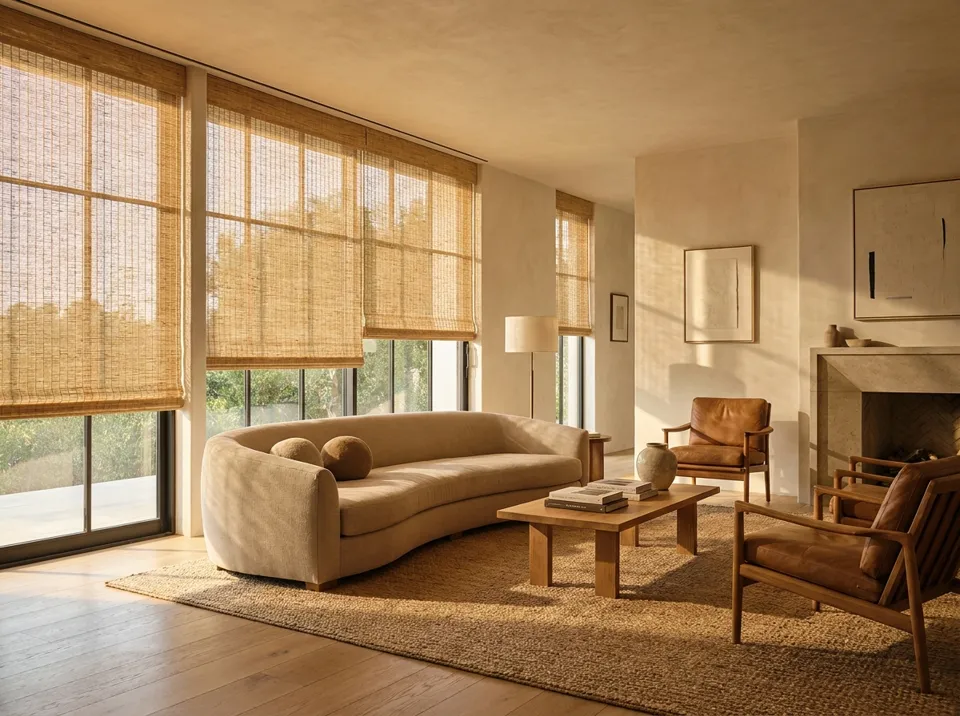
Roman shades fold into soft horizontal pleats and read as soft furnishing rather than hardware, which is why they anchor formal living and dining rooms. Woven wood shades, built from natural grasses and bamboos, bring real texture that fabric cannot copy, and with a liner they control light respectably.
Roman and woven wood pros: the richest texture in the lineup; drapery-adjacent look without drapery maintenance; strong in Pacific Northwest interiors that lean natural. Roman and woven wood cons: taller stack height at the top of the window when raised, which steals view on short windows; natural weaves show more variation than machine fabric.
Consider both for living and dining rooms. Skip them in kitchens and baths, where steam and grease argue for a wipeable roller.
7. Outdoor, skylight, and shaped shades: best for the openings catalogs skip
Some Auburn windows are not rectangles at eye level. Outdoor shades on west patios and slider walls stop heat before it hits the glass, in cable-guided or zipper-track hardware. Skylight shades handle vaulted ceilings. Arch, trapezoid, and other shaped openings get templated on site, because curved and angled fabric cannot be trimmed after the fact.
Specialty pros: they solve the rooms that stock programs simply cannot; exterior fabric cuts heat before it enters the house. Specialty cons: each one is a template job, so cost runs above standard rectangles; lead times can stretch a week or two longer.
Treat these case by case: buy when the opening is the problem, and get the template done on site before anything is ordered.
How we ranked
Every pick above was judged on four criteria, in order: does it solve a real Auburn problem (heat loss, glare, dark bedrooms, tall glass), how well does it fit real South King County framing, what does it cost to do the job right the first time, and what does ownership look like after five years. A shade that wins one criterion but fails the fit test on older trim did not make the Buy list.
What to avoid
- Self-measured orders for pre-2000 homes. Out-of-square frames are the norm, not the exception, and custom fabric cut to bad numbers is rarely returnable.
- One fabric for the whole house. Blackout in a noon living room feels like a cave; sheer in a street-facing bedroom silhouettes people at night.
- Corded hardware within reach of kids or pets. Cordless lift is the 2026 baseline on bedrooms, and motors belong on anything above reach.
- Motors with no local service path. A dead motor that requires shipping the unit back is a shade you stop using.
How local measure and install works
Rainier Blinds is a measure-and-install company based in Auburn. The crew that measures your windows is the same crew that comes back to hang them. Manufacturing happens at a wholesale supplier to your exact measurements; measurement and installation stay in-house. That split is deliberate: supplier fabric ranges with local accountability on fit.
- Consult: walk the rooms, name which windows fail and when, note cranks, locks, and trim depth.
- Measure on site: three widths and three heights per window, mount depth checked, obstacles logged.
- Quote on the spot: real pricing before anyone leaves, on every window in the project. Standard rectangular windows start from $275, backed by a warranty of up to 5 years depending on package.
- Custom-made and installed: shades arrive typically 2 to 4 weeks after measurements are confirmed, and one visit hangs them, with motors paired and limits set before the crew leaves.
Scheduling and coverage details for Auburn-area homes sit on the Auburn service area page.
FAQ
What are the best custom window shades for Auburn WA homes in 2026?
How much do custom shades cost in Auburn, WA?
Which shades are best for keeping heat in during Auburn winters?
Are motorized shades worth it in 2026?
Zebra shades vs. roller shades: which should I choose?
Can I get blackout and sheer on the same window?
Do you install outdoor shades in the Auburn area?
How long does custom shade installation take?
One last thing
The detail most homeowners miss in 2026 is mount depth, checked before the order, not after. A deep cassette or a double-cell shade shoved into shallow older trim binds, sits proud, or leaves a bright rail at the edges, and no fabric choice fixes a bad mount. Outside mount with a 2-to-3-inch overlap is the correct answer when depth is the constraint, and deciding that at the measure visit costs nothing.
Book the free in-home quote and walk the rooms with the crew while the sun is doing the damage. Watching where light actually lands at 3 p.m. settles the shade choice faster than any spec sheet.