
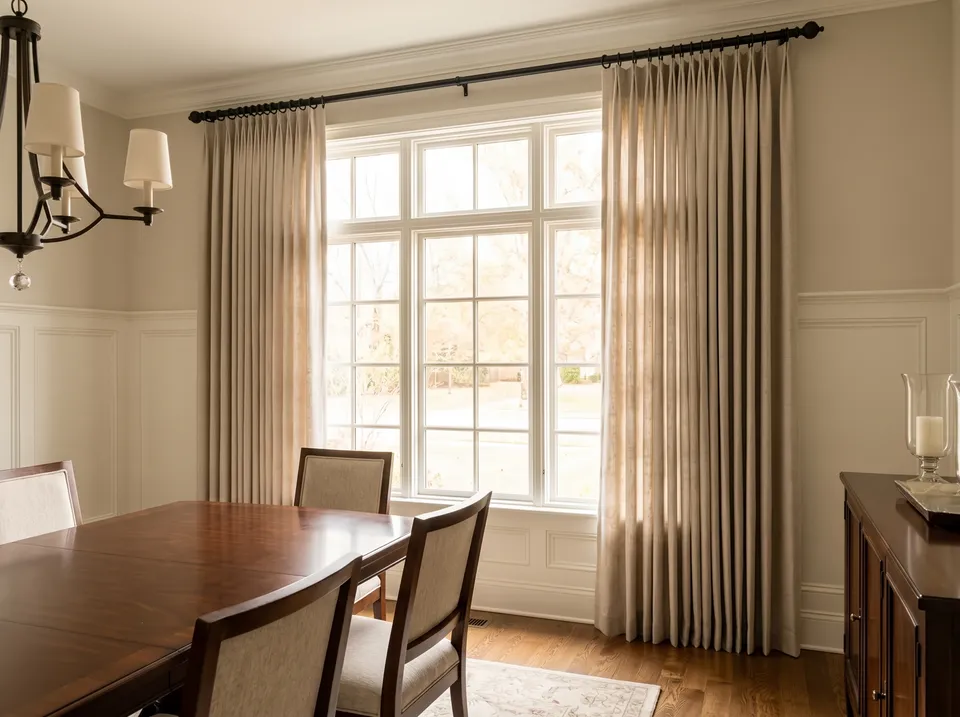
Custom drapes in Kent, WA should be measured, lined, and hung for the exact window you have — not pulled off a rack in three stock lengths that stop short of the sill or pool on the floor. This 2026 buyer guide for custom drapes in Kent, WA covers fabric and lining choices, rod and track hardware, layering drapery over shades, and the measure, custom-order, and install process Rainier Blinds runs for South King County homes.
TL;DR
- Lined, floor-length custom drapes are the Buy for Kent living and dining rooms in 2026.
- Bedrooms get blackout-lined drapery layered over a roller or cellular shade for real darkness.
- Sliding glass doors need tracked panels sized to the opening, not a stock 84-inch panel.
- Rainier Blinds measures, has drapes custom-made by a wholesale supplier, and installs with its own crew.
Why this matters
Kent homes split into three window problems, and no single panel fixes all three. East Hill ramblers and two-stories carry standard-height openings where off-the-shelf lengths almost fit — and almost is the problem. Valley-floor homes along Highway 167 and I-5 fight streetlight glare, headlights, and traffic noise after dark, which is a lining and layering problem. Newer construction near Kent Station and the valley floor brings tall great-room glass and wide sliding doors, which is a hardware and reach problem.
A stock panel answers none of it. Retail panels come in a handful of fixed lengths — 84, 95, and 108 inches are the common ones — in widths sized for price, not for your window. Custom drapery sets length, width, fullness, lining, and hardware to the actual opening. In 2026, that difference shows up in the two places homeowners feel it: how dark the bedroom actually gets, and how the big window wall reads from across the room.
Who this guide is for
This guide is for Kent homeowners replacing dated or broken panels, finishing a remodel, dressing a new build, or solving one stubborn opening — a slider, a two-story window, a bedroom that never gets fully dark. It also fits buyers in Covington, Maple Valley, Renton, and Federal Way who want local measuring and installation instead of a big-box special order that arrives wrong and has nobody local to call.
If your windows are a standard size, get good light, and face a quiet street, store panels can honestly do the job. The cases below are where custom drapes earn their price.
What to look for in custom drapes for Kent homes
Start with the measure, not the swatch
A drapery project starts with the opening and the wall, not the fabric book. The measure should record width, height, ceiling or casing height, what sits in the way — window cranks, handles, outlets, deep trim — and how far the rod can extend past the window on each side.
Rod placement decides the result. Mounting high and wide makes a window look larger and lets panels stack fully off the glass when open. The measure also confirms stack-back: an open panel needs wall space to live in, and a rod barely wider than the window squeezes it back over the glass. Get the rod plan settled before fabric is chosen, because the supplier builds pleats and hems around the hardware.
Choose the lining for the room's job
Drapery fabric alone is decoration; the lining does the work. Unlined panels filter a little light and add softness — right for a dining room where darkness is not the goal. Light-filtering lining softens daylight and takes the edge off afternoon glare. Blackout lining is the correct starting point for bedrooms, nurseries, home theaters, and anyone sleeping after a night shift.
One honest caveat: no hanging panel makes a room pitch-black by itself. Light leaks at the sides and top of any drape. Blackout drapes get close when they wrap around the rod or run in side channels, and they deliver full darkness when layered over a blackout roller or cellular shade. Pick the lining by the room's worst hour, not its best one.
Get the hardware right before the fabric ships
Drapery is a hardware project as much as a fabric project. Blackout-lined panels are heavy; brackets need to land in studs or solid blocking, not bare drywall. Rod diameter, finish, and the number of supports belong in the first conversation.
Pleat style changes the result too. Pinch pleats look tailored and need more fullness, grommets read casual and slide easily, and rings split the difference. A traverse track is the right call on wide openings because carriers move the panel evenly and stack-back can be planned to the inch. Name the hardware, mount, and panel construction together on the custom order, because the supplier sews the hems around them.
Layer drapery over a shade instead of choosing between them
The strongest window in a 2026 Kent home usually has two layers. A roller, cellular, or roman shade handles the daily job — glare, privacy, insulation — and the drapery frames the room, adds a second air layer at the glass, and softens street noise. The shade works; the drape finishes.
Layering is also the honest answer to the blackout question: the shade seals the glass, and the drapes cover what the shade cannot, mainly the edges. Rainier Blinds builds these pairings within its custom window treatment services, and both layers get measured in one visit so the brackets never collide.
Consider a motorized traverse rod for wide or tall glass
Two-story foyers, tall great-room windows, and wide window walls are the cases where hand-drawn drapes stop getting used — the rod is out of reach, or the panel is too heavy to bother with every day. A motorized traverse rod opens and closes on a remote, a phone schedule, or a smart-home routine, which means the treatment actually runs instead of freezing half-open.
Rainier Blinds lists motorization on its shade packages at +$100 per shade for Motorized and +$200 per shade for Smart, with 1-, 3-, and 5-year package warranties respectively; motorized drapery track pricing depends on track length and layout, so ask for it during the consult. Power and track depth affect the mount, which is another reason the decision comes before the order.
Verify who measures, orders, and installs
Ask three direct questions before approving a drapery project: Who measures the windows? Who places the custom order? Who installs and handles follow-up?
Rainier Blinds does not sew drapes in a shop behind the office. A wholesale supplier custom-makes each panel to the measured dimensions, and Rainier Blinds handles the consultation, measurement, order coordination, and installation with its own crew — not a subcontractor. When a pleat hangs wrong or a track binds, one local team owns the fix.
The best custom drapes for Kent homes in 2026
Living and dining rooms: lined, floor-length panels — Buy
The finish pick. Floor-length panels hung high and wide are the single biggest visual upgrade drapery makes. Light-filtering lining keeps the room bright while cutting afternoon glare on west- and south-facing glass, and the panels frame the room even when they are open. Verdict: Buy — this is the default custom-drapery project, and the measure visit is what makes it look right.
Bedrooms: blackout-lined panels over a shade — Buy
The sleep pick. Blackout-lined drapes layered over a blackout cellular or roller shade give a two-stage darkening setup: the shade seals the glass, the drapes swallow the side and top light. This is the combination that gets a valley-floor bedroom facing the street close to fully dark. Verdict: Buy when darkness matters; a lined drape alone is a partial fix.
Sliding glass doors and wide openings: tracked panels — Buy
The hardware pick. Patio doors and wide sliders need a panel that moves with the door or stacks fully clear of the opening. A traverse track sized to the opening, with planned stack-back, keeps the doorway usable every day. Stock 84-inch panels fail here on both length and width. Verdict: Buy on a track; skip single stock panels entirely.
Tall and two-story windows: motorized traverse drapery — Consider
The reach pick. When the rod sits over a stairwell or above a two-story foyer, a motorized track turns an unusable window into one that runs on a schedule. It adds cost and needs power planned at the mount, so it earns its place on high, heavy, or scheduled openings — not on a rod you can touch. Verdict: Consider, and confirm the power plan during the measure.
Home offices and media rooms: drapes over blackout shades — Consider
The control pick. A blackout shade handles video-call glare and screen reflections; the drapery layer tunes how the room looks and sounds. Both layers, one measure visit. Verdict: Consider when the room needs daily light control and a finished frame at the same time.
What to avoid
Buying length off a chart
Sizing a panel from a "fits windows up to" chart ignores casing, rod projection, and the floor. Carpet takes a different break than hardwood, and a panel that skims the floor in one room puddles in another. The finished length gets set per opening at the measure — that is the whole point of custom.
Treating hardware as an afterthought
Heavy blackout panels on thin rods sag in the middle; brackets into bare drywall pull out under the weight. The rod diameter, finish, support count, and anchor points belong in the first conversation with the crew, not in a surprise on install day.
Assuming custom means made on-site
Local service and local manufacturing are different claims. Rainier Blinds measures and installs with its own crew; a wholesale supplier custom-makes every panel. That model is how a local shop delivers custom fabric, lining, and pleats without pretending there is a sewing floor in Auburn.
Drapery options at a glance
| Room | Best drapery pick | Main job | Verdict |
|---|---|---|---|
| Living and dining rooms | Light-filtering, floor-length panels | Soften glare, frame the room | Buy |
| Bedrooms | Blackout-lined panels over a shade | Two-stage darkness | Buy |
| Sliders and wide doors | Traverse-track panels | Full movement, planned stack-back | Buy |
| Tall, two-story windows | Motorized traverse rod | Reach and daily use | Consider |
| Offices and media rooms | Drapery over blackout shades | Glare control plus finish | Consider |
How the Kent measure, custom order, and install process works
Rainier Blinds keeps the process short:
- Consult: describe the rooms, the light problems, and any smart-home plans.
- Measure: the crew records each opening's dimensions, mount, obstructions, stack-back space, and floor condition.
- Order: choose fabric, lining, pleat, and hardware. The wholesale supplier custom-makes the panels to the measured dimensions.
- Install: Rainier Blinds' own crew hangs the rod or track, dresses the panels, checks the break at the floor, and sets up motorization where selected.
Auburn is the home base, and the same crew serves Kent and the rest of South King County — the Auburn service area page describes the same model one city over. The quote page states that new requests get a response within 1 business day; use the quote request once you know the rooms and openings. Final pricing depends on fabric, lining, dimensions, hardware, and the number of panels.
FAQ
How much do custom drapes cost in Kent, WA?
What length should custom drapes be?
Do custom drapes block out all light?
Are custom drapes worth it over store-bought panels?
Can drapery be motorized in a Kent home?
Does Rainier Blinds sew the drapes in-house?
Can I layer drapes over my existing shades?
How do I get a custom drapery quote in Kent?
One last thing
The detail most homeowners skip is stack-back — the wall space a panel needs when it is open. A beautiful drape squeezed onto a rod barely wider than the window never fully clears the glass, so the room loses the daylight the project was supposed to add. Ask for rod width, stack-back, and bracket locations in the same breath as the fabric pick, and the 2026 drapery project finishes as good as it looks.