
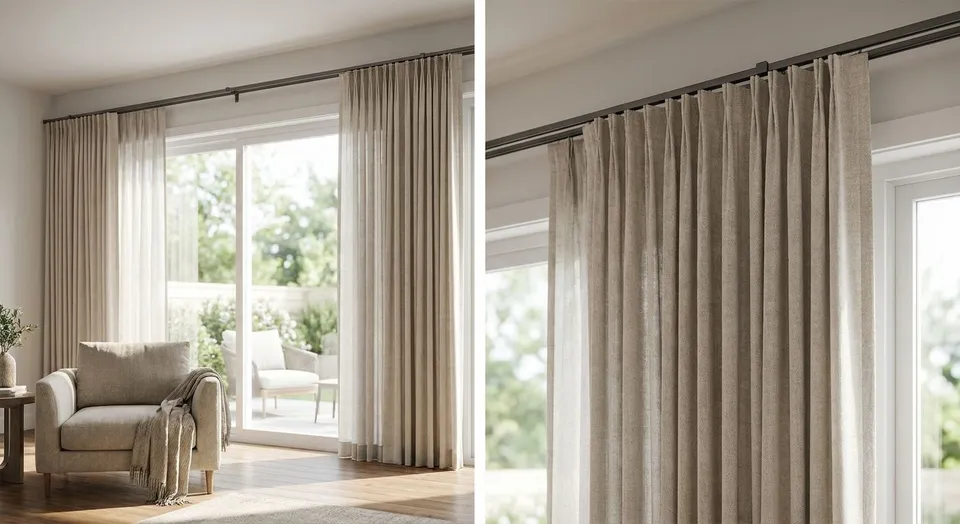
Sliding glass doors are the widest, most awkward openings in most Puget Sound homes, and stock curtain panels rarely hang right on them. This guide breaks down what actually works for drapery panels on sliding doors in 2026, from track choice to fabric weight, so you don't end up with a panel that drags on the floor or won't glide past the door handle.
- A panel track system is the safest custom drapery for sliding glass doors up to 12 feet wide in 2026.
- Pinch pleat traverse panels look classic but need a 2.5x fullness ratio to hang correctly.
- Sheer panels layered over a cellular or roller shade solve the privacy-versus-light problem most Seattle homes face.
- Skip floor-length grommet panels on sliding doors -- they catch on the track hardware every time the door opens.
Why this matters
A sliding glass door is a moving part, not a fixed window. Drapery hung wrong doesn't just look off -- it physically interferes with the door operation, catches on the handle, or bunches against the track every time someone walks through. Getting the hardware, fullness, and fabric right upfront saves a re-order and a second install visit.
Most sliding doors in Auburn, Bellevue, and Tacoma-area homes run 6 to 12 feet wide, which puts them past the width where a basic curtain rod holds up. That's the gap this guide is built to close, and it's also where a lot of the blinds for sliding glass doors comparisons stop short -- drapery solves a different problem than a hard shade does, mainly softness, room framing, and full-width coverage without segmented slats.
Who this is for
This guide is for homeowners replacing a stock curtain rod and panel set on a patio slider, adding drapery to a great room with an 8-to-10-foot sliding door, or layering fabric drapery over an existing shade for a finished look. It's also for anyone comparing drapery against a hard window covering for a wide opening and trying to figure out which hangs better and lasts longer through Pacific Northwest humidity swings.
What to look for in custom drapery for sliding glass doors
Fullness ratio and fabric weight
A panel that isn't full enough looks flat and thin against a wide sliding door -- it reads as an afterthought rather than a finished treatment. Pinch pleat and ripple fold styles need roughly 2.5x the width of the door in fabric to stack and drape correctly; anything less and the panel hangs like a bedsheet.
Fabric weight also determines how the panel behaves near a door that opens and closes daily. Lightweight linen blends move too easily and catch drafts from the door seal, while a mid-weight cotton or blackout-lined fabric holds its shape and stacks cleanly to one side.
Mount type and stack-back
On a sliding door, mount type decides whether the panel clears the door handle when it's pushed fully open. Ceiling-mounted tracks give the cleanest stack-back and the most usable door width, which matters most on doors under 8 feet where every inch of glass counts.
Wall-mounted rods work fine on wider doors with room to spare on either side, but they eat into usable glass on narrower sliders. Measure the stack-back space -- the width the panels occupy when fully open -- before committing to a rod style.
Track and hardware compatibility
A sliding door spanning more than 8 feet needs hardware rated for that span, not a standard tension rod. Traverse rods and panel track systems distribute weight across multiple carriers so the fabric doesn't sag in the middle over time.
This is the detail that gets skipped most often on DIY installs -- a rod rated for a 6-foot window bows within a season on a 10-foot slider, and the fabric starts dragging on the floor at the center.
Fabric selection for light and privacy
Seattle-area light is soft and diffuse most of the year, but west-facing sliders still get direct glare in summer evenings. Choosing drapery fabric for a sliding door means balancing how much privacy you need after dark against how much daylight you want to keep during the day -- sheer, light-filtering, and blackout linings each solve a different version of that problem.
Blackout lining matters more on sliders facing a neighbor's patio or a street-facing backyard. Light-filtering fabric works better when the door faces a private yard and you mainly want glare control, not full privacy.
Layering with a functional shade
Drapery panels alone don't give you daytime privacy without closing the whole opening. Pairing panels with a roller or cellular shade underneath lets you control light and privacy independently of the decorative layer, which is the setup most homeowners land on after living with drapery-only for a season.
Motorization for wide or high-ceiling openings
On sliding doors over 9 feet wide or in rooms with vaulted ceilings, manual traverse cords get harder to reach and operate smoothly. A motorized traverse system removes that friction entirely and is worth the added cost on any opening you'll operate daily.
Top picks for sliding glass door drapery
Panel track drapery -- the practical pick. One track glides the full width of the door, up to 12 feet on a single run, and the fabric stacks cleanly off the glass when open. It's the closest drapery equivalent to a vertical shade but with softer fabric and a finished, tailored look. Buy for doors 8 feet and wider where a rod-and-panel setup would need too much stack-back space.
Pinch pleat traverse panels -- the classic pick. Built at a 2.5x fullness ratio, these hang in even folds and operate on a cord-drawn traverse rod. They suit formal living rooms and dining areas where the door is part of the room's overall look, not just a functional opening. Consider this option if you want a traditional silhouette and don't mind a slightly narrower stack-back than panel track.
Motorized traverse drapery -- the smart-home pick. Motorization removes the cord entirely and works well on doors over 9 feet or in great rooms with high ceilings where reaching a cord is impractical. Buy for daily-use doors in main living spaces; Skip it for guest rooms or rarely-used slides where the added cost doesn't pay off.
Sheer panels over a cellular shade -- the light-control pick. Sheer drapery softens the light coming through a slider without blocking the view, and pairing it with a cellular shade underneath for a sliding glass door adds real privacy and insulation you don't get from fabric alone. Buy for any slider that faces a neighbor's yard or a street.
Ripple fold panels -- the modern minimalist pick. Ripple fold uses a continuous S-curve fold on a track system, giving a cleaner, more contemporary line than pinch pleat. It reads best in newer construction with clean sightlines and less ornate trim. Consider for contemporary builds; Skip it in a traditional or historic-style home where pinch pleat fits the architecture better.
What to avoid on sliding glass door drapery
- Floor-length grommet panels sized for a standard window. Grommet rings bunch unevenly at 2.5x fullness and the extra length drags across the floor track every time the door opens, fraying the hem within a year.
- Lightweight, unlined fabric on south or west-facing sliders. Direct sun through unlined fabric fades color fast and offers almost no glare control on summer evenings -- lining is not optional on sun-exposed doors.
- A single-support tension rod on any door over 7 feet. It looks fine on install day and sags within a few months once the fabric weight settles into the middle of the span.
Get your sliding door drapery measured right
In-home measurement and installation across the Greater Seattle Area.
Verdict comparison
| Style | Best for | Light control | Verdict |
|---|---|---|---|
| Panel track | Doors 8-12 ft wide | Moderate | Buy |
| Pinch pleat traverse | Formal rooms, doors under 9 ft | Moderate | Consider |
| Motorized traverse | Daily-use, wide or high-ceiling doors | Moderate | Buy |
| Sheer + cellular layer | Privacy-sensitive sliders | High | Buy |
| Ripple fold | Contemporary builds | Moderate | Consider |
Rainier Blinds measures and installs custom drapery for sliding glass doors with its own crew, not a subcontractor, which matters most on wide-span installs where hardware has to be leveled and anchored correctly the first time.
FAQ
What is the best type of custom drapery for sliding glass doors?
Panel track drapery is the best option for most sliding glass doors in 2026 because it glides on a dedicated track and stacks cleanly off the glass, unlike a rod-and-panel setup on wide spans. Pinch pleat traverse panels work well too on doors under 9 feet where a more traditional look is the priority.
How much fabric fullness do I need for sliding door drapery?
Pinch pleat and ripple fold panels need roughly 2.5 times the width of the door in fabric to hang and stack correctly. Less fullness leaves the panel looking flat and thin against a wide opening.
Is drapery better than blinds for sliding glass doors?
Drapery gives a softer, more finished look and covers the full width of the door without segmented slats, while blinds or shades give tighter light and privacy control. Many homeowners layer sheer drapery over a functional shade to get both.
Can drapery panels be motorized on a sliding glass door?
Yes, motorized traverse drapery works well on sliding doors over 9 feet wide or in rooms with high ceilings where reaching a manual cord is impractical. It's worth the added cost mainly on doors used daily.
What fabric works best for sliding doors that get direct sun?
A blackout or light-filtering lined fabric holds up better under direct sun than unlined lightweight fabric, which fades quickly on south or west-facing sliders. Lining also improves how the panel stacks and holds its shape over time.
Do sliding glass door drapery panels need a special track?
Doors wider than 8 feet need a traverse rod or panel track rated for that span, not a standard tension rod. A single-support rod sags in the middle within a few months on a wide slider.
How wide can a single panel track span be for a sliding door?
A single panel track can typically span up to 12 feet, which covers most standard and oversized sliding glass doors without needing a joined or double-track system.
One last thing
The detail most homeowners skip is stack-back space -- the width the panels occupy once pushed fully open. On a 6-foot slider, even 6 inches of stack-back on each side eats nearly 20% of your usable glass, which is the difference between a door that feels open and one that still feels curtained even mid-day.