
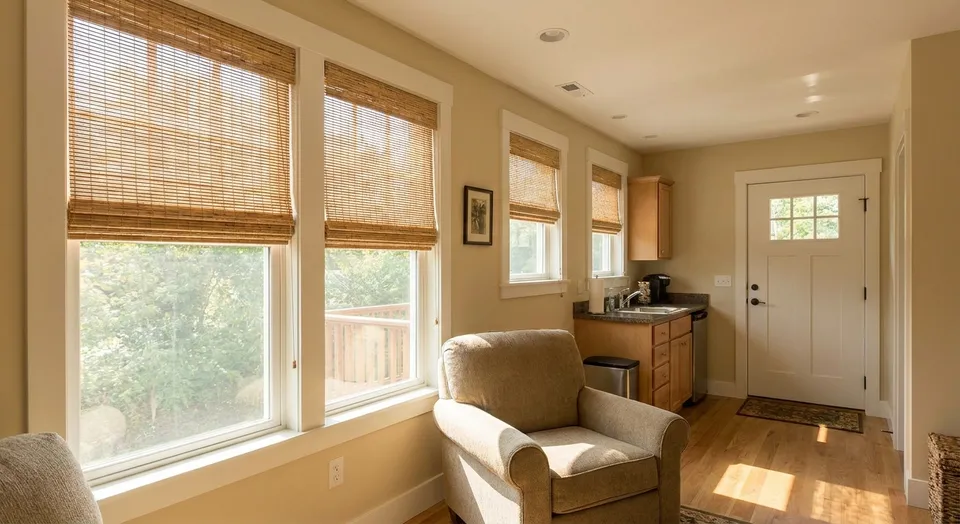
In-law suites mix generations under one roof, and the windows in them do more work than a typical bedroom or living room. They need to handle privacy, light control, and easy operation for whoever's living there, from a teenager to a parent who uses a walker. This guide breaks down what to look for in custom blinds for in-law suites and which product types actually earn a spot on those windows in 2026.
- Cordless insulated cellular shades are the safe pick for garage and basement in-law suites in 2026. Buy them.
- Motorized shades win for aging-in-place suites where reaching a window isn't easy. Buy over manual wands.
- Blackout shades matter more in a suite than the main house because sleep schedules rarely match. Buy for the bedroom window.
- Skip decorative valances and heavy drapery as the only layer; they don't solve the privacy or insulation problem an in-law suite actually has.
Why this matters
An in-law suite is a different living situation than a spare bedroom, even when it's the same square footage. The occupant is often older, sometimes less mobile, and almost always sharing a thin wall, a converted garage envelope, or a below-grade space with worse insulation than the rest of the house.
That changes the priority order for window treatments. A suite window has to control privacy against a shared driveway or backyard, block enough light for a sleep schedule that doesn't match the main household, and, if it's a garage or basement conversion, pull double duty as insulation. Custom blinds for in-law suites need to solve all three at once, not just look good in a listing photo.
Who this is for
This guide is for homeowners in the Greater Seattle area converting a garage, basement, or attached suite into a living space for a parent, adult child, or long-term renter, and who need window treatments that handle privacy, temperature swings, and accessibility, not just a matching look with the rest of the house.
What to look for in custom blinds for in-law suites
Privacy that doesn't kill daylight
An in-law suite window often faces a shared driveway, side yard, or a neighbor's window closer than anywhere else in the house. Light-filtering fabrics hold privacy during the day while still letting the room feel occupied instead of sealed off, which matters when the resident is home most of the day.
Cordless or motorized operation
If the suite is for an aging parent, cords and wands are a fall risk and a daily annoyance. Cordless lift removes loose cords entirely, and motorized shades take that a step further, one remote or app tap instead of reaching, bending, or climbing on anything.
Insulation for converted spaces
Garage and basement conversions rarely get the same insulation upgrade as the walls when they're converted into livable square footage. A cellular shade's honeycomb structure traps a pocket of air against the glass, which matters more in a converted garage than in a room that was built as a bedroom from day one.
Light control matched to a different sleep schedule
When the suite occupant is a shift worker, a night-shift caregiver, or simply an early riser on a different clock than the rest of the house, blackout matters more here than anywhere else in the home. This is the one room where light-filtering alone often isn't enough.
Mount type for odd window shapes
Garage conversions and basement suites frequently have garden windows, narrow transom strips, or windows set into a deeper-than-normal wall. Getting the mount type right before ordering avoids a shade that either doesn't clear the frame or leaves gaps at the edges.
Budget relative to the rest of the house
An in-law suite is usually one or two windows, not a whole-house order, so it's tempting to treat it as an afterthought. Budgeting it as its own line item keeps the suite from getting the cheapest option in the house when it's often the room with the highest actual need.
Top picks for in-law suite windows
1. Insulated cellular shades: the safe pick for garage and basement conversions
Cellular shades use a honeycomb cross-section that holds a layer of still air against the glass, which is the single biggest lever you have in a converted space that wasn't built with bedroom-grade insulation. They come in light-filtering and blackout fabric options, so one product line covers both the temperature problem and the light problem.
For a garage-conversion in-law suite specifically, insulated cellular shades built for garage conversions are the starting point, not an upgrade. Verdict: Buy.
2. Motorized shades: the low-effort pick for aging-in-place suites
If the resident has limited mobility, a motorized shade removes the daily friction of reaching a cord or wand, and most systems pair with a single remote that sits on a nightstand. Setup and daily programming aren't complicated once the shade is installed, the programming steps for motorized window shades take a few minutes per window.
This is the pick that matters most when the suite occupant can't or shouldn't be climbing on a stool to adjust a shade. Verdict: Buy.
3. Blackout shades: the pick for mismatched sleep schedules
A suite bedroom with a resident on a different schedule than the rest of the house needs real blackout, not light-filtering with a privacy liner. Blackout shades built for bedrooms block daylight fully instead of just dimming it, which is the difference between actual daytime sleep and a room that's merely darker.
This is the room in the house where blackout earns its keep the most, even more than a home theater or nursery. Verdict: Buy.
4. Light-filtering roller or zebra shades: the pick for the suite's living area
If the in-law suite has its own small living room or kitchenette, that window doesn't need blackout. It needs privacy during the day without turning the room into a cave. A light-filtering roller or dual-layered zebra fabric holds a soft, even glow while blocking a direct view in from outside.
This pick works well as the daytime-use companion to the bedroom's blackout shade, and it's the one to skimp on last if the budget is tight. Verdict: Consider.
Get real pricing for your in-law suite windows
Rainier Blinds measures and installs across Auburn, Bellevue, Tacoma, and Seattle.
What to avoid
- Decorative valances as the only layer. A valance dresses up the top of a window but does nothing for privacy or insulation, fine as a topper over a functional shade, wrong as the entire solution on a suite window.
- Heavy drapery alone in a converted garage. Drapery panels add softness to a living room, but they don't seal a converted garage's temperature swings the way an insulated cellular shade does, and they're harder for a less mobile resident to open and close daily.
- The cheapest corded blind in the house. Cutting cost on the in-law suite window usually means putting the weakest product on the room with the highest actual need. The opposite of how the budget should be split.
“An in-law suite window carries more daily use than almost any other window in the house, so it's the wrong room to put the cheapest shade in.”
Verdict comparison
| Pick | Privacy | Insulation | Operation | Verdict |
|---|---|---|---|---|
| Insulated cellular shades | Strong (light-filtering or blackout fabric) | Best of the group | Cordless available | Buy |
| Motorized shades | Depends on fabric chosen | Moderate | Best for limited mobility | Buy |
| Blackout shades | Full blackout | Moderate | Cordless or motorized | Buy |
| Light-filtering roller/zebra | Good, daytime-only | Lower | Manual or motorized | Consider |
Rainier Blinds measures each in-law suite window on-site before recommending a product, since a garden window in a garage conversion behaves differently than a standard bedroom window even at the same rough size.
FAQ
What are the best custom blinds for in-law suites?
Insulated cellular shades are the best all-around pick for in-law suites in 2026, since they handle both temperature swings in converted spaces and daytime privacy. Blackout shades are the better pick specifically for the suite's sleeping area.
Do in-law suites need blackout shades?
Yes, if the resident's sleep schedule doesn't match the rest of the household, blackout shades matter more in that bedroom than almost anywhere else in the house. Light-filtering alone often isn't enough for daytime sleep.
Are motorized shades worth it for an aging parent's suite?
Motorized shades are worth it when the resident has limited mobility, since they remove the need to reach, bend, or use a cord daily. A single remote or wall switch replaces the physical effort of manual operation.
Are cordless shades safer for in-law suites?
Cordless shades remove loose cords entirely, which lowers fall and entanglement risk for an elderly or less mobile resident. This matters more in a suite than in a typical guest bedroom.
What window treatments work best for a garage-conversion in-law suite?
Insulated cellular shades work best for garage conversions because the honeycomb structure adds insulation the converted wall usually lacks. Skip drapery alone in this room since it doesn't address the temperature gap.
How much should I budget for an in-law suite's window treatments?
Budget the suite as its own line item rather than an afterthought to a whole-house order, since it's usually one or two windows with higher functional need. Costs vary by product line and window size, so a measured quote is more accurate than a flat estimate.
Do zebra shades work in an in-law suite?
Zebra shades work well in the suite's living or kitchen area where daytime privacy matters more than full blackout. They're a better fit for shared common space than for the bedroom window.
Can I mix blackout and light-filtering shades in the same suite?
Yes, and it's the standard approach, blackout in the bedroom for sleep, light-filtering in the living area for daytime privacy without darkening the room. Each window gets treated based on how that room is actually used.
One last thing
The window that gets skipped most often in an in-law suite build isn't the bedroom. It's the small garden or transom window near the entry or kitchenette, and it's usually the one letting in the most direct sightline from a driveway or side yard. Measure and treat that window with the same seriousness as the bedroom, not as an afterthought.