
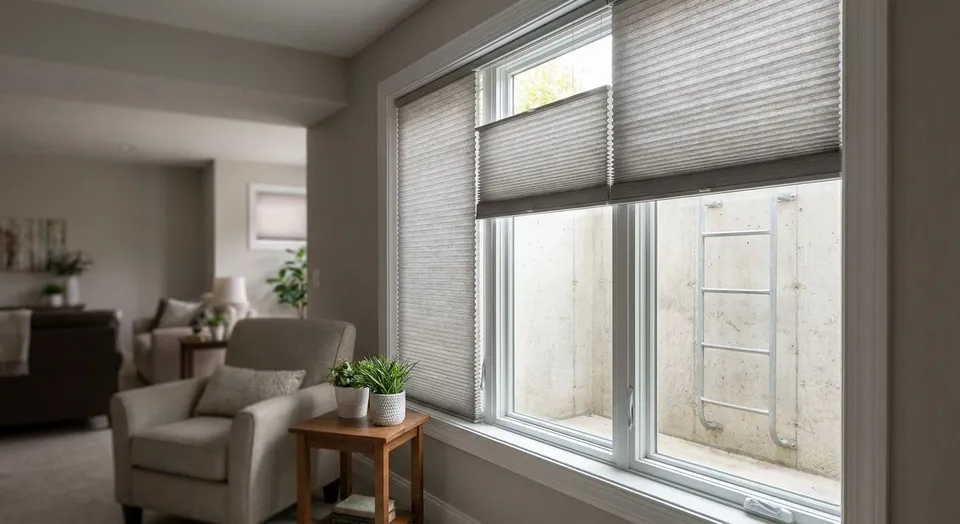
Basement egress windows exist so someone can get out fast, and the wrong window covering turns a code-compliant window back into a hazard. This guide breaks down what actually holds up to inspection versus what just looks fine until someone tries to climb out.
- Top-down bottom-up cellular shades are the safe custom blinds for basement egress windows in 2026. Buy.
- Cordless lift systems are non-negotiable on any window that serves as a legal exit, not optional child-safety upsell.
- Corded blinds and fixed security bars fail egress checks even when the glass opening itself meets code, Skip.
- Vinyl-faced roller shades handle below-grade condensation better than fabric cellular shades in unfinished basement wells.
Why this matters
An egress window is a legal exit, not a design element, and building departments across South King County check that the covering doesn't reduce the operable opening below code minimums. A shade that blocks the crank, a valance bracket that reduces the swing radius, or a cord that snags during a fast exit can turn a passed inspection into a re-inspection.
Basements finished into bedrooms or ADUs in 2026 get more scrutiny than a decade ago, because more jurisdictions require egress compliance documentation before final occupancy sign-off. Custom blinds for basement egress windows have to solve two problems at once: privacy for a below-grade room and zero interference with the opening mechanism.
Who this is for
This is for homeowners finishing a basement bedroom, converting a daylight basement into a rental unit, or adding an in-law suite where the egress window has to stay fully operable at all times. If you're just covering an unfinished basement's hopper windows for light control with no bedroom use planned, code pressure is lower, the garden-level and daylight basement window guide covers that case separately.
What to look for in custom blinds for basement egress windows
Full clearance for the sash swing or crank
Casement and awning-style basement windows open on a hinge or crank mechanism, and the shade hardware can't sit in that swing path. Measure the crank's full arc before ordering, not just the glass dimensions, because a headrail mounted 2 inches too far into the frame can jam a crank mid-turn during an actual emergency.
Cordless lift as a baseline, not an upgrade
A loose cord across an egress window is a snag hazard exactly when speed matters most. Cordless lift systems are standard on most custom cellular and roller shades ordered in 2026, and they remove the fumbling step entirely, pull, push, done.
Net clear opening math that survives inspection
The shade itself doesn't count against the 5.7 square foot net clear opening requirement, but any permanent mounting hardware, side channels, or brackets that physically reduce the glass's usable swing do. Outside-mount hardware that sits proud of the frame is the usual culprit inspectors flag.
Moisture and condensation resistance
Below-grade window wells run more humid than above-grade rooms, especially in Pacific Northwest winters, and fabric shades in a damp well can mildew within a season. Vinyl-faced or PVC-backed roller shades hold up better than untreated fabric cellular shades in unfinished or partially sealed basement window wells.
Light and privacy balance at grade level
Garden-level basement windows sit close to eye height for anyone walking past on the sidewalk or driveway, so full transparency isn't an option, but full blackout during daylight hours makes a below-grade bedroom feel like a cell. Layered light control that opens from the top solves both.
No fixed obstructions near the opening
Valances, cornices, or decorative brackets mounted directly over the operable section reduce the swing radius even when they look purely cosmetic. Anything screwed into the frame within the opening's arc is a liability, full stop.
Get an egress-safe window measured right
Rainier Blinds measures the actual swing radius, not just the glass, before quoting.
Top picks for basement egress windows
Top-down bottom-up cellular shade. The compliance pick. The bottom rail drops independently from the top, so you can keep the lower half of the window fully clear while the upper half stays covered for privacy and glare. Cellular models add an R-value around 3.0 to 4.0 depending on cell depth, which matters in an unheated basement well. Buy. This is the single design that solves privacy and clearance at once, and the top-down bottom-up shades breakdown covers how the lift mechanism handles a basement's shorter drop.
Cordless roller shade, the simple pick. One continuous fabric roll, spring or clutch-operated, with zero loose cord anywhere near the sash. It won't give you the top-down flexibility of a cellular shade, but for a hopper window that only opens outward, that flexibility isn't needed anyway. Buy. Cordless roller shades are the lowest-cost route to a compliant, clean-looking egress window, and the cordless blinds for homes with kids guide applies directly here since egress bedrooms often double as kids' rooms in finished basements.
Zebra shade. The light-control wildcard. Alternating sheer and solid bands let you dial in exactly how much street-level view gets in, adjustable in small increments rather than all-or-nothing. It costs more than a basic roller shade and the banding mechanism sits slightly deeper in the headrail, so double-check swing clearance before ordering. Consider, good for above-grade portions of a walkout basement, less ideal on a tight hopper window where every inch of headrail depth counts.
Vinyl-faced roller shade, the moisture-resistant pick. Built for damp basement wells where fabric would mildew within a season or two, vinyl-faced material wipes clean and doesn't wick condensation the way woven fabric does. It reads more utilitarian than a fabric shade, so it fits an unfinished mechanical-room egress window better than a finished bedroom. Buy for wells with visible moisture, Skip for a fully conditioned basement bedroom where a fabric cellular shade will outlast it aesthetically.
What to avoid
- Corded blinds of any style: a dangling cord across an egress path is exactly the snag hazard cordless systems exist to remove, and it's the first thing an inspector or insurance adjuster flags on a basement bedroom.
- Security bars or fixed grates behind the shade: even when the shade itself is compliant, a security bar bolted over the frame defeats the entire purpose of the egress window and will fail inspection outright.
- Deep-projection valances or cornices: anything that adds bulk to the header beyond what the swing radius allows looks finished on install day and gets flagged the first time someone measures the actual clear opening.
“If a shade blocks the sash swing, it fails egress inspection regardless of how good the fabric looks.”
Verdict comparison
| Option | Cordless | Clearance impact | Moisture resistance | Verdict |
|---|---|---|---|---|
| Top-down bottom-up cellular | Yes | None when sized correctly | Moderate | Buy |
| Cordless roller shade | Yes | Minimal | Good with vinyl face | Buy |
| Zebra shade | Yes | Slight (deeper headrail) | Moderate | Consider |
| Vinyl-faced roller | Yes | Minimal | Excellent | Buy for damp wells |
| Corded blind (any style) | No | Varies | Varies | Skip |
FAQ
Do custom blinds count against the egress window's net clear opening?
No, the shade fabric itself doesn't count against the 5.7 square foot net clear opening under IRC R310, but permanent mounting hardware or brackets that physically block the swing path do. Measure the crank's full arc, not just the glass, before ordering.
Are corded blinds allowed on basement egress windows?
Corded blinds aren't code-banned outright, but a loose cord across an egress path creates a snag hazard exactly when speed matters. Cordless lift systems are the practical standard on egress windows ordered in 2026.
What's the best window covering for a basement bedroom egress window?
Top-down bottom-up cellular shades are the best fit because the bottom half can stay fully clear for the opening while the top half handles privacy and glare. They also add insulation value in an unheated basement well.
Can I install a valance over a basement egress window?
Skip fixed valances or cornices mounted directly over the operable section, since they add bulk to the header that can reduce the swing radius below code minimums. A soft fabric treatment mounted well above the frame is lower risk.
How much does a below-grade window humidity affect shade choice?
Basement window wells run more humid than above-grade rooms, and untreated fabric cellular shades can mildew within a season in a damp well. Vinyl-faced roller shades hold up significantly better in that environment.
Is a zebra shade a good choice for a walkout basement egress window?
Zebra shades work well on the above-grade portion of a walkout basement where adjustable sheer-to-solid banding controls street-level sightlines. On a tight hopper window, the deeper headrail can eat into clearance, so measure carefully first.
Does an ADU basement bedroom need the same egress-compliant shades as a primary bedroom?
Yes, any basement bedroom used as a legal sleeping space in an ADU needs the same egress-compliant window covering as the main house, since the requirement attaches to the room's use, not the structure type.
What size opening does an egress window need in 2026?
Current IRC R310 requirements call for a minimum net clear opening of 5.7 square feet, at least 20 inches wide, at least 24 inches high, with a sill no higher than 44 inches from the floor.
One last thing
The most-missed detail on basement egress windows isn't the shade at all. It's the outside-mount bracket depth. A bracket that projects even a half-inch past the frame into the window well can catch on a ladder or the sash itself during an actual escape, and it's the detail most homeowners never think to measure before ordering.