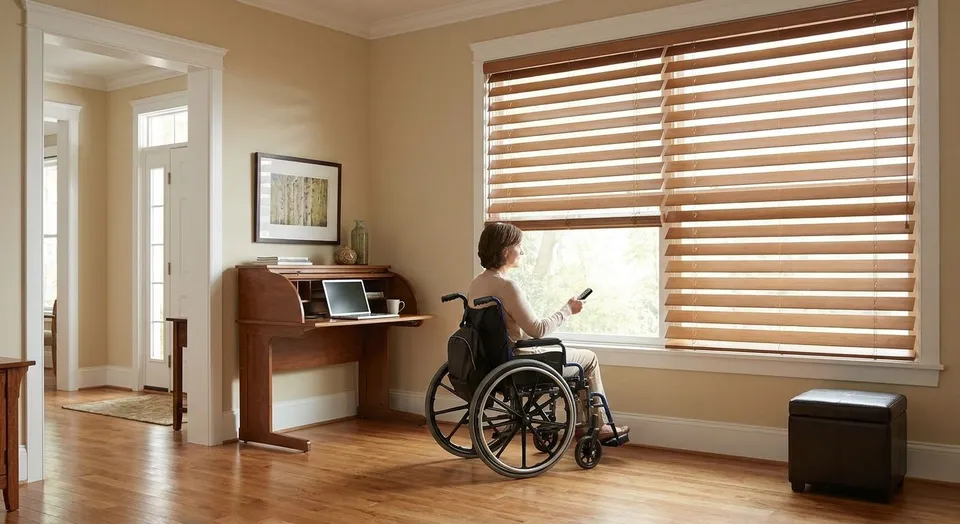
Custom blinds for accessible homes need more than good looks. They need to work for hands that can't reach a cord, eyes that struggle with glare, or a wheelchair user who can't stand to adjust a wand. This guide breaks down what actually matters and names the shade types that hold up.
- Motorized cellular and roller shades are the safest custom blinds for accessible homes in 2026. Buy them first.
- Cordless zebra shades solve glare control for low-vision residents without a single pull cord.
- Skip anything requiring a wand or high-mounted pull cord if a wheelchair user or limited-mobility resident lives there.
- App and voice control matter more than fabric choice once a home has an aging-in-place resident.
Why this matters
ADA Standards for Accessible Design cap unobstructed forward reach at 48 inches. Most factory-standard pull cords and tilt wands sit well above that, and a lot of stock blinds from big-box stores are built for average reach, not accessible reach.
The CDC estimates roughly 1 in 4 US adults lives with a disability, and a growing share of homeowners in the Greater Seattle area are retrofitting for aging parents, ADUs, or in-law suites. Custom blinds for accessible homes solve a real, physical problem, not a style preference. Rainier Blinds measures and installs shades built around reach, not around whatever fits a standard window.
Who this is for
This guide is for homeowners retrofitting a house for a wheelchair user, an aging parent moving in, a resident with low vision or tremors, or anyone managing a multi-generational household where one set of hands can't operate a stiff wand. It's also for anyone building or converting an ADU with accessibility in mind from day one.
What to look for in custom blinds for accessible homes
Cordless or motorized operation
A cord or wand assumes two working hands, a standing reach, and steady fine motor control. Take any of those away and a standard blind becomes unusable. Motorized shades remove the physical operation step entirely. A button press or voice command does the work.
Voice and app control compatibility
A resident who can't reach a wall switch still needs to control light and privacy. Shades that pair with a smart home hub let a caregiver or the resident themselves set schedules, group rooms, or trigger shades by voice, which matters more in an accessible home than in a standard one.
Battery life and maintenance simplicity
Motorized shades typically run 12 months on a charge before needing attention, and that gap matters when the person operating the shade isn't the person who'll climb a ladder to swap a battery. Look for rechargeable systems with a simple USB or solar top-up rather than anything requiring disassembly.
Light control for low vision or light sensitivity
Harsh glare is a bigger problem for low-vision residents than for anyone else in the house. Dual-layer zebra shades let a resident dial light from sheer to blackout in small increments without full-blind operation, which beats an all-or-nothing roller shade for anyone sensitive to sudden light changes.
Cord safety for shared and multi-generational homes
Any home with young children, pets, or residents prone to tangling gets a second reason to go cordless. Strangulation risk isn't limited to nurseries. The guide to childproofing cordless blinds covers the mechanics of why cord-free designs matter across every room, not just kids' rooms.
Easy-clean, allergy-friendly fabric
Cellular shades trap dust in their honeycomb structure less than heavy drapery does, and light-filtering fabrics wipe clean without heavy laundering. For residents with respiratory sensitivity, that's a real quality-of-life factor, not a marketing line.
Get an accessibility-focused measure
Rainier Blinds measures reach height and mount type on-site, no guessing.
Top picks for accessible and ADA-friendly homes
Motorized cellular shades. The quiet workhorse. Honeycomb construction adds insulation on top of hands-free operation, and a single remote or app command controls every room paired to the hub. Battery life runs about 12 months per charge in typical use. Buy. This is the default for bedrooms and living rooms in an accessible retrofit.
Motorized roller shades, the smart-home favorite. Clean, single-layer fabric with full open-close range via app, voice assistant, or wall switch, and it's the easiest style to program into existing routines. Rainier Blinds' guide to programming motorized window shades walks through hub setup once the shades are installed. Buy, best for kitchens, home offices, and rooms with a single large window.
Cordless zebra shades. The light-control specialist. Alternating sheer and solid bands let a resident dial in exact light levels by hand, without a cord, in increments a standard roller can't match. Consider, strong pick where glare sensitivity outweighs the need for full motorization.
Motorized roman shades, the traditional look with modern operation. Soft fabric folds retain a more residential feel than a roller shade while still running cordless and app-controlled. Heavier fabric weights slow motor response slightly, so match motor strength to fabric before ordering. Consider, works well in formal living or dining rooms where full-track roller shades feel too utilitarian.
Motorized outdoor zipper shades, for patio and deck access. Steel wire and zipper-track systems seal against wind while still running push-button, useful for residents who use a covered patio as a primary outdoor space. Consider. Skip if the deck isn't a regular part of daily routine, since it's a bigger investment than an interior room.
Homes with a resident who can't stand or reach comfortably should treat motorization as the answer to aging-in-place window treatments first, and treat fabric or style choice as a second-priority decision.
What to avoid
- High-mounted pull cords or continuous-loop chains. They look tidy in a showroom but sit above the ADA's 48-inch reach limit for anyone using a wheelchair or seated most of the day.
- Heavy blackout roman shades without motorization: the fabric weight that makes them great for a nursery makes them hard to raise by hand for anyone with limited grip strength.
- Any window treatment requiring a stepladder to reach a manual crank, common on outdoor and skylight installs, and a real fall risk for a resident who lives alone.
Verdict comparison
| Style | Operation | Cord-free | Best for | 2026 Verdict |
|---|---|---|---|---|
| Motorized cellular shades | App/voice/remote | Yes | Bedrooms, living rooms | Buy |
| Motorized roller shades | App/voice/remote | Yes | Kitchens, offices | Buy |
| Cordless zebra shades | Manual, no cord | Yes | Glare-sensitive rooms | Consider |
| Motorized roman shades | App/voice/remote | Yes | Formal rooms | Consider |
| Motorized outdoor zipper shades | App/voice/remote | Yes | Patios, decks | Consider |
FAQ
What are the best custom blinds for accessible homes in 2026?
Motorized cellular and roller shades are the top picks for accessible homes in 2026 because they remove cords and wands entirely and run on app, voice, or remote control. Cordless zebra shades are the runner-up for residents who need fine glare control without full motorization.
Do motorized shades meet ADA reach requirements?
Motorized shades operated by a remote, wall switch, or voice assistant sidestep the ADA's 48-inch forward reach limit entirely, since no physical reach to the window is required. That makes them the most reliable ADA-friendly option compared to a standard pull cord or wand.
Are cordless blinds safer for accessible and multi-generational homes?
Yes, cordless blinds remove the strangulation and tangling risk that cords pose, which matters in homes with children, pets, or residents prone to grabbing at fabric. They also remove the fine-motor-control requirement that a cord or wand demands.
How much does motorized window shade installation cost in 2026?
Cost varies by window size, fabric, and whether the home already has a smart hub in place. A tailored quote from a local installer accounts for reach height and mount type specific to the accessibility need.
Can motorized shades connect to an existing smart home hub?
Most motorized cellular and roller shades pair with major smart home hubs for voice and app control. Setup typically happens during or right after installation, not as a separate project.
What's the difference between cordless and motorized shades for accessibility?
Cordless shades remove the strangulation hazard but still require a hand to lift or lower the shade manually. Motorized shades remove the physical operation step entirely, which matters more for residents with limited mobility or grip strength.
How long do motorized shade batteries last?
Motorized shade batteries typically run about 12 months between charges under normal use. Rechargeable systems avoid the need to replace hardware, which matters for residents who can't maintain equipment themselves.
Are custom blinds better than off-the-shelf blinds for ADA-friendly homes?
Custom blinds account for exact reach height, window size, and motor placement, which off-the-shelf blinds are not built to address. A stock blind sized for an average window rarely lines up with a resident's actual reach zone.
One last thing
The detail most homeowners miss: mount type changes reach height as much as shade style does. An inside-mount shade sits recessed in the window frame, which can push a manual control higher than an outside mount would, worth checking before assuming motorization solves the problem alone.