
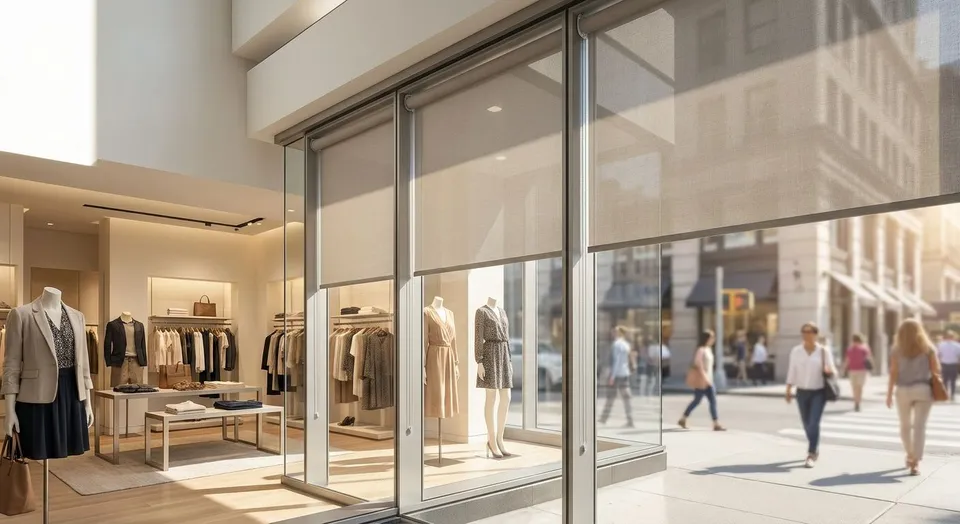
Retail storefront window treatments are commercial shades installed on street-facing glass with the aim of cutting glare and UV fade while keeping window displays visible during business hours. A storefront differs from a home window in scale and sightline: glass often runs floor to ceiling, sun exposure changes by street orientation, and every shade decision changes how merchandise reads from the sidewalk.
- Commercial window treatments for storefronts in 2026 favor roller and zebra shades that cut glare without hiding the display window.
- Rainier Blinds measures and installs motorized and manual shades for storefronts across the Greater Seattle Area with its own crew, not a subcontractor.
- Cellular shades add insulation value for older strip-mall glass but stack thicker at the header than roller fabric.
- Outdoor zipper-track shades handle covered entries and patio seating, not the interior storefront glass itself.
- Blackout fabric belongs on stockroom or back-of-house glass, never on the main display window during open hours.
Why commercial window treatments for storefronts matter for retail
A storefront sees more direct sun hours than a typical home window because retail hours run through the brightest part of the day, every day, not just mornings or weekends. Registers, POS screens, and product boxes stacked near south- or west-facing glass take the worst of it, and faded packaging near the window is usually the first sign the glass has been unshaded too long.
Foot traffic sightlines matter here in a way they don't at home. A shade that's too opaque during business hours kills the point of a display window, and a shade that's too sheer at night leaves the sales floor visible from the sidewalk after close. Getting commercial window treatments for storefronts right in 2026 means solving both problems with one product, not two separate ones.
Lease terms add a layer most homeowners never deal with. Property managers in strip malls and mixed-use buildings often have a say in what's visible from the street, which pushes storefront owners toward neutral fabric colors and away from anything that reads as residential. Motorized shades for corporate office buildings face a similar constraint, though the visibility stakes are lower than a retail display window that's meant to be seen.
Audit your storefront's sun exposure by orientation
Start with a walk-through at both open and close, not just once at noon.
- Note which panes take direct sun at opening and which take it at closing, since a corner storefront often gets both.
- Check east-facing glass for morning glare that hits the register or POS screen first thing.
- Look at west-facing glass for afternoon heat gain that affects HVAC load, not just visibility.
- Photograph any faded flooring, signage, or product boxes near the glass, that's proof the fade is already happening.
- Check for clerestory or transom glass above the entry door, a strip most storefront owners forget to shade at all.
Set your daytime opacity level
This is the core decision for any storefront, and it's the one that determines whether the shade helps or hurts the display.
- Light-filtering roller fabric in a low openness range cuts glare on registers and screens while keeping the window display visible from the sidewalk.
- Blackout roller fabric belongs on stockroom glass, staff break rooms, or any back-of-house pane where visibility isn't the point.
- Zebra shades let staff slide the alternating sheer and solid bands through the day, opening up for the morning rush and dimming for an afternoon glare spike without a full fabric swap.
- Cellular shades work for older single-pane storefront glass common in strip malls built in the 1970s and 1980s, adding insulation value along with glare control.
Decide between manual, motorized, and smart operation
Manual works, but a storefront run by rotating staff usually outgrows it fast.
- Manual chain or cordless lift costs the least and fits a single-window storefront with one consistent opener.
- Motorized shades run on a timer or wall switch, which matters when three different employees open and close the store across a week.
- Smart shades pair with a hub or app, useful for a multi-location retailer that wants every storefront on the same schedule.
- Battery-powered motors avoid running new electrical to older strip-mall glass lines that were never wired for it.
Rainier Blinds measures and installs all three operation tiers on storefront glass across Auburn, Bellevue, Tacoma, and the rest of the Greater Seattle Area with its own crew, never a subcontractor. That in-house measure and install step matters more on commercial glass than residential, since a storefront window is rarely a standard size and a bad measurement means a shade that binds against the header or door frame.
Match mount type to your storefront glass and header
Storefront headers vary a lot more than residential window trim, and the wrong mount type shows immediately from the sidewalk.
- Inside mount keeps the shade flush against the glass, cleanest look for a display window.
- Outside mount covers a shallow or uneven header where an inside mount won't seat properly.
- Check clearance around any glass entry door track before ordering, since a shade that overlaps the door swing is a daily problem, not a one-time annoyance.
- Standalone shades for a glass entry door itself need a different bracket than the flanking display windows.
Plan for after-hours privacy and security
Once the store closes, the same glass that shows off merchandise all day becomes a sightline into an empty sales floor.
- Blackout backing on roller fabric blocks the after-hours view without a second shade layer.
- Cellular shades' insulating cell structure helps overnight HVAC cost on top of the privacy benefit.
- A secure bottom bar matters on tall storefront glass where a loose shade edge can be pried or lifted.
- How windows get measured for custom blinds applies just as much to commercial glass, since an undersized shade leaves gap light at the edges even with blackout fabric.
Coordinate with your landlord or property manager
Skip this step and you risk reordering shades after the fact.
- Check the lease for any clause on visible shade color or style before placing a custom order.
- Get written signoff on anything besides a neutral white or gray fabric.
- Confirm who owns the shades at lease end, since some landlords count them as fixtures.
- Align any motorized schedule with building hours if the landlord controls common-area lighting or security systems.
- Multi-family property managers deal with a version of this same approval chain across tenant units, and the same discipline about getting sign-off in writing applies to a retail lease.
Comparison: storefront window treatment options
| Option | Best for | Operation tiers | Key limitation |
|---|---|---|---|
| Roller shades | Daytime glare control while keeping the display window visible | Manual, motorized, smart | Sheer or light-filtering fabric doesn't fully block interior sightlines after dark |
| Zebra shades | Adjustable privacy through the day without closing the window entirely | Manual, motorized, smart | Sheer bands still show a silhouette from the sidewalk at night |
| Cellular shades | Insulating older strip-mall glass and cutting HVAC load | Manual, motorized, smart | Thicker stack height can crowd a tall display header |
| Outdoor shades (zipper track) | Covered entries or outdoor seating attached to the storefront | Manual, motorized | Built for exterior use, not the interior storefront glass |
| Drapery | Softening an entrance or adding brand color at the door | Manual, motorized | Needs rod or track space many storefront glass fronts don't have |
Roller shades win for most storefronts because they solve daytime glare and nighttime privacy with one fabric choice, and they mount cleanly on standard commercial glass headers.
“A storefront shade that's too opaque during business hours defeats the whole point of a display window.”
Common mistakes retail storefronts make
- Skipping the clerestory glass. Ordering shades for the main display window and forgetting the transom strip above the entry door leaves one uncovered pane that keeps generating glare complaints.
- Choosing blackout fabric for the display window. This kills sidewalk visibility of the merchandise during the exact hours it's supposed to be seen.
- Going manual on a storefront with rotating staff. Shades end up half-raised for months when no single employee owns the daily routine.
- Skipping the property manager check. A custom color that violates the lease means a reorder, and reorders cost time a retailer doesn't want to lose during open hours.
- Measuring once and ordering for every window at that size. Corner storefronts almost always have at least one pane that's narrower or taller than the rest.
FAQ
What's the best window treatment for a retail storefront?
Roller shades in a light-filtering fabric are the best fit for most retail storefronts in 2026 because they cut glare on registers and screens while keeping the window display visible from the sidewalk. Zebra shades are a close second where staff need to adjust privacy through the day.
Are motorized shades worth it for a storefront?
Yes for any storefront opened and closed by more than one employee, since a timer or wall switch removes the daily manual step entirely. Manual shades still work fine for a single-window storefront with one consistent opener.
Can zebra shades work on a retail storefront?
Zebra shades work well on storefront glass because the alternating sheer and solid bands let staff dial privacy up or down through the day without a full fabric change. They're a common pick for storefronts with a morning glare problem and an afternoon privacy need.
Do storefront shades need to match building lease requirements?
Many commercial leases include a clause on visible shade color or style, so getting written signoff before ordering a custom color avoids a costly reorder. Check the lease before placing any storefront shade order.
What's the difference between roller shades and cellular shades for storefronts?
Roller shades give a flatter, cleaner look on tall display glass and handle daytime glare well, while cellular shades add insulation value that matters more on older single-pane storefront windows. Cellular shades stack thicker, which can crowd a shallow header.
How long does it take to get storefront shades installed?
Timelines depend on fabric and motorization choice, and a free in-home consultation is where exact scheduling gets confirmed. Rainier Blinds measures and installs storefront shades with its own crew across the Greater Seattle Area.
Does Rainier Blinds install commercial window treatments in Seattle?
Yes, Rainier Blinds measures and installs commercial window treatments for storefronts across Seattle, Bellevue, Tacoma, and Auburn, using its own measure and install crew rather than a subcontractor.
Do storefront shades need to be replaced more often than home shades?
Storefront glass typically sees more direct sun hours per day than a home window because retail hours run through peak daylight, which shortens fabric life if the wrong opacity was chosen at the start. Picking the right fabric during the initial consultation reduces that wear.
One last thing
The window most storefront owners forget isn't the big display pane, it's the narrow clerestory strip above the entry door. That glass catches direct morning sun most owners never think to shade, and it's usually the actual source of the glare complaint at the register, not the front window everyone blames first. Get that strip measured along with the rest of the storefront in 2026 and the register glare problem usually disappears.