
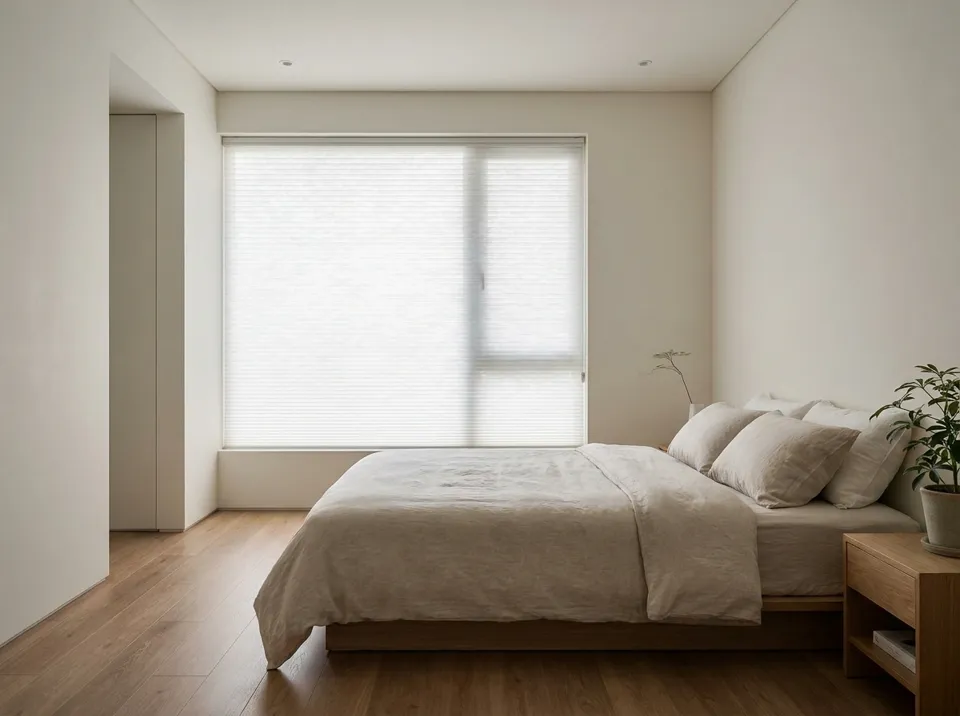
Blackout shades in Auburn, WA are the fix for bedrooms that wake with the sun. And South King County sun comes up before 5:30 AM around the June solstice. This 2026 guide covers the difference between true blackout and room-darkening fabric, the edge sealing that decides whether a room actually gets dark, cellular vs roller vs dual-shade picks by room, and how a local crew that measures, has shades custom-made, and installs keeps the light out.
TL;DR
- Blackout shades Auburn WA homes buy in 2026 when bedrooms, nurseries, or shift-work sleep need real dark.
- True blackout blocks about 99% of light through the fabric; room-darkening still glows at dawn.
- Edge sealing, outside mount or side channels. Matters more than fabric choice.
- Blackout cellular wins dark plus insulation; blackout roller wins the tightest seal in channels.
- Rainier Blinds measures, has custom shades made by the supplier, and installs with our own crew.
Key numbers
Why this matters
Auburn sits far enough north that summer daylight runs long, sunrise lands before 5:30 AM in late June and the sky stays light past 9:00 PM. For a bedroom on the east elevation, a nursery, or a shift worker sleeping at 7:00 AM, that is the whole problem. Light-filtering fabric softens the glare but still passes enough glow to wake a light sleeper, and a dark gray "room-darkening" shade from a big-box shelf is not blackout no matter what the packaging says.
The second reason this guide exists is the failure mode. Homeowners buy blackout fabric, install it inside the frame, and the room still glows, because light travels around the fabric, not through it. On a settled Auburn frame that reads a quarter inch out of square, an inside-mounted blackout shade leaves bright rails down both sides and a U-shaped outline at the sill. The fabric did its job; the edges did not.
That is why edge sealing is the core decision in this guide, ahead of fabric brand or color. Blackout fabric with an outside mount that overlaps the casing, or side channels on an inside mount, closes the light path. The fabric alone blocks roughly 99% of light through the face. And the remainder along the edges is exactly what wakes people up at dawn in 2026. When insulation matters as much as darkness on the same window, the comparison lives in our cellular shades Auburn WA guide; this page is about getting the room genuinely dark.
Who this is for
This guide is for Auburn and South King County homeowners who need a room genuinely dark: primary bedrooms hit by early summer sunrise, nurseries and kids' rooms, guest rooms on the east side of the house, media rooms, and shift workers or day sleepers. It also fits buyers finishing a remodel who planned dark rooms but have not picked a product, and anyone replacing blackout curtains that pooled on the sill and never sealed.
It is not for day rooms where the goal is soft daylight. Light-filtering shades do that job better, and a blackout shade forced into a living room reads cave-like by noon. It is also not for outdoor openings; exterior fabric is a different product family with different hardware. If the room only needs day-to-night flexibility on one window, a dual day/night system may be the better tool. That comparison is covered in the picks below.
What to look for in blackout shades for Auburn homes
True blackout vs room-darkening fabric
The labels are not interchangeable, and the difference shows up at 5:00 AM. True blackout fabric blocks roughly 99% of light through the face, a dense coating or laminated backing on the fabric. Room-darkening fabric blocks most direct light but still glows when the sun hits it, and light-filtering fabric only softens daylight.
Ask for the fabric's blackout classification during the measure visit, in plain words: does the face pass light under direct sun or not. A fabric that passes glow in a showroom under LED lighting will pass far more on an east-facing Auburn window at dawn. If the sleeper needs dark for daytime sleep, order true blackout and plan the edges. There is no middle ground that does the job.
Edge sealing: outside mount and side channels
This is the decision that separates a dark room from a glowing one. Light runs around the fabric, so the mount does the sealing:
- Outside mount: the shade hangs over the casing and overlaps the opening by a couple of inches on each side and at the top. The fabric covers the frame instead of riding inside it, which closes the side gaps and forgives out-of-square openings. The default for bedrooms in 2026.
- Side channels: aluminum rails on the left and right of an inside-mounted shade that trap the fabric edge. The tightest light seal available on a retrofit window, and the standard for media rooms and shift-work bedrooms.
- Bare inside mount: the fabric face blocks light; the sides do not. Acceptable only in rooms where darkness is a preference, not a requirement.
Sill gaps matter too. A drop that stops a hair short of the sill draws a bright outline along the bottom. The measure visit should confirm the drop runs to the sill or slightly past it.
Cellular vs roller for blackout rooms
Both do blackout well; they solve different second problems. Blackout cellular shades trap air in the honeycomb structure, so they darken and insulate at the same time, the right pick on older single- or double-pane glass, where a cold window surface fights the dark room's comfort from November through March. Double-cell fabric adds the most insulation, with the trade of a deeper stack and a deeper casing requirement.
Blackout roller shades give the cleanest flat face and the slimmest stack, with the same blackout coating behind a plain fabric front. They pair most cleanly with side channels, which is why they win media rooms. Many South King County homes in 2026 run blackout cellular in bedrooms and blackout rollers in media rooms, same darkness, different second job.
Layering: sheer plus blackout on one window
Bedrooms rarely need one fabric doing two jobs. A sheer or light-filtering layer for daytime, plus a blackout layer behind it for sleep, gives each layer one job. And this is exactly how day/night (dual) shades and stacked dual rollers work: two fabrics, one headrail, one control each. The blackout layer still needs its edge plan; the sheer in front does not change the light path around the blackout face.
Layering also solves the "I hate waking up in a cave" problem. Daytime light comes through the sheer; night darkness comes from the blackout layer pulled down. If a window needs both behaviors daily, price the dual system once instead of buying a second product a year later.
Cordless and motorized lift
Cordless lift is the 2026 child- and pet-safety baseline for any blackout shade within reach. Dangling cords on a bedroom window are a documented strangulation hazard, and modern cordless hardware removes them. Continuous-loop corded hardware still appears on some wide drops; treat it as a skip unless the opening is fully out of reach.
Battery motors sit in the headrail or tube, pair with a remote or phone app, and recharge roughly every 6 to 12 months depending on cycle count. Motorize the openings you operate while half-asleep, a nursery shade dropped at naptime, a media-room shade for movie start, or tall glass behind a bed. Hardwired motors suit new construction where electrical is already planned. Schedules only work when travel limits are set cleanly on install day, which is what the installing crew does before it leaves.
Fit on out-of-square frames
Blackout shows fit errors faster than any other shade type. A frame 1/4 inch out of square leaves a light wedge an inside-mount shade cannot close. Which is why the measuring crew records three widths and three heights and orders to the tightest usable number, then picks inside vs outside mount based on the real frame, not the catalog assumption. Window cranks, deep sills, and security sensors also change bracket placement, and none of them show up on a phone-photo measurement.
This is also where self-measure fails hardest. Custom blackout fabric cut to uploaded numbers is rarely returnable, and the errors are invisible until the first dawn. A local measure costs less than one remake.
Top picks for Auburn and South King County
The safe pick: blackout cellular with outside mount
The dark-and-warm pick. Double-cell blackout cellular darkens the room and insulates the glass in the same product, the standard for Auburn primary bedrooms, nurseries, and any older window that runs cold from November through March. Buy for sleep rooms on pre-1990s glass. Custom-made to your exact measurements after an on-site measure, not cut from a stock chart.
The media-room pick: blackout roller with side channels
The sealed pick. A blackout roller in side channels is the tightest light seal available on a retrofit window. The rails close the sides, and the coated face blocks the rest. Buy for media rooms, home theaters, and shift-work bedrooms where any glow ruins the room. Skip bare inside-mount blackout on any sleeper-sensitive room in 2026.
The flexible pick: dual day/night shades
The two-jobs pick. A sheer or light-filtering layer stacked with a blackout layer in one cassette gives daytime view and night darkness on one window without swapping products. Buy for primary bedrooms that want a bright morning option and true dark at night, and for nurseries where naptime and playtime share the window. Confirm casing depth at the measure visit. Two fabrics need more stack depth than one.
The formal pick: blackout-lined roman or drapery pairing
The dressed pick. A roman shade with blackout lining, or a shade paired with drapery panels, darkens the room while the window still reads as finished fabric from across the space. Buy for primary suites and guest rooms where a bare roller looks unfinished. The blackout layer still needs the outside mount or liner plan; fabric folds alone do not seal edges.
The access pick: motorized blackout shades
The never-touch-it pick. Battery motors on nursery, media-room, and behind-the-bed openings remove the reach problem and enable schedules, drop at naptime, raise at bedtime, all from a remote or phone. Consider for any opening you operate daily; motorization is an access and scheduling upgrade, not a darkness requirement. Budget the 6-to-12-month recharge cadence on high-cycle windows.
What to avoid
Room-darkening fabric sold as blackout
A dark gray shade is not a blackout shade. Under direct dawn sun, room-darkening fabric glows, and a sleeper who ordered darkness gets a dim room instead. Ask whether the fabric blocks about 99% of light through the face, and get the answer before the order sheet is signed.
Bare inside mounts in bedrooms
The fabric face is only half the light path. Inside a slightly out-of-square frame, a blackout shade leaves bright rails at the sides and a glow line at the sill that no fabric weight fixes. Outside mount or side channels are the fix, decide it on measure day, not after the first sunrise.
Self-measure kits ordered online
Custom blackout fabric cut to uploaded numbers is rarely returnable, and blackout exposes every measurement error. Older Auburn casings read different widths at top, middle, and bottom. Three width readings, the tightest number, and a depth check at the frame are the rules a local crew already follows, and the reasons the quote includes the measure visit.
Verdict comparison
| Option | Best for | Key detail | Verdict |
|---|---|---|---|
| Blackout cellular, outside mount | Bedrooms on older glass | Dark plus insulation | Buy |
| Blackout roller + side channels | Media rooms, shift sleep | Tightest edge seal | Buy |
| Dual day/night shades | Rooms needing both jobs | Two fabrics, one headrail | Buy |
| Blackout-lined roman or drapery pairing | Formal and staged rooms | Darkness with a finished look | Buy |
| Motorized blackout | Nursery, media, tall glass | Battery 6-12 mo cycle | Consider |
| Room-darkening fabric as blackout | , | Glows at dawn | Skip |
How local measure, custom-make, and install works
Rainier Blinds is a measure-and-install company based in Auburn. The crew that measures your windows is the same crew that comes back to hang the finished shades. Custom shades are built by an established wholesale supplier to those exact measurements; measurement and installation stay in-house. That split is intentional. You get supplier fabric ranges with local accountability on the fit that blackout depends on.
- Consult and measure: on-site, room by room: which rooms need true dark, which need daytime light, three widths and three heights per window, casing depth, and every crank or sensor noted.
- Quote on the spot: real pricing before we leave, on every window in the project, including edge-sealing hardware and any motorization. Standard rectangular windows start from $275, backed by a warranty of up to 5 years depending on package.
- Custom-made by the supplier: fabric and hardware built to your measurements, typically arriving 2-4 weeks after the order is confirmed.
- Install: usually one visit. Side channels aligned, travel limits set on motors, and the light seal checked before the crew leaves.
Coverage and scheduling details for Auburn jobs sit on the Auburn service area page, and the full range we measure and install, from daylight fabric to true blackout, is on the custom window treatments services page. The free quote starts with a measure visit, not a showroom appointment.
FAQ
What are the best blackout shades for bedrooms in Auburn, WA in 2026?
Do blackout shades really block all light?
How much do blackout shades cost in Auburn, WA?
What is the difference between blackout and room-darkening shades?
Should blackout shades be inside mount or outside mount?
Can blackout shades be motorized?
How long do blackout shades last?
How long does it take to get custom blackout shades?
One last thing
The detail most homeowners miss is the morning test, not the showroom test. Blackout fabric that looks perfectly dark under retail lighting will glow on an east-facing Auburn window at 5:15 AM in June unless the edges are sealed. Before you sign the order, ask the measuring crew to confirm two things in writing: the fabric's true blackout rating, and the edge plan, outside-mount overlap or side channels, for every sleep room.
Then book the measure visit in the early morning if your schedule allows. Watching where dawn light actually enters the room answers more questions than any spec sheet in 2026.