
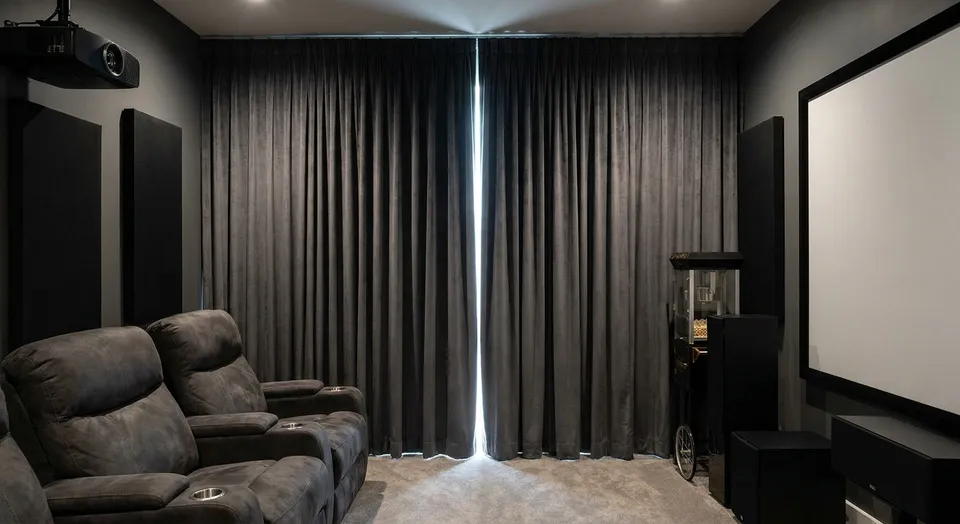
A home theater only works in the dark. If daylight leaks around the window frame, your projector's black level turns gray and the whole picture flattens out. So the window treatment isn't decor here, it's part of the AV build.
- Insulated blackout cellular shades win for garage or basement theater conversions in 2026. Buy them for the dead-air gap they add.
- Blackout drapery panels with a 2 to 3 inch side overlap beat off-the-shelf blackout curtains for true room darkening.
- Single-layer big-box blackout curtains leave light gaps at the frame. Skip them for a dedicated theater room.
- Layered zebra plus blackout combos work when the room doubles as an office by day and a theater by night.
Why this matters
A true home theater needs the room to hit near 0 lux with the lights off and the screen dark, anything less and contrast ratio suffers, no matter how much you spent on the projector. Big-box blackout curtains are rated for bedrooms, not for the total dark a 100-inch screen demands.
Rainier Blinds measures for this specific problem across Auburn, Kent, Bellevue, and Tacoma, theater rooms, converted garages, basement media rooms, and bonus rooms with one bad west-facing window that ruins every afternoon screening. The fix is rarely a single product. It's the right layer, the right overlap, and the right mount for the room you actually have.
Who this is for
This guide is for homeowners finishing a dedicated theater or media room, garage conversions, basements, bonus rooms. Where the goal is full-room darkening for projector contrast, not just privacy or a softer bedroom glow. If you're shopping for a nursery or a guest bedroom, a lighter blackout shade does the job; a theater room needs the heavier-duty version of the same idea.
What to look for in blackout curtains for a home theater
Actual light blockage, not marketing language
Many curtains labeled "blackout" are triple-weave polyester that dims a room but still glows at the edges. For a theater, you want a fabric or shade rated for full room darkening, confirmed against the room's brightest window at midday before you commit.
Frame overlap and mount type
Light sneaks in at the sides and top, not through the fabric itself. Outside-mount panels or shades need a side and top overlap of at least 2 to 3 inches per side to close that gap, inside mounts almost never achieve true blackout on their own.
Layering compatibility
A theater room that also functions as a home office or playroom during the day needs a system that can shift from light-filtering to full blackout without replacing the whole treatment. Dual-layer options solve this; single-layer blackout doesn't flex.
Thermal and acoustic value
Garage and basement conversions often have thinner insulation than the rest of the house. A cellular shade's honeycomb structure traps a layer of still air against the glass, which helps hold room temperature steady during long screening sessions. A side benefit curtains alone don't offer.
Motorization for scene control
A theater room with a lighting scene or a smart home hub benefits from shades that drop to full blackout on the same remote or app trigger as the projector and lights. Manual drapery works, but it adds a step every time someone starts a movie.
Fabric weight and drape at theater-sized windows
Wide picture windows and sliding glass doors common in newer South King County construction need heavier panels or wider shade widths to hold blackout performance across the full span, thin fabric sags and gaps at scale.
Top picks for home theater blackout
Insulated blackout cellular shades, the garage-conversion pick. The honeycomb cell traps dead air against the glass, which matters most in a converted garage or basement theater with thinner wall insulation than the rest of the house. Pair with a light-blocking side channel for true room darkening. See how this plays out in insulated cellular shades for garage conversions. Buy for garage and basement theater builds in 2026.
Blackout drapery panels, the flexible, heavy-duty pick. Lined drapery with a 2 to 3 inch overlap on each side closes the frame gap that ruins most off-the-shelf curtain setups, and the fabric weight holds its drape across wide theater walls better than thin polyester. Full detail on panel sizing and living-room-scale installs is in custom drapery panels for living rooms. Buy if the theater room has standard or picture windows and you want a softer, more finished look than a shade.
Roller shades in blackout fabric. The baseline pick. A single-layer blackout roller is the most affordable way to get real light blockage on a standard theater window, though it won't add the insulation value a cellular shade offers. Reasonable choice for a spare room being repurposed into a casual theater setup. Consider it if the room is small and budget-focused rather than a full dedicated build.
Top-down bottom-up blackout shades. The daytime-office pick. These let you drop the top for privacy while keeping the bottom open for daylight during work hours, then close fully for a screening. That flexibility matters in a bonus room that's an office by day and a theater by night. Consider for dual-purpose rooms; skip for a room with only one function.
Layered zebra plus blackout combo. The wildcard pick. Zebra shades alone don't hit true blackout, but layering a blackout liner behind the sheer bands gives you dimmable ambient light for pre-movie setup and full dark for the film itself. It's a more complex install than a single shade or curtain. Consider it only if you want light control on a dimmer, not just an on/off switch.
Get a theater room blackout quote
Measurement and install across Auburn, Bellevue, Tacoma, and South King County.
What to avoid
- Big-box blackout curtains with an inside mount. They look right in the store but leave a light halo around the frame the moment the sun hits that side of the house. The fabric isn't the problem, the mount is.
- Single-layer sheer-to-blackout claims. Some listed "blackout" curtains are actually light-filtering with a dark lining. If the tag doesn't specify a full opacity liner, assume it isn't dark enough for a projector room.
- Undersized panels on wide theater windows or sliding doors. A panel sized for a standard bedroom window will gap badly across a picture window or slider. Width has to scale with the opening, not just look proportional.
“If the room still shows daylight at noon with the shades down, it's not a home theater yet. It's a bright den with a projector.”
Verdict comparison
| Option | Light block | Insulation value | Best for | Verdict |
|---|---|---|---|---|
| Insulated blackout cellular shades | Full room darkening | High, honeycomb air pocket | Garage or basement conversions | Buy |
| Blackout drapery panels | Full room darkening with proper overlap | Moderate | Standard and picture windows | Buy |
| Blackout roller shades | Full room darkening | Low | Small or budget theater setups | Consider |
| Top-down bottom-up blackout shades | Full, adjustable | Moderate | Dual-purpose office/theater rooms | Consider |
| Layered zebra + blackout combo | Full when layered | Low | Rooms needing dimmable ambient light | Consider |
FAQ
What's the best blackout curtain for a home theater?
Lined blackout drapery with a 2 to 3 inch frame overlap on each side is the most reliable choice for full room darkening in a home theater. Insulated blackout cellular shades outperform it in garage or basement conversions where added insulation matters.
Are blackout curtains better than blackout shades for a media room?
Curtains give a softer, more finished look while shades give a tighter, gap-free fit against the frame. For a dedicated theater room, shades or a shade-and-drapery combo usually beats curtains alone on light control.
How much light do blackout curtains actually block?
Properly lined blackout drapery with the right overlap gets a room close to 0 lux ambient light with interior lights off. Thin, single-layer "blackout" curtains without a full opacity liner rarely get that dark.
Can you layer blackout drapery over cellular shades?
Yes, and it's a common setup for theater rooms, the cellular shade handles daily light control and insulation while the drapery adds a second blackout layer and softens the room visually.
Do blackout curtains help with sound in a home theater?
Heavy lined drapery adds some sound dampening on hard-surfaced walls, but it isn't a substitute for acoustic treatment. Treat it as a light-control upgrade with a minor acoustic side benefit, not a soundproofing fix.
How much does custom blackout drapery cost in 2026?
Cost depends on window count, panel width, and fabric weight, so get a measured quote rather than relying on a generic online estimate. A local measure-and-install visit in 2026 gives you real numbers for your specific room.
Can blackout shades be motorized for a home theater?
Yes. Motorized blackout cellular and roller shades can be set to a single remote or smart home trigger alongside the projector and lighting scene. This is common in newer theater builds across South King County in 2026.
What size overlap do blackout curtains need for a home theater?
Aim for at least 2 to 3 inches of overlap past the window frame on each side and at the top. Less than that and light leaks around the edge no matter how dark the fabric is.
One last thing
The detail most homeowners skip is the top overlap, not the sides. A curtain rod mounted flush with the window frame lets light spill over the top of the panel even with perfect side coverage. Mounting the rod 4 to 6 inches above the frame and letting the panel run past the top edge closes that last gap, and it's the difference between a dim room and a true blackout in 2026 theater builds.