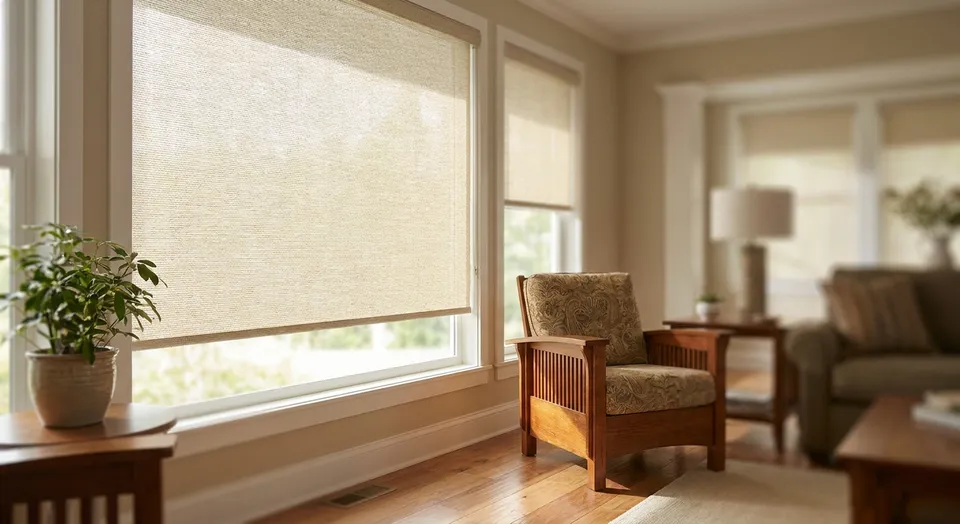
Solar shades block UV rays before they reach your hardwood floors, leather furniture, and family photos. But the wrong openness percentage still lets enough sun through to bleach a rug over one Pacific Northwest summer. This guide ranks the solar shade options that actually protect furniture and flooring in 2026, not just the ones that cut glare.
- 1% openness solar shades win for fade prevention in 2026. Buy for west-facing rooms with hardwood or leather.
- 3% openness fabric is the sunroom standard, balancing UV block with a usable view.
- 10% openness shades look good but leave floors exposed on direct-sun windows. Skip for fade-sensitive rooms.
- Dual-shade systems pairing solar fabric with a blackout layer give the strongest protection for high-value rooms.
- Rainier Blinds measures and installs custom solar shades across the Greater Seattle Area, matched to each room's sun exposure.
Why this matters
Fading isn't just a summer problem in the Greater Seattle Area, low winter sun angles push light deep into rooms that feel shaded the rest of the year. West-facing living rooms in Bellevue and Tacoma take the worst of it, with afternoon sun hitting hardwood floors and leather furniture at a low, direct angle for hours.
Once fading starts on a hardwood floor or a fabric sofa, it doesn't reverse. Openness factor, the percentage of a shade fabric that lets light physically pass through, is the single number that determines how much UV actually reaches your furniture. A shade with 10% openness is see-through enough to feel airy; it also lets in roughly twice the UV of a 5% fabric. That gap is the whole story in this guide.
How this list is ranked
Each pick below is ranked on openness factor and aggregated manufacturer UV-block ratings for tightly woven solar fabric, the same standard used across the solar shade industry to grade fade protection. Rooms get matched by direction (south and west-facing get the tightest weaves), by what's inside them (hardwood and leather rank higher-risk than tile or laminate), and by how much daylight the room needs to still function. A shade that blocks 99% of UV but turns a home office into a cave isn't a win. It's a different problem.
The ranked list
1. 1% openness solar shades: the fortress pick
A 1% openness fabric is woven tight enough to block up to 99% of UV rays, making it the strongest single-layer defense against fading. It's the right call for west-facing windows where afternoon sun hits hardwood floors or leather furniture directly for hours.
The tradeoff is view: at 1% openness, you're looking at a fairly opaque screen, not a sheer. For a room where the floor or furniture matters more than the outward view, that's the right tradeoff. Buy for any west or south-facing room with hardwood, leather, or an area rug you care about.
2. 3% openness solar shades: the sunroom standard
Sunrooms take direct sun for most of the day from multiple angles, which is why 3% openness fabric has become the default recommendation for sunroom windows. It blocks an estimated 97-98% of UV while keeping enough transparency that the room doesn't lose its point.
That balance matters in a sunroom specifically because it's usually furnished with pieces meant to be seen, wicker, upholstered seating, sometimes artwork. Buy for any sunroom or three-season room in 2026; it's the fabric weight that holds up best against year-round exposure.
3. 5% openness solar shades: the daily driver
For living rooms and bedrooms without direct south or west exposure, 5% openness fabric blocks roughly 95% of UV while preserving a clear outward view, the most common spec sold across South King County homes. It's worth comparing against a cellular shade alternative if insulation matters as much as fade control, since the two solve different problems.
On an east or north-facing window, 5% openness is enough protection for most furniture. On a west-facing window with direct afternoon sun, it's not tight enough for anything you can't afford to fade. Buy for moderate-exposure rooms; Hold for direct-sun rooms and step up to 1% or 3% instead.
4. Dual-shade systems: the belt-and-suspenders pick
Layering a solar fabric with a blackout or room-darkening layer behind it pushes UV block above 99% while adding full light control after dark, a setup worth layering with drapery in rooms where the furnishings are irreplaceable: home libraries, art studios, rooms with an antique rug.
The cost is higher because you're paying for two shade systems on one window. For a room with a $6,000 sofa or a family heirloom rug, that math works. For a guest bedroom with basic furniture, it doesn't. Buy for high-value rooms; Skip for low-traffic or low-value rooms where the extra cost doesn't match the risk.
5. Motorized solar shades with scheduling: the set-and-forget upgrade
A motorized shade set to close automatically during peak UV hours, typically 11am to 3pm, protects furniture on the days nobody's home to lower it manually. That's the gap that ruins fade protection in practice: the shade that works perfectly but only gets closed three days out of seven.
Scheduling doesn't change the fabric's UV-block rating, but it changes whether that rating actually gets used. Consider it for any room where the shade tends to sit open out of habit; Hold if you're disciplined about closing shades manually and the budget is tight.
6. Skip: 10% openness solar shades on direct-sun windows
A 10% openness fabric blocks an estimated 85-90% of UV, solid for glare control, weak for fade prevention on a window that gets direct sun for more than a couple hours a day. It's a fine choice for a north-facing window where the priority is keeping a view without harsh light.
On a west-facing window over a hardwood floor, though, that remaining 10-15% of UV adds up fast over a Seattle summer. Skip for direct-sun, fade-sensitive rooms; fine everywhere else.
Comparison table
| Openness Factor | UV Block | Best For | Verdict |
|---|---|---|---|
| 1% | Up to 99% | West/south-facing rooms, hardwood or leather | Buy |
| 3% | ~97-98% | Sunrooms, all-day sun exposure | Buy |
| 5% | ~95% | Moderate exposure, east/north-facing rooms | Hold on direct-sun rooms |
| Dual-shade (solar + blackout) | 99%+ | Home libraries, art rooms, high-value furnishings | Buy |
| Motorized + schedule | Matches fabric, plus automated timing | Any high-value room needing consistency | Consider |
| 10% | ~85-90% | View-priority rooms, low fade risk | Skip for direct sun |
Where to buy
Three rules matter more than brand names when you're actually ordering:
- Get the exact openness factor printed on the fabric swatch, not the marketing label. "Solar shade" alone tells you nothing. 1%, 3%, 5%, and 10% versions all get sold under that same umbrella term.
- Measure the specific window, not the room. Sun angle changes with window height, overhangs, and nearby trees, so the same wall can need two different openness factors on two different windows.
- Get an in-home consultation before ordering. Sun exposure in a Seattle-area home varies enough by season and by window that a sight-unseen online order is a guess, not a measurement.
Rainier Blinds measures and installs custom solar shades across the Greater Seattle Area, including Bellevue, Tacoma, and Seattle, and matches openness factor to the actual sun exposure of each window rather than a one-size spec.
Get your windows measured for solar shades
Rainier Blinds measures and installs custom solar shades across the Greater Seattle Area.
FAQ
What's the best solar shade openness factor for fade prevention?
1% openness fabric is the best solar shade option for fade prevention in 2026, blocking up to 99% of UV rays. Reserve it for west or south-facing rooms with hardwood floors or leather furniture that take direct sun.
Is 1% or 5% openness better for blocking UV?
1% openness blocks more UV than 5% openness, roughly 99% versus 95%. The tradeoff is view: 5% keeps more visibility, which works fine on rooms without direct sun exposure.
Do solar shades really stop furniture fading?
Solar shades reduce UV exposure significantly, with tightly woven fabrics blocking up to 99% of UV rays. They don't stop fading entirely, since visible light also contributes to fading, but they cut the primary cause dramatically.
How much UV do solar shades block compared to blackout shades?
A tight-weave solar shade at 1% openness blocks close to as much UV as a blackout shade while still letting in filtered light. Blackout shades block essentially all light and UV but leave a room dark, which most homeowners don't want during the day.
Are motorized solar shades worth it for fade protection?
Motorized solar shades are worth it if a room's shade tends to sit open out of habit, since scheduling ensures the fabric's UV-block rating actually gets used during peak sun hours. The fabric protection is identical to a manual shade. Automation just guarantees consistency.
What openness factor is best for a Seattle-area sunroom?
3% openness fabric is the standard recommendation for Seattle-area sunrooms in 2026, blocking an estimated 97-98% of UV while keeping enough transparency for the room to still function as a sunroom.
Can solar shades be paired with drapery for extra protection?
Yes, layering a solar shade with a blackout drapery panel behind it pushes UV block above 99% and adds full light control after dark. This dual-shade approach is worth the added cost in rooms with irreplaceable furnishings, like a home library or art studio.
How much do custom solar shades cost in 2026?
Custom solar shade pricing in 2026 varies by window size, fabric openness, and whether the shade is motorized. Get an in-home measurement for exact numbers, since sight-unseen online quotes rarely match the final installed price.
One last thing
UV isn't the whole fading story. Conservation research on light damage attributes roughly 40% of fade damage to UV light, another 25% to visible light, and the rest to heat and humidity. Which means even a 1% openness solar shade, blocking 99% of UV, still leaves a slice of fade risk from visible light alone. Rotating rugs and repositioning furniture every year or two still matters, even behind the tightest solar fabric on the market in 2026.