
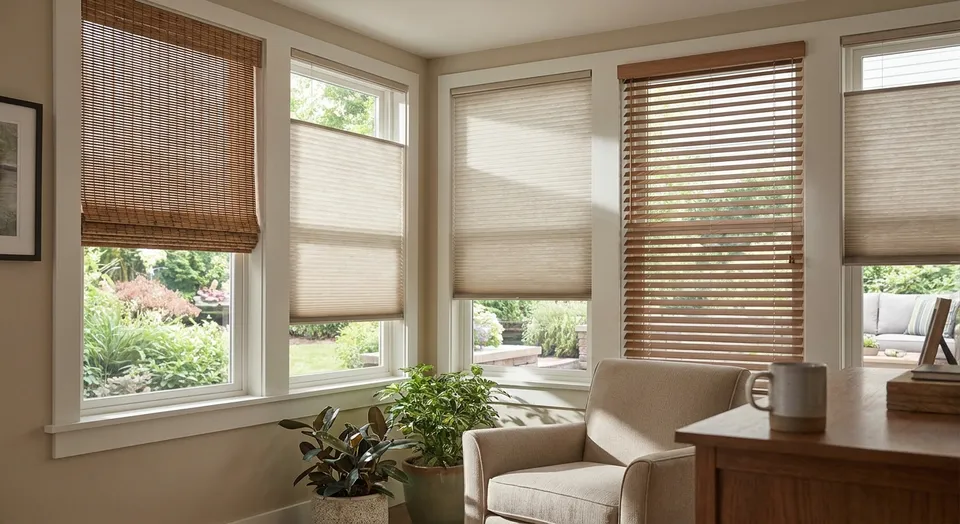
Garden-level and daylight basement windows sit at grade or just below it, which means passersby, pets, and headlights get a clear view straight into the room unless the coverage is chosen right. The best blinds for garden-level basement windows in 2026 balance privacy at eye level, moisture tolerance, and light control without turning the room into a cave.
- Cordless cellular shades win for garden-level basement windows in 2026 because they block sightlines without a cord hazard at floor height.
- Top-down-bottom-up shades let basement bedrooms keep daylight up top while blocking the sidewalk-eye-level view below.
- Blackout roller shades are the pick for basement bedrooms and home theaters where daylight leaks around egress wells.
- Insulated cellular shades matter more in basements than upstairs rooms because below-grade rooms run colder and more humid.
- Skip standard slat blinds on egress windows for 2026 code compliance since the operating hardware can block the swing-out path.
Why this matters
Garden-level windows aren't ordinary windows shrunk down. They usually sit in a window well, they're often egress windows tied to bedroom code requirements, and the humidity in a below-grade room runs higher than the rest of the house.
That combination rules out a lot of standard picks. A blind that looks fine in a living room can trap moisture in a basement, warp, or interfere with the window's ability to open fully in an emergency. The window covering also has to do double duty: block a five-foot-high sightline from the yard while still letting in whatever daylight the well allows.
Under the 2015 IRC (still the baseline most Washington jurisdictions reference for egress in 2026), a basement bedroom window needs a net clear opening of at least 5.7 square feet, a minimum height of 24 inches, a minimum width of 20 inches, and a sill no higher than 44 inches off the floor. Any shade or blind mounted on that window has to clear that opening when it's raised, not just look tidy when it's down.
How this list was ranked
This ranking weighs three factors specific to below-grade windows: privacy performance at eye level, moisture and temperature tolerance, and compatibility with egress hardware. General-purpose ratings (color options, decorative styles) take a back seat here because a basement window's job is functional first.
Each pick below assumes a garden-level or daylight basement window in a Pacific Northwest home, where humidity swings and cold glass in winter are the norm rather than the exception.
The ranked list
1. Cordless cellular shades, the egress-safe pick. Cellular shades fold into a honeycomb structure that raises fully out of the frame, clearing the opening for code-required egress. The cordless lift also removes the loose-cord hazard that matters in a basement bedroom or a converted play space. Custom blinds for garden-level apartments covers the sizing quirks specific to below-grade openings in more depth. Buy for any basement bedroom or egress window in 2026.
2. Top-down-bottom-up shades. The privacy-without-a-cave pick. These lower from the top and raise from the bottom independently, so you can block the exact eye-level band a sidewalk or driveway sees while still letting daylight in above. On a garden-level window where the top third sits above grade, this is the single biggest upgrade over a standard shade. Top-down-bottom-up shades for privacy and light control breaks down how the dual-rail hardware works. Buy if the window well leaves any daylight zone above ground level.
3. Blackout roller shades. The basement bedroom and theater pick. A daylight basement bedroom or a below-grade home theater needs full light exclusion, not just filtering. Roller shades in a blackout fabric, mounted with side channels, close the gap around the frame that light-filtering fabrics leave open. Best blackout shades for bedrooms covers fabric and mount choices for full darkness. Buy for any basement room used for sleep or media.
4. Insulated cellular shades. The moisture and energy pick. Below-grade rooms run colder against the glass and more humid overall, which is the combination that warps fabric shades and clouds hardware over a Pacific Northwest winter. Insulated cellular fabric resists that swing better than uninsulated roller or roman fabric. Insulated cellular shades for garage conversions walks through the same moisture logic applied to another below-grade space. Buy for basements converted to living space, ADUs, or garage-level rooms.
5. Outside-mount roller shades. The small or odd-shaped window pick. A lot of garden-level windows are narrower or shorter than standard, and an inside mount on a shallow frame leaves gaps at the edges that defeat the privacy goal. Mounting outside the frame on the wall covers those gaps and simplifies fit on an irregular opening. Consider when the window frame is too shallow for an inside mount, common on poured-concrete basement openings.
6. Zebra shades, the flexible light-filtering pick for in-law suites. Alternating sheer and solid bands let you dial in exactly how much of the yard view comes through, which works well in a basement in-law suite or ADU where the occupant wants control without full blackout during the day. Consider for basement living spaces that get regular daytime use.
What to skip on garden-level windows
- Standard 2-inch slat blinds on egress windows. The tilt wand and lift cords can catch on the window well ladder or obstruct the full open swing required for emergency exit.
- Uninsulated roman shades in fabric that isn't moisture-treated. Basement humidity in the Puget Sound region will show up as mildew spotting on natural fiber roman shades within a season or two.
- Sheer-only shades as the sole covering. Sheers filter light but do nothing for eye-level privacy on a window that sits at sidewalk height; pair them with a blackout or cellular layer instead of using them alone.
Comparison table
| Pick | Best for | Egress-compatible | Verdict |
|---|---|---|---|
| Cordless cellular shades | Basement bedrooms | Yes | Buy |
| Top-down-bottom-up shades | Windows with a daylight zone above grade | Yes | Buy |
| Blackout roller shades | Basement bedrooms and theaters | Yes | Buy |
| Insulated cellular shades | Converted basements and ADUs | Yes | Buy |
| Outside-mount roller shades | Narrow or shallow-frame windows | Yes | Consider |
| Zebra shades | Basement in-law suites | Yes | Consider |
Get a garden-level window quote
In-home measure and real pricing on the spot for basement and egress windows.
Where to buy
- Measure the well, not just the frame. Below-grade windows often have an irregular reveal from the poured foundation; we measure in-home to ensure shades are custom-made to the exact dimensions before installation.
- Confirm egress clearance before installation. We confirm the shade's raised profile clears the code-required opening when we measure your window, not just the visible glass.
- Skip big-box stock sizes on odd basement openings. Standard width increments rarely match a poured-concrete basement window exactly, and a half-inch gap on either side undercuts the privacy the shade is supposed to provide.
FAQ
What's the best blind for a garden-level basement window?
Cordless cellular shades are the best overall pick for garden-level basement windows in 2026 because they clear egress openings fully and carry no loose cord. Top-down-bottom-up shades are the better choice when the window has any daylight zone above ground level.
Do basement windows need blackout shades?
Only if the room is used as a bedroom or media space; otherwise a light-filtering or zebra shade works fine. Basement bedrooms in particular benefit from blackout roller shades since daylight wells often leak light around the frame edges.
Can you put blinds on an egress window?
Yes, as long as the fully raised shade clears the code-required opening, which under IRC R310 is at least 20 by 24 inches with a sill no higher than 44 inches. Cellular and roller shades with a compact raised profile clear this easily; bulky valance-and-slat blinds sometimes don't.
Are cellular shades good for basements?
Yes, insulated cellular shades handle basement humidity and cold-glass conditions better than uninsulated fabric shades. They also fold to a low profile when raised, which matters for egress clearance.
How do you get privacy on a basement window at sidewalk level?
Top-down-bottom-up shades solve this directly by covering the eye-level band while leaving the upper section open for light. A single fixed-position roller shade forces a choice between privacy and daylight instead.
What window covering works best for a basement ADU?
Insulated cellular shades or zebra shades both work well in a basement ADU or in-law suite in 2026, depending on whether the occupant prioritizes energy performance or adjustable daytime light. Blackout shades make sense if the ADU includes a sleeping area.
Do window well covers replace the need for interior shades?
No, a window well cover manages debris and drainage outside the glass but does nothing for interior privacy or light control. Interior shades are still needed for both.
One last thing
The detail most homeowners miss on a garden-level window isn't the shade fabric, it's the mount depth. A basement window frame poured into concrete is often shallower than a standard framed opening upstairs, and an inside-mount shade ordered to standard depth specs won't seat flush. How to choose the right mount type for custom blinds covers how to check that clearance before ordering, and it's worth five minutes with a tape measure before any basement order goes in for 2026 installation.