
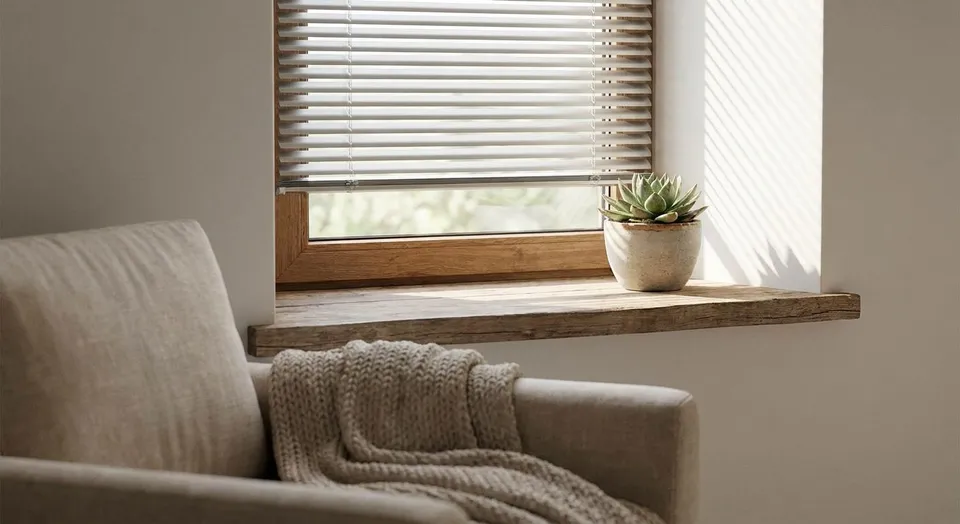
Aluminum mini blinds show up in nearly every home improvement aisle, but on a small window they often disappoint: the slats bend, the stock width never quite matches an odd-sized opening, and the cord mechanism wears out fast. This guide ranks the real options for small windows in 2026 -- including when a mini blind actually makes sense and when a custom shade solves the fit problem for good.
- Custom cellular shades win for small windows needing insulation and a flush fit -- the better upgrade over stock aluminum mini blinds in 2026.
- Off-the-shelf aluminum mini blinds are the cheapest fix, but slats bend and stock widths rarely match an odd small window exactly.
- Roller shades beat aluminum mini blinds in kitchens and bathrooms because flat fabric wipes clean and won't corrode near steam.
- Zebra shades give small windows adjustable privacy without the slat-and-cord maintenance aluminum mini blinds require.
- Roman shades add a tailored, furnished look aluminum mini blinds can't match, though full blackout needs a liner.
Why this matters
Small windows -- bathroom sashes, basement egress panes, laundry room glass, kitchen windows over a sink -- are where stock aluminum mini blinds fail most often. Retailers cut them down from standard widths, so a window that's a few inches off the nearest stock size ends up with light gaps at the frame edges. Getting the mount type right matters more on a small opening than a large one, because there's less margin for error.
Aluminum resists moisture, which is why it's a common choice in bathrooms, but the slats themselves bend easily and don't recover their shape once dented. Cord-operated versions also carry a strangulation risk that the window-covering industry's ANSI/WCMA safety standard addressed with a major update in 2018, pushing most stock retail blinds toward cordless designs or added tie-downs. That history matters for anyone shopping mini blinds for a room with kids or pets nearby.
Custom shades solve the fit problem at the source -- they're built to the exact opening instead of cut down from a stock size. That's the core tradeoff running through every option below.
What makes the best small-window treatment
- Exact fit for irregular openings, so there's no light gap at the frame edges
- Cordless or motorized operation for child and pet safety
- Material that resists warping after repeated tilting or handling
- Mount depth that clears trim on shallow window wells
- Light control matched to the room -- blackout for bedrooms, filtering for living spaces
- Ease of cleaning for kitchens, bathrooms, and laundry rooms
Small window treatments at a glance
| Option | Best for | Standout feature | Key limitation |
|---|---|---|---|
| Cellular Shades | Small windows needing insulation | Honeycomb pockets trap air against the glass | Costs more than a stock aluminum blind |
| Roller Shades | Kitchens and bathrooms | Flat fabric wipes clean, no slats to catch grease | Less insulating than cellular |
| Zebra Shades | Adjustable light control | Sheer/solid stripes with no exposed cords | Sheer bands still pass some light when closed |
| Roman Shades | A tailored, decorative look | Fabric folds flat when raised | Needs a liner for full blackout |
| Aluminum Mini Blinds | Renters and short-term budgets | Cheapest same-day option at hardware stores | Stock sizing rarely fits a small window exactly |
1. Cellular Shades: best for small windows needing insulation
Cellular shades use honeycomb-shaped pockets that trap air against the glass, which matters on small, drafty windows in additions, basements, and garage conversions. Rainier Blinds measures each opening and has the shade custom-made to the exact frame, so there's no edge gap the way a stock aluminum mini blind gets when the width doesn't quite match.
Cellular shades pros:
- Honeycomb pockets reduce drafts on cold, small panes
- Cordless lift options remove strangulation risk entirely
- Custom width and height eliminate light gaps at the frame
- Available in light-filtering or blackout fabric
Cellular shades cons:
- Costs more upfront than a stock aluminum mini blind
- Honeycomb folds can trap dust if not vacuumed periodically
- Standard fabric isn't ideal in a high-humidity bathroom without a moisture-rated option
Cellular shades in Auburn cover fit and insulation questions specific to Pacific Northwest homes.
Best for: small windows in additions, basements, or garage conversions that need real insulation, not just coverage.
Verdict: Buy if drafts or heat loss through a small window are the actual problem.
2. Roller Shades: best for small kitchen and bathroom windows
A roller shade is a single flat fabric panel on a tube -- no slats to collect grease or soap scum, which is exactly where aluminum mini blinds struggle in a kitchen or bath. Rainier Blinds cuts roller shades to the window's inside mount depth, so a small sash over a sink gets full coverage without the slat gaps a stock aluminum blind leaves at the sides.
Roller shades pros:
- Flat fabric wipes clean in seconds, no slat-by-slat dusting
- Low profile fits shallow window wells above sinks and counters
- Opacity ranges from light-filtering to full blackout
Roller shades cons:
- No adjustable slat tilt for partial light mid-shade
- Fabric can show water spots if splashed directly and left unwiped
Roller shades built for kitchen windows walk through fabric choices that hold up near a sink or stove.
Best for: kitchen and bathroom windows where grease, steam, or splashes hit the covering daily.
Verdict: Buy for any small window in a wet or greasy zone.
3. Zebra Shades: best for adjustable light control on small windows
Zebra shades alternate sheer and solid fabric bands that slide to overlap or open, giving dimmer-switch style light control without the lift cords a mini blind hangs near a small sill.
Zebra shades pros:
- Adjustable privacy without the exposed cords aluminum mini blinds rely on
- Sheer bands soften direct sun without blacking out the room
- Stacks compactly over a shallow sill where a blind's headrail would overhang
Zebra shades cons:
- Sheer bands still pass some light even when stripes are aligned
- Not a full blackout solution on their own
Zebra shades on small windows get requested most often for home offices and nurseries where partial light control matters more than total blackout.
Best for: home offices, nurseries, and small living-room windows that need adjustable light, not full blackout.
Verdict: Buy if the room needs graduated light control through the day.
4. Roman Shades: best for a tailored look on decorative small windows
Roman shades fold flat into neat horizontal pleats when raised, giving a small window a furnished look that aluminum mini blinds don't attempt. Woven wood roman shades add texture for a more casual room without going fully opaque.
Roman shades pros:
- Fabric matches drapery or upholstery already in the room
- Flat stack looks finished even on a narrow window width
- Woven wood option adds texture for a less formal space
Roman shades cons:
- Needs a blackout liner added for full light block
- Costs more than aluminum mini blinds and takes longer to build
Best for: small dining nooks, guest bedrooms, or any window that's part of the room's decor, not just a light source.
Verdict: Buy for the right room; Hold if blackout is the actual priority.
5. Aluminum Mini Blinds: best for renters and short-term budgets
Aluminum mini blinds are horizontal slats on a cord or wand-tilt mechanism, sold in stock widths at hardware and big-box stores, then cut down to the closest available size. They're the option most people searching for this topic already have in mind, so it's worth being direct about where they hold up and where they don't.
Aluminum mini blinds pros:
- Lowest upfront cost of any option on this list
- Widely available same-day at hardware stores
- Resists water and won't rot in a damp room
Aluminum mini blinds cons:
- Stock sizing rarely matches an odd small-window opening exactly, leaving light gaps at the edges
- Slats bend and dent easily, especially with kids or pets nearby
- Corded versions carry a strangulation risk the industry's own 2018 safety standard update was written to address
- No custom build option -- Rainier Blinds does not sell or install aluminum blinds, so an exact fit on a small window means a custom shade instead
Best for: a rental unit or a short-term fix where an exact fit isn't the priority.
Verdict: Skip if you want an exact fit or plan to stay in the home past a year or two.
How this list was ranked
Each option was weighed against the six criteria above: fit accuracy on small or irregular openings, cord/child safety, material durability, mount depth flexibility, light control range, and ease of cleaning. Aluminum mini blinds score well on cost and availability but lose ground on fit and durability -- the two issues that matter most on a small window, where there's little room to hide a gap or a bent slat.
Which small-window treatment should you choose?
For most small windows in 2026, a custom cellular or roller shade beats a stock aluminum mini blind on the two things that actually matter: exact fit and long-term durability. Choose cellular shades if the window is drafty, roller shades if it's in a kitchen or bath, zebra shades if you want adjustable light without cords, and roman shades if the window is part of the room's look. Aluminum mini blinds still make sense for a short-term rental fix, but they're not the answer for a window you plan to live with for years.
Get an exact fit for your small windows
Rainier Blinds measures and installs custom shades across the Greater Seattle Area.
FAQ
What is the best window treatment for a small window in 2026?
Cellular shades are the best overall choice for small windows in 2026 because they're built to the exact opening and add insulation. Roller shades are the better pick for small kitchen and bathroom windows that need daily wipe-downs.
Are aluminum mini blinds good for small windows?
Aluminum mini blinds work as a low-cost short-term option, but stock sizing rarely fits an odd small window exactly, leaving light gaps at the edges. Slats also bend easily with regular use.
Do custom shades cost more than aluminum mini blinds?
Yes, custom shades typically cost more upfront than a stock aluminum mini blind because they're built to the exact window instead of cut down from a standard size. The tradeoff is a flush fit and longer material life.
What's the safest window treatment for a small window in a kid's room?
Cordless cellular or zebra shades are the safer choice for a child's room because there's no lift cord hanging near the sill. Corded stock blinds, including aluminum mini blinds, carry a strangulation risk the industry's 2018 safety standard update targeted directly.
Can zebra shades fully block light on a small window?
Not on their own -- zebra shades control light in graduated steps by overlapping sheer and solid bands, but some light passes even when the stripes are aligned. A blackout roller or cellular shade is the better choice for a room that needs total darkness.
What's the best small-window treatment for a bathroom?
Roller shades in a moisture-resistant fabric are the best fit for a small bathroom window because the flat surface wipes clean and won't corrode the way aluminum slats can pit over time.
Do roman shades work on narrow windows?
Yes, roman shades fold flat into a neat stack even on a narrow width, which is part of why they're chosen for small decorative windows in dining nooks and bedrooms. Full blackout on a roman shade requires an added liner.
One last thing
The detail most people miss when comparing aluminum mini blinds to custom shades isn't cost -- it's mount depth. A shallow window well that can't clear a mini blind's headrail without hitting the trim is a common reason small-window jobs get re-measured after the first attempt, and it's the kind of problem a stock blind cut to the wrong depth simply can't solve.