
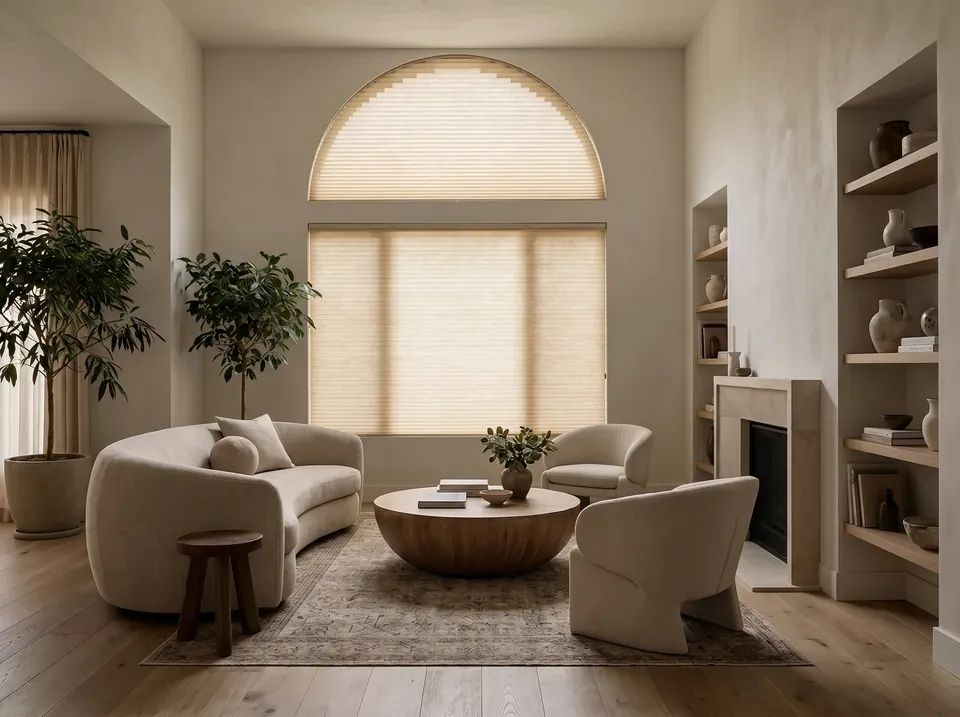
Arched windows show up all over Auburn, WA, half-circle transoms above entry doors, quarter-rounds in stairwells, full arches crowning picture windows in Lakeland Hills and Lea Hill builds. Stock shade programs stop at rectangles, so curved glass often stays bare while it bakes the room. This 2026 guide explains when a fixed arch cover does the job, when a movable arch shade is worth it, which fabrics fit curved windows, and how custom window treatments from a local measure-and-install crew handle shapes no catalog width covers.
TL;DR
- Fixed arch covers block light and heat on decorative arches you never open.
- Movable arch shades cost more but give real light control in living spaces.
- Cellular fabric wins on insulation; sunscreen fabric wins on view and glare.
- Motorized lift suits high transoms above stairwells and two-story entries.
- Rainier Blinds traces the curve on site and installs with our own crew.
Why this matters
Curved glass is a heat and glare problem, not just a design detail. A half-circle transom above a great-room picture window sits at the top of the wall where summer sun enters at its steepest angle, and in Auburn's July and August stretch that top-light is exactly what fades flooring and pushes afternoon room temperatures up. In winter, warm air collects at the ceiling and escapes through the same glass.
In 2026, the retail fix still does not exist. Big-box shade programs and online retailers sell rectangles; the moment the top of the window is a curve, the options collapse to "leave it bare" or "order something custom." That is why so many South King County homes have perfectly dressed rectangular windows with a glaring half-moon above them.
Two product paths actually solve it: fixed covers shaped to the arch, and movable arch shades that raise on a curved track. Which one is right depends on whether the window is decorative or whether the room needs the light controlled on demand, and that decision is the core of this guide.
Who this is for
This guide is for Auburn and South King County homeowners with eyebrow, half-circle, quarter-round, or full-arch windows, in entry transoms, great rooms, stairwells, and gable ends, who want the arch treated like every other window instead of skipped. It also fits buyers finishing new construction where the builder left transoms bare, and anyone replacing a failed DIY attempt on a curved window.
If your arch sits above a door and is purely decorative, the fixed-cover section is your answer. If the arch lights a room you sit in daily, keep reading to the movable options.
What to look for in arched shades for Auburn homes
Template accuracy on the curve
An arch is not one measurement. It is a width, a rise, a springline, and a radius. Suppliers build curved shades from a paper or digital template traced on site, not from width-and-height numbers. Ask whether the order includes an on-site template. A shade built from "roughly 60 inches wide" arrives wrong, and curved fabric cannot be trimmed like a rectangle. Template-on-site is the single non-negotiable when you compare quotes in 2026.
Fixed cover vs. movable shade
A fixed cover is shaped to the arch and stays up. It blocks light and heat but never opens. A movable arch shade raises and lowers on a curved side track. Fixed covers cost less and suit decorative arches above doors. Movable shades suit arches in living spaces where morning sun should come in by 10:00 AM and be blocked by 3:00 PM. Decide this before fabric: it changes the hardware, the price, and the install.
Fabric and opacity
The same room-by-room logic from flat windows applies. Sunscreen fabric holds the view and cuts glare on street-facing transoms. Light-filtering fabric softens top-light in living rooms. Blackout works for arches above beds in primary suites. For arched windows that bleed heat, cellular fabric in a curved build adds the insulating air pocket flat shades get, with the shape built into the rails. Pairing an arched cover with a matching rectangular shade below the springline keeps the fabric line continuous across the whole opening.
Motorization for high arches
An arch above a stairwell or a two-story entry is out of reach by design. Manual wands and long cords on tall curved windows are awkward and, on corded hardware, a safety problem. Battery motors raise and lower the shade from a remote or phone and remove the reach problem entirely. Motorization adds cost per window, so reserve it for arches you actually adjust. A decorative entry transom does not need a motor.
Light gaps and mount depth
Curved windows leak light at the springline, the line where the curve meets the rectangle below. A tight headrail fit and, on blackout orders, side channels along the straight sections close the gap. Older Auburn frames settle, so the template visit doubles as a fit check: trace the curve, confirm depth for the headrail, and note cranks or trim that interfere. Depth planning at the template beats a remake after fabric ships.
Top picks for arched windows in Auburn homes
The safe pick: fixed cellular arch cover
The set-and-forget pick. A fixed cellular cover cut to the arch template blocks the top-light permanently and costs the least of the custom options. Cellular fabric adds insulation at the ceiling line where winter heat collects. Buy for decorative transoms above entry doors and windows you never uncover. Combine it with a movable shade on the rectangle below when the lower window still needs daily light control.
The daylight pick: movable sunscreen arch shade
The view pick. A movable arch shade in sunscreen fabric lowers on a curved track to cut glare while keeping the neighborhood view and daytime brightness. Openness levels let you tune how much light passes. Tighter weaves cut more glare, more open weaves hold more view. Buy for great-room arches and stairwell quarter-rounds where the glass is high but the light is constant. This is the pick for west-facing rooms that hit hard afternoon glare by midsummer.
The blackout pick: movable blackout arch shade
The sleep pick. Blackout fabric in a movable arch build with side channels at the straight sections gets an arched primary-suite window genuinely dark. Pacific Northwest summer sunrises land early, before 5:30 AM around the June solstice, and top-light wakes rooms first because the arch sits highest in the wall. Buy for arches above beds. Expect the highest price of the four picks; the curved track and channels are what make blackout real instead of a soft glow.
The smart-home pick: motorized curved cellular
The high-arch pick. Battery-powered lift on a curved cellular shade handles stairwell and two-story-entry arches you cannot reach, and it pairs with the same remotes and schedules as the flat motorized shades in the rest of the house. One remote, one routine, whole-house control in 2026. Consider for any arch above eight feet or behind furniture.
What to avoid
Rough measurements from the ground
"About five feet wide" does not build a curved shade. Radius errors of half an inch show as puckers at the springline and gaps at the rail. Template on site or skip the order.
One fixed cover across the whole opening
Treating the arch and the rectangle below as one unit with a single fixed cover kills the light control of the lower window. Split the opening: fixed or movable on the curve, a matching shade on the rectangle. Continuous fabric line, two independent controls.
Corded lift hardware on high arches
Long cords on two-story transoms tangle, stretch, and hang within reach of kids and pets. On arches above reach, cordless or motorized is the correct hardware. Corded on a high arch is a callback waiting to happen.
Verdict comparison
| Option | Best for | Key detail | Verdict |
|---|---|---|---|
| Fixed cellular arch cover | Decorative transoms | Lowest cost, template-built | Buy |
| Movable sunscreen arch | Great rooms, views | Curved-track glare control | Buy |
| Movable blackout arch | Primary suites | Side channels for true dark | Buy |
| Motorized curved cellular | High and stairwell arches | Remote or scheduled lift | Consider |
| Ground-level rough measurements | , | Radius errors show as gaps | Skip |
How local measure and install works
Rainier Blinds is a measure-and-install company based in Auburn. The crew that traces the arch template is the same crew that comes back to hang the finished shade. Manufacturing happens at the wholesale supplier to those exact templates, and installation stays in-house. That split is deliberate: you get supplier fabric ranges with local accountability on fit.
- Consult: tell us the rooms and the windows; we note which arches are decorative and which need daily control.
- Template on site: the curve is traced, depth is checked, and obstacles like cranks and trim are logged.
- Quote on the spot: real pricing before we leave, on every window in the project. Standard rectangular windows start from $275, and curved shapes are quoted to the template, backed by a warranty of up to 5 years depending on package.
- Custom-made and installed: shades arrive typically 2-4 weeks after measurements are confirmed; one visit hangs them, with motors paired and limits set before the crew leaves.
Coverage details sit on the Auburn service area page.
FAQ
What are the best window treatments for arched windows in 2026?
Can you put shades on arched windows?
How much do arched window shades cost in Auburn, WA?
What is the difference between a fixed arch cover and a movable arch shade?
Can arched shades be motorized?
Do cellular shades work on curved windows?
How do you measure an arched window for shades?
How long does it take to get custom arched shades?
One last thing
The detail most homeowners miss: the springline, not the curve, is where arched shades fail. The curve gets templated carefully; the straight line where arch meets rectangle is where the headrail mounts, and on settled frames that line is rarely level. A crew that shims the rail to the actual line, not the assumed one, is the difference between a shade that closes clean and one that leaves a bright wedge every afternoon.
Ask about springline fit at the template visit, and book the free in-home quote while the sun is hitting the arch, watching where the light lands answers the fixed-vs-movable question faster than any spec sheet.